Anthropic says junior technical hires fell to 9% as employees manage more Claudes
An internal study reports a smaller junior hiring share and more meeting time, while warning that its AI adoption comparisons are observational.
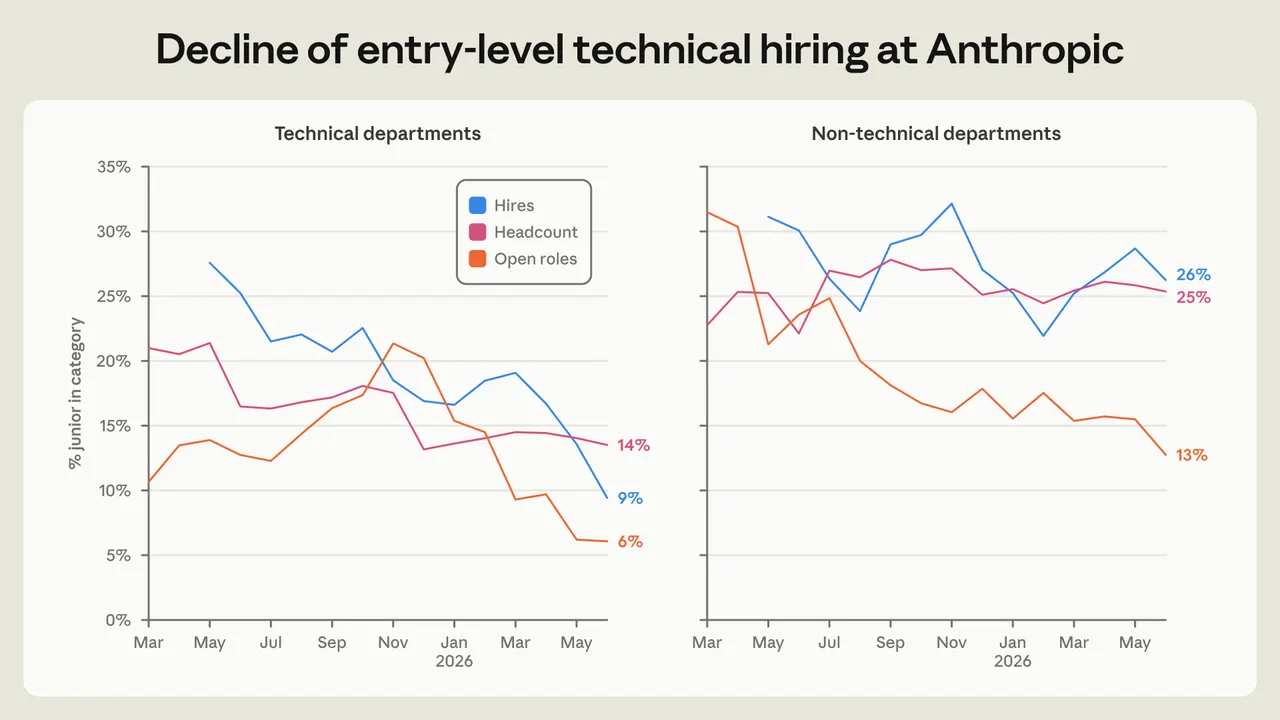
More agents, a smaller junior hiring share
Anthropic says junior employees’ share of its technical hires fell from 27% to 9%, while staff increasingly spend their time supervising Claude agents. Its October 16 study, covered by TechCrunch on October 17, gives an unusually detailed company account of how AI adoption and employment are changing together.
The share of junior employees within technical departments fell from 21% to 14% since early 2025, according to the report. These are shares, not a count of eliminated jobs. Anthropic says technical hiring continued to grow in absolute terms, while sales, finance and recruiting expanded faster. The company says its overall size tripled in the past year.
The study combines internal employment records, AI usage, output measures, surveys, calendars and hiring assessments with 17 employee interviews. In an April survey’s open-ended responses, 20% described a shift from doing work to managing Claudes, while 27% described productivity gains. Those figures describe employees’ reported experiences, not independently measured productivity across the economy.
Human attention becomes the constraint
Anthropic estimates that, by August, employee-directed interactive agents accumulated six times the working hours of human employees. Agent time includes inference and active tool use and excludes waits longer than 30 minutes; the human comparison assumes a 40-hour week. It is not six times the output or a measure of equivalent human labor.
The company also reports that the median employee spent 20% more time in meetings than a year earlier. Meeting time among technical individual contributors rose 16%. The report connects this with coordination and accountability as people oversee growing volumes of agent output, while acknowledging that company growth and changing job composition also matter.
Its productivity analysis follows 192 engineers adopting coding agents and compares them with 74 non-adopters. Anthropic explicitly warns that adoption was not random: employees beginning major projects might be more likely to adopt the tools. More code also does not necessarily mean better code or business impact. The company reports no difference on its examined code-quality proxies, which does not establish that all AI-generated code is equally reliable.
The hiring shift is newsworthy evidence from an intensive AI user, with clear limits. It documents what Anthropic says happened inside its own expanding organization; it does not prove AI caused every staffing change or establish a forecast for other employers.