ATAS releases world-memory code to keep AI video shots consistent
The research framework gives video agents separate memories for places and past events, so later shots can revisit a room or replay an action from another camera.
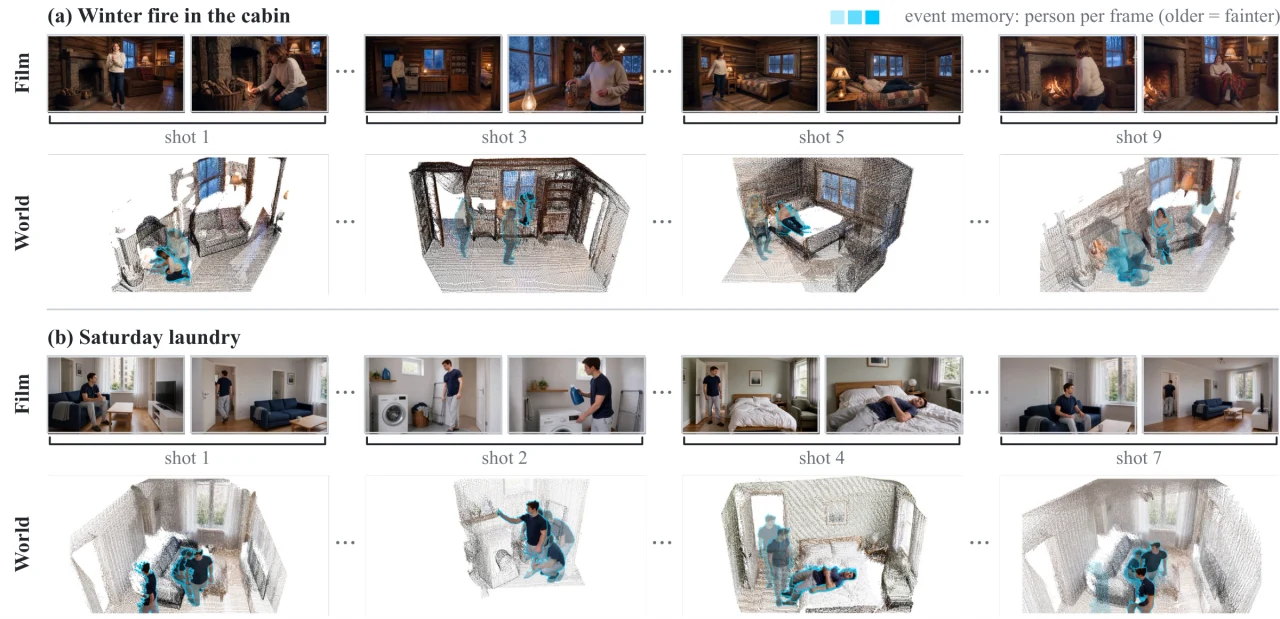
A room should survive the next cut
ATAS, short for Any Time, Any Space, has released code for a video-generation agent built around a persistent world. The practical hook is continuity: return to a room after several other shots, or show an earlier event again from a different camera, without relying only on a prompt and a few recent frames.
The framework compiles a screenplay into shot requests with explicit scene, spatial anchor, camera, time and event references. Scene memory holds registered static geometry. Event memory separately stores dynamic observations tied to a particular occurrence and time interval. Before generating a shot, the agent retrieves the relevant evidence from those memories.
After generation, ATAS reconstructs and registers the clip, then checks whether its observation should update the persistent world. Delivering a clip and admitting it to memory are separate decisions: a shot can remain in the film without becoming evidence for later shots.
Released code, attributed results
The paper’s authors report improved cross-shot consistency across four video generators. Their project page shows generated film frames alongside reconstructed world views. These are the team’s reported experiments and examples, not an AITrending reproduction or a guarantee that every generated film will remain consistent. The page identifies exact action-state reproduction as a remaining difficulty when recapturing an event.
The release is usable as a documented research workflow, but it has real setup requirements. The README calls for a Python 3.12 client with ffmpeg, a separate NVIDIA GPU geometry service with about 20 GB of free memory, and Pi3X and SAM3 model files. Users configure DashScope and LLM credentials; video generations can incur charges. Installation uses the repository’s client and geometry packages, followed by an atas run --screenplay ... command. The client needs no GPU, and the README says rerunning a job resumes without repeating paid generations.
The paper arrived on October 14 and the initial repository commit followed on October 15. ATAS is MIT-licensed, with separate licenses retained for third-party geometry backbones.