Doc2Harness asks AI to build the agent itself; the best reported score is 53%
The new benchmark tests model-built coding-agent frameworks, with a public subset that exposes practical failure modes but cannot reproduce its full leaderboard alone.
Build the framework, then test it
Doc2Harness turns a familiar coding-agent benchmark inside out. Instead of asking a model to fix a repository while an existing agent handles the machinery, it asks the model to build that machinery: the harness that manages tools, model requests, sessions and permissions.
The authors report that the strongest of nineteen tested models averaged 53.05% on their full 328-case suite, with three independently built harnesses per model. That is a result for this specific harness-engineering protocol, not a claim that the model fails half of all coding tasks. AITrending has not independently reproduced the scores.
The paper was submitted on October 14. Its public repository is explicitly a partial release: 94 scenarios comprising 53 scored cases and 41 positive controls. The remaining cases are held out, so downloading the public subset does not let users reproduce the full-suite leaderboard alone.
A mock model makes the harness observable
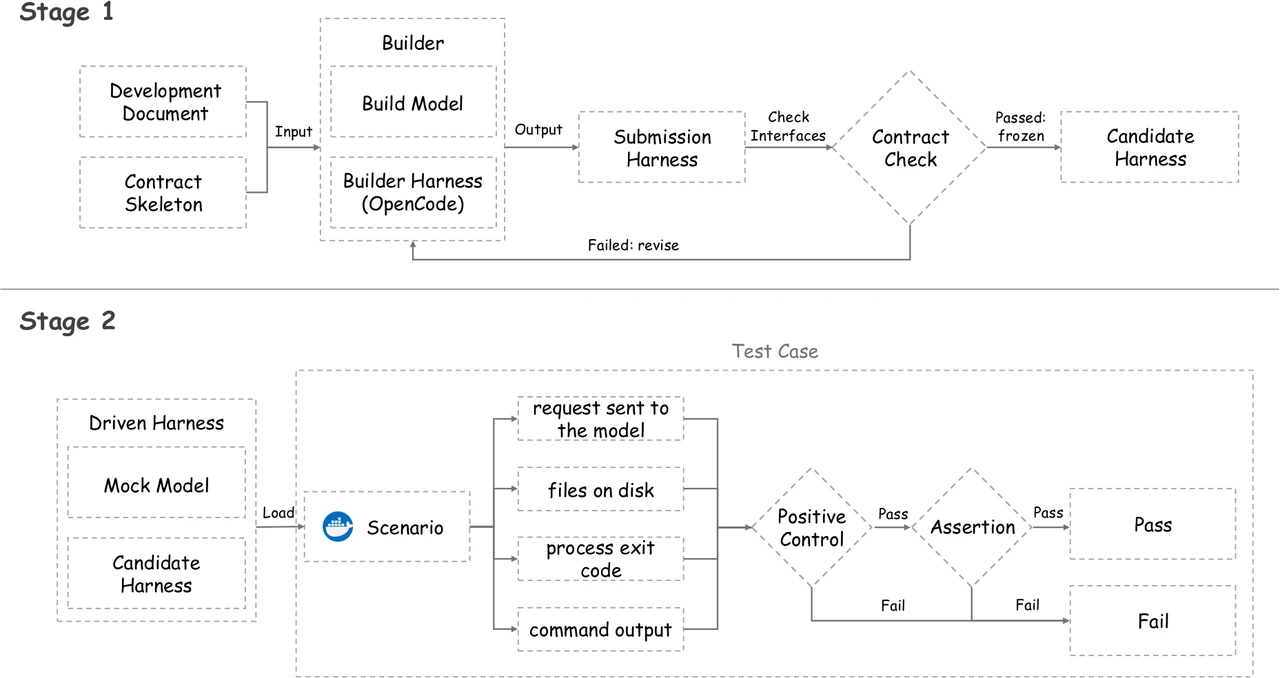
In the build stage, OpenCode 1.17.0 gives the model a development document and an interface-only skeleton of about seventy lines. The protocol allows up to two hours, 24 turns and three submissions. After a form check accepts a product, it is frozen rather than iteratively repaired using the scored tests.
Evaluation moves that harness to a separate container and drives it with scripted mock-model responses. Tests inspect requests to the model, files on disk, process exit and command output. Positive controls distinguish a real boundary from a broken tool: blocking a forbidden file operation is not meaningful if permitted operations cannot work either.
Failures can also be correlated. A single implementation defect may break several related cases, so the percentages should not be read as counts of independent engineering mistakes.
A usable subset for agent builders
The Apache-2.0 repository requires Python 3.11 or newer and Docker, with standard-library Python code. Users can build the evaluation image and point the catalog runner at an existing harness without a model API key because scoring uses the mock gateway.
Building a new harness is a separate route through OpenCode and a local LiteLLM gateway holding the user’s provider key; those model calls may incur charges. For teams building coding agents, the immediate value is a concrete set of observable behavior checks, alongside a leaderboard whose full reproduction remains limited by the held-out suite.