FLUX 3 Image Klein brings box-controlled image editing to downloadable weights
Black Forest Labs releases base and distilled checkpoints with up to ten reference images, local layout control and day-one LoRA support. Commercial use has a revenue-based boundary.
Put the edit where you want it
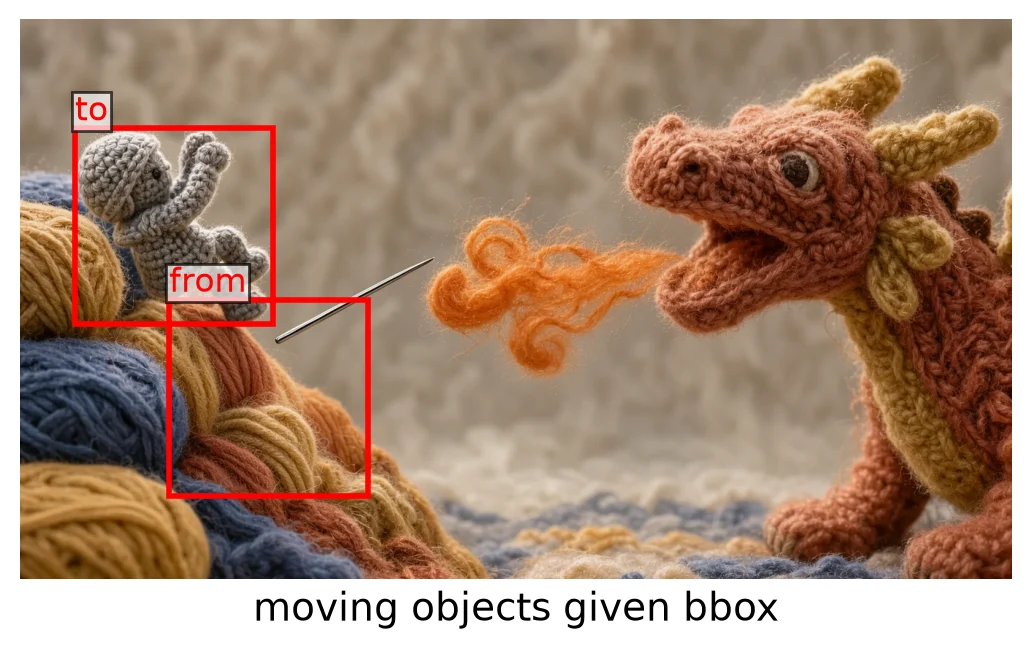
Black Forest Labs released FLUX 3 Image Klein on October 15, bringing text-to-image generation, image editing and compositions using up to ten reference images into one downloadable model. Its most practical control is a set of boxes written into the prompt: creators can specify where an object belongs or give an existing object a source position and a destination.
The 5.6B parameter count covers the image transformer. The Qwen3-VL-4B-Instruct text encoder is a separate component. Two checkpoints serve different jobs: a base model for fine-tuning and research, and a distilled model with a default 16-step generation path. Hugging Face provides day-one Modular Diffusers integration and LoRA training scripts for both generation and instruction-based editing.
The English tutorial demonstrates moving a knitted knight within a generated scene, combining multiple references and placing a silhouette inside a described region. Boxes use a normalized 0-to-1000 coordinate grid, so the same layout can be reused at different output sizes.
Local boxes are guidance, not a pixel lock
The model card makes an important distinction: local bounding boxes guide placement and scale, but do not impose a hard mask. Objects may extend beyond their boxes, small elements may disappear, and edits can change content outside the requested region. Black Forest Labs separately says its hosted API includes pixel restoration to preserve unedited regions exactly. That API feature should not be assumed to come automatically with a local checkpoint.
Hardware claims also depend on the implementation. Black Forest Labs says an INT8 build can run on GeForce cards with as little as 8GB of VRAM, and reports NVIDIA measurements of about four seconds per one-megapixel image on an RTX 5090 through ComfyUI. Hugging Face’s tutorial reports 1.93 seconds for a 1024-by-1024 text-to-image run on an H100 80GB. These are source-reported measurements under different configurations, not an AITrending reproduction or a promise for every GPU.
Open weights with a commercial condition
The weights use the FLUX Kommunity License v1.0. It grants non-commercial uses and a commercial-output exception for qualifying users whose gross annualized revenue, including affiliates, is below $5 million, subject to the license’s conditions. That exception is not blanket permission for commercial fine-tuning or distribution; other uses can require a separate license.
For creators and local AI developers, the release supplies a concrete new option: downloadable editing weights, reusable spatial prompts and training routes for custom LoRAs. The launch is established; benchmark leadership and exact editing quality remain the publishers’ claims.