GenieX 0.9.1 ships signed HTP support for local AI on Snapdragon
Qualcomm's local inference runtime packages a Microsoft-signed Hexagon catalog and loader fixes, with no certificate import required for the release on Windows on Snapdragon.
One less setup obstacle for local Snapdragon inference
GenieX v0.9.1 packages a Microsoft-signed Hexagon HTP catalog, with no certificate import required on Windows on Snapdragon, according to its release notes. The October 17 patch also updates the geniex-qairt dependency for FastRPC loader fixes and joins ADSP_LIBRARY_PATH entries with a semicolon on every platform.
The practical hook is deployment reliability: the project’s run guide distinguishes Microsoft-signed SDK releases from self-signed test builds that need additional Windows setup. Version 0.9.1 explicitly identifies its signed HTP catalog and the associated llama.cpp revision, e467e5. These notes establish what the maintainers shipped; AITrending has not installed or benchmarked this release on Snapdragon hardware.
A runtime, with two different model routes
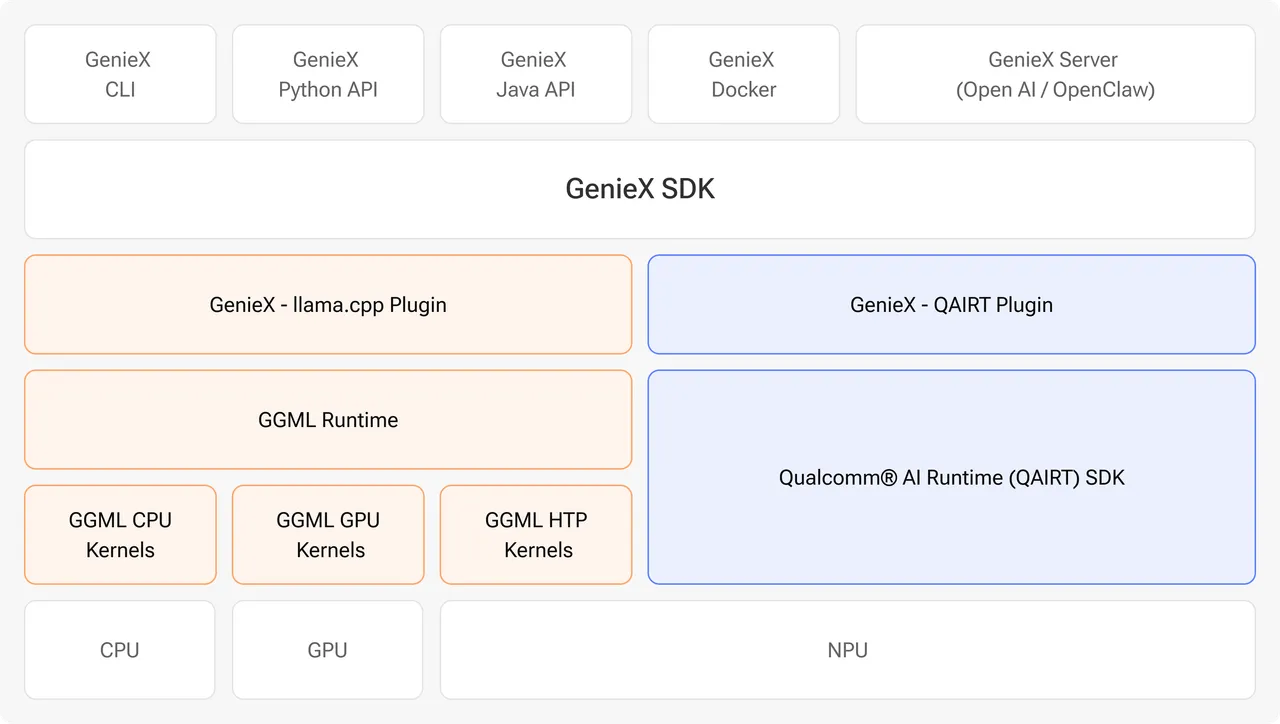
GenieX exposes one C SDK through a command-line tool, Python, Kotlin/Java, Docker and an OpenAI-compatible server. It is not an AI model, and it does not supply the complete tool-execution loop of a coding-agent harness.
The tagged English README lists Windows ARM64 devices such as Snapdragon X and X Elite, Android devices such as Snapdragon 8 Elite, and Linux ARM64 hardware such as Dragonwing QCS9075. It states that GenieX runs only on Qualcomm Snapdragon and labels the project a developer preview.
Its two backends are materially different. The llama_cpp route consumes GGUF models and can target CPU, Adreno GPU or Hexagon NPU. The qairt route uses precompiled, per-chipset bundles through Qualcomm AI Engine Direct on the NPU. Those formats and execution paths are not interchangeable. The README recommends Q4_0 precision for the best Hexagon NPU support in its llama.cpp route; that is the project’s guidance, not a guarantee that every GGUF architecture works.
Installation and a local API endpoint
Windows users can download the release’s ARM64 installer and open a new terminal after installation. Python users have a documented pip install geniex route. The existing local server workflow pulls a model and runs geniex serve, exposing an OpenAI-compatible API at http://127.0.0.1:18181/v1.
That server can provide local inference to a compatible client without making GenieX the model provider. The README’s local request example specifies no paid hosted inference credential. Users still need compatible hardware, the selected model files and any permissions or licenses those downloads require. The project code is BSD-3-Clause licensed, and the README also points to Qualcomm’s terms of use; that does not relicense downloaded model weights.
The release is a concrete packaging and loader update for an existing local AI stack. Its notes do not establish a new inference-speed record, universal model compatibility or a new supported hardware family.
Related reading
AlphaClaw fixes Codex OAuth and gateway restarts for self-hosted OpenClaw