Google wants LLMs to sleep so their memories can outlast a chat
Google's October 27 research explanation describes offline weight updates and synthetic rehearsal, with reported long-context retention reaching 10 million tokens.
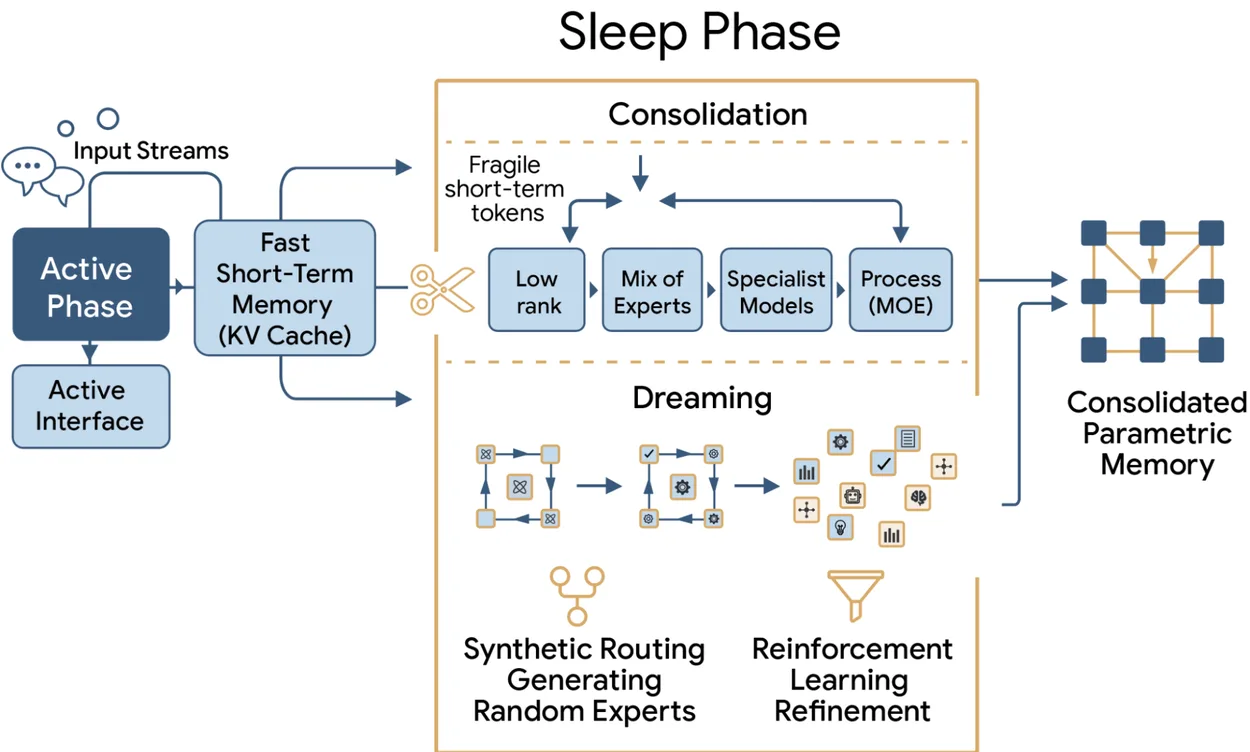
Google Research is proposing a way for language models to keep useful knowledge after a conversation ends: pause incoming work, consolidate short-term information into model weights, then rehearse with synthetic examples. Its October 27 explanation calls this a sleep framework, borrowing a biological metaphor for an automated training cycle rather than claiming that a model literally sleeps or becomes conscious.
The design separates an active phase from offline maintenance. During interaction, information accumulates in fast, short-term memory. During consolidation, the system unlocks pre-allocated mixture-of-experts capacity and uses distillation and reinforcement learning to transfer selected knowledge into longer-term parameters. Temporary memory can then be reset. The architecture and training rules remain human-defined; this is not a model rewriting its own core software.
What the 10-million-token claim means
The authors report near-perfect scaling up to 10 million tokens on the BABILong benchmark, using sleep-time consolidation to put information into parametric memory. That is an experimental retention result, not an announcement of a 10-million-token live Gemini context window. They also report improved continual translation, factual knowledge incorporation and mathematical reasoning against the baselines described in the post.
The second stage, called dreaming, mixes experts while generating synthetic practice material, filters the samples and refines the model with further training. Those updates require an offline phase; the proposed model pauses processing new inputs while consolidating. The blog does not establish an always-on consumer service that learns every user’s conversations.
An October 28 English Hacker News discussion supplied a fresh public hook. Participants discussed how reserved capacity could store new information and raised the practical problem of tracing when and why a model’s knowledge changes. Those comments are implementation questions, not independent validation of Google’s experiments. AITrending reviewed the English explanation and discussion but has not reproduced the reported results.