HybridAgent moves reasoning out of text, and developers want to know what they can still inspect
Open 8B and 14B agents alternate latent computation with text tool calls; a fresh Hacker News discussion tests the promise of their nearest-token inspector.
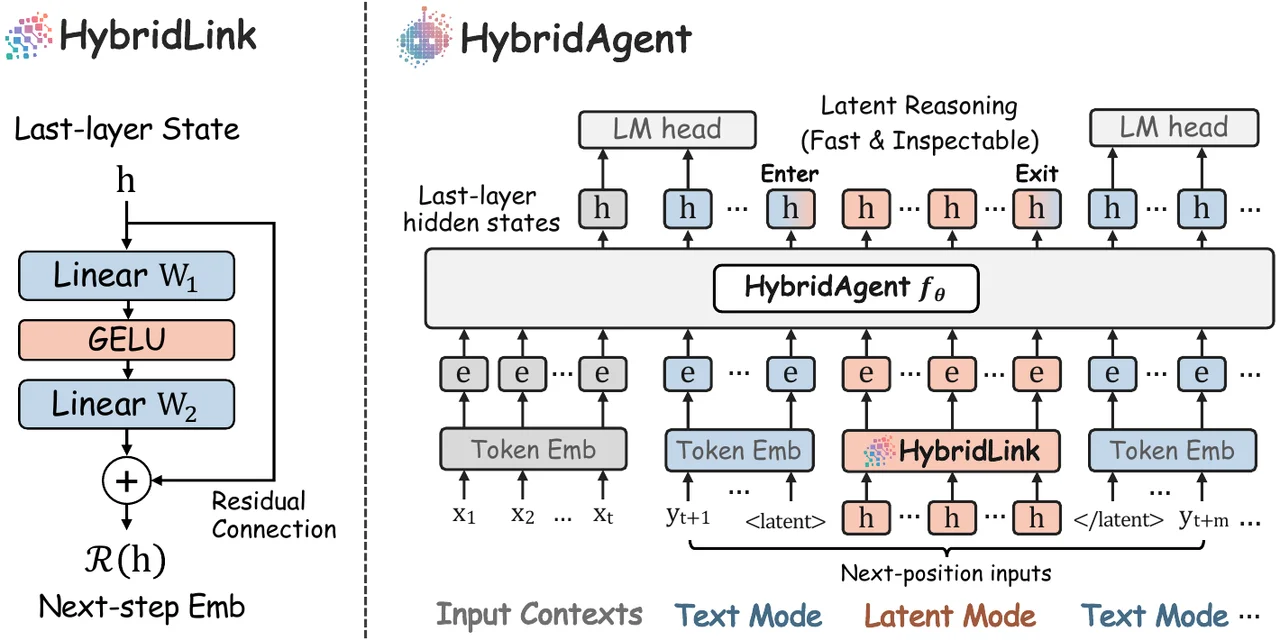
What if an agent could skip writing out much of its reasoning, yet still call tools and show you a readable trace? HybridAgent offers downloadable models and an inspector built around that proposition. A fresh October 18 Hacker News discussion has turned the research into a debate over what developers actually gain, and what they can still audit.
The paper was submitted on October 13, not newly released with the discussion. At our October 19 review, the thread showed 202 points and 125 comments. Those are observed discussion totals, not unique users or evidence of platform-wide adoption.
A model engine, not a prompt trick
HybridAgent uses Qwen3-Base backbones and a learned residual adapter called HybridLink. During latent mode, the engine feeds transformed hidden states into the next computation step instead of decoding each step into a text token. It switches back to text for external tool calls and answers, retaining mixed latent, text and tool context across turns.
The project publishes 8B and 14B Agentic checkpoints, source code and an MIT license. Its documented tools include Python execution and Tavily search. This is a custom model runtime, rather than a plugin that gives an existing coding assistant the same capability.
There is an important installation distinction: the Hugging Face card says ordinary Transformers loading supplies the text-only backbone. Full latent generation and tool use require the project’s hybrid inference engine and adapter files. A conventional model-loading experiment does not automatically test that engine.
The inspector is the interesting part
The repository includes a terminal view and a standalone HTML report that separate text, latent spans and tool activity. For each latent step, its pseudo-text readout selects the nearest token embedding; the HTML inspector can expose additional nearest-token candidates.
That gives builders a concrete way to examine traces. It does not establish that one projected token captures every feature encoded in the continuous vector, or that the displayed sequence is a complete account of the model’s computation.
HN commenters questioned both the method’s novelty relative to continuous chain-of-thought work and the safety implications of reducing visible reasoning. Those are community objections, not demonstrated deception by these checkpoints. The authors, for their part, report monitoring, debugging and correction experiments on 560 math problems using visible text and tool traces. That bounded evaluation is more specific than a general guarantee of safe or fully transparent agents.
What builders can try
The English setup guide specifies Python 3.11, a source installation and the project’s inference commands. The inspector can run a question against togethercomputer/HybridAgent-14B-Agentic and write report.html. Search-enabled runs require a Tavily API key; model hosting and any paid search usage remain separate costs. The guide does not establish a universal minimum inference GPU configuration.
The paper evaluates three model scales across eleven benchmarks and reports efficiency and accuracy gains against its selected baselines. Those are author results, not an AITrending reproduction or proof that these checkpoints beat every current model. The practical attraction is the combination of an executable hybrid agent and an inspection tool that developers can scrutinize themselves.