Jev 1.14 opens a danger zone for images, bounding boxes and 262k context
TypeSafe's decision model gains opt-in visual inputs and a new single-box output, while the company explicitly keeps these experimental capabilities outside its production-readiness claim.
Typed decisions can now look at pictures
TypeSafe has released Jev 1.14 alongside experimental image support, a bounding-box answer type and an opt-in 262k-token context. The October 14 announcement calls these capabilities its “danger zone”: available for prototypes, but still too uneven for the company to endorse for production use.
Images can appear in a request’s state, a question’s instructions or its criteria. A shared assets map supplies the files, and references place them within the JSON interface. This allows a workflow to compare a picture against visual examples while still asking for constrained decisions.
Image support also works with Jev 1.13. The new box type requires 1.14 and returns one bounding rectangle as four normalized edges, plus confidence. It is an output type for locating a target, not a general image-generation feature.
A box is not proof that the target exists
The Box documentation makes an important limitation explicit: there is no “not found” answer. A question about an absent object still produces four edges. TypeSafe recommends asking a separate Noul presence question and ignoring the box when that answer is low. Finding several objects requires separate questions or a workflow that splits the image into regions.
Images and Box questions require TypeSafe-Danger-Zone-Images: true on each relevant request. The separate TypeSafe-Danger-Zone-Long-Context: true header raises both per-request and per-question limits to 262k tokens on Jev 1.13 and 1.14. Defaults remain 64k per request and 32k per question; the company says longer context is slower and less accurate.
Preview today, stable alias later
The reviewed documentation maps jev-preview to jev-1.14.0, while jev-latest still points to 1.13. TypeSafe says it plans to move the stable alias a week after the announcement. Developers who need consistent behavior can select a versioned ID and log the version returned by the API.
Both versions cost $0.042 per million input tokens, with free output tokens. Images count as input tokens at the same rate. Calls use TypeSafe’s hosted endpoint and an account API key.
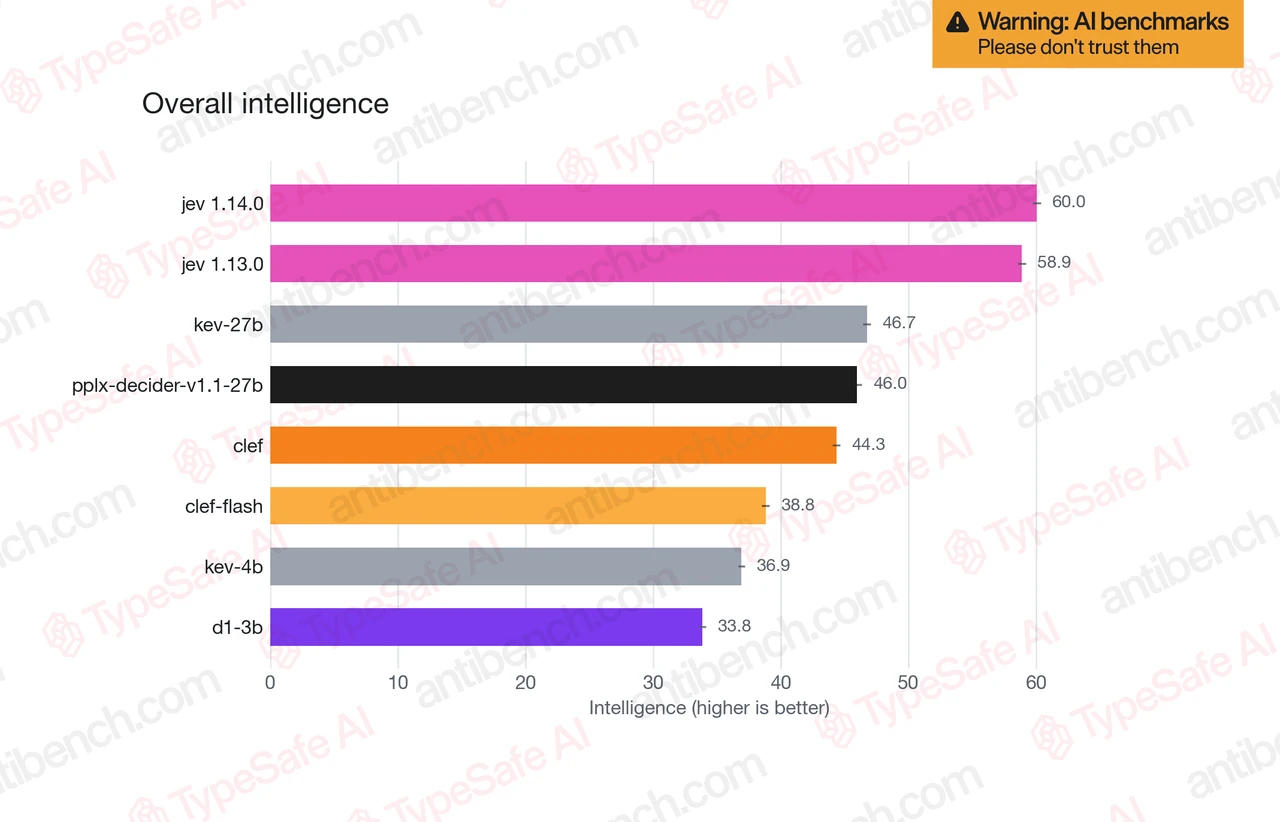
TypeSafe describes the base-model update as small improvements, with its largest expected gain in multilingual support. Its published comparison uses a private validation set and explicitly warns of bias toward its own models; the chart is not an independent ranking. The announcement also adds an opt-in setting for analyzing customer queries to debug model issues, while saying those queries will not be used for training.
Related reading
TechCrunch reports TypeSafe raised $870M at a $7.5B valuation
Simon Willison says Jev may be a new shape of LLM
