Maxwell claims nearly 2x faster LTX-2.5 video generation
doubleAI's October 19 demo cuts a five-second 4K clip from about 250 to 134 seconds on two B200s, alongside its pitch for code that improves while running.
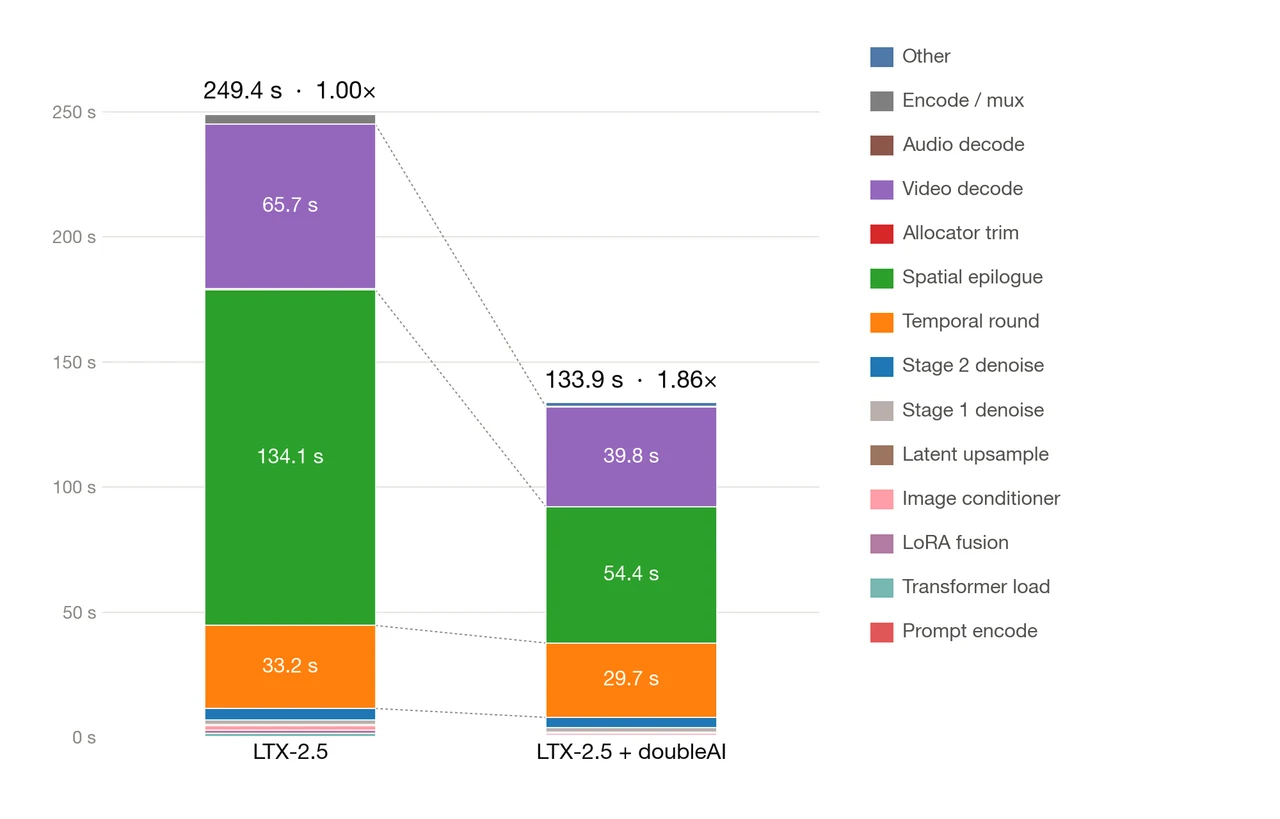
doubleAI says Maxwell made LTX-2.5 generate a five-second 4K video clip in 134 seconds instead of about 250 seconds on two NVIDIA B200 GPUs. Its October 19 report presents the result as performance engineering on an already optimized inference pipeline, with changes spanning algorithms and individual GPU kernels.
The demonstration gives a concrete example of the company’s broader pitch: a Code Execution Model that uses traces, profiling information and runtime data to improve how programs run. In an October 19 Hacker News introduction, a doubleAI founder described adapting to hardware and inputs without changing source code. The product page offers early access; it does not establish a general price or public installation command.
What changed in the video pipeline
The LTX report describes exchanging small partial attention results between GPUs instead of large video key/value tensors, reducing redundant work in overlapping image tiles, and changing the decoder’s kernel launches. These are doubleAI’s explanations of its collaboration, rather than measurements reproduced by AITrending.
The accompanying component chart reports 249.4 seconds for the original pipeline and 133.9 seconds for the optimized one. Those precise chart totals and the headline’s rounded 250/134 figures refer to the same reported workload. They do not imply that every video model or hardware configuration gets the same gain.
Verification claims need their own boundaries
Maxwell’s general product page says runtime replacements are formally proven equivalent. The separate LTX report describes a video-quality comparison: bit-identical audio and 41 dB PSNR between the original and optimized video on LTX’s benchmark prompt. It calls the videos visually indistinguishable; it does not report bit-identical video frames.
Public HN commenters asked about the proof framework, debugging visibility and the computation spent finding optimizations. The founder said verification is deterministic even when optimization is not. That exchange establishes a live technical discussion, while leaving practical deployment costs and the full verification boundary as questions for prospective users.