NorthCUA-Nano puts 9B computer-use weights up for download
The independent Qwen3.5-based release includes four BF16 weight shards and a native chat template. An external runtime still supplies the desktop and executes actions.
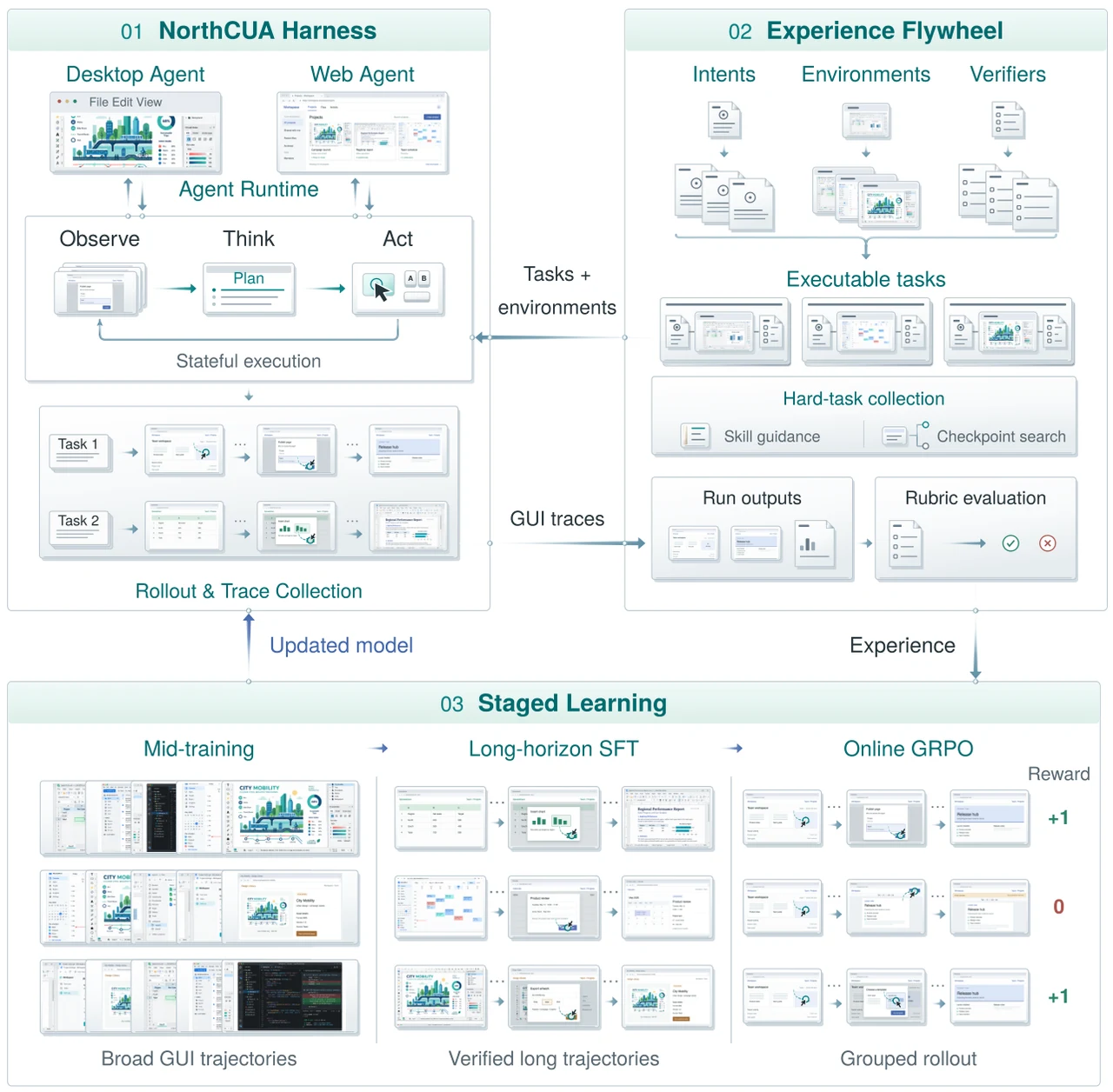
NorthCUA-Nano now offers downloadable weights for developers building agents that work from screenshots. The independent NorthCUA project describes its compact model as a dense 9B computer-use model built on Qwen3.5, accepting requests, screenshots and interaction history to generate responses and tool calls for desktop or browser workflows.
The concrete November 2 development is the weight release. Four Safetensors shards finished uploading at 06:45 UTC, with the release card following at 06:45:57. The repository was created the previous evening; subsequent documentation and diagram updates are not separate checkpoint launches.
What developers can download
The export is identified as r13 post-training checkpoint 975. Its English card lists approximately 18.84 GB of model files before runtime caches, predominantly BF16 weights, plus configuration, tokenizer, image processor, native chat template and checksums. The release uses Apache 2.0 licensing. This is independent post-training on Qwen3.5-9B, not an official Qwen release or endorsement.
The documented download route is hf download beipo-ai/NorthCUA-Nano --local-dir ./NorthCUA-Nano, with --revision available to pin a commit. The configuration records the Qwen3_5ForConditionalGeneration architecture and Transformers 5.20.2. Loading also requires compatible PyTorch, Accelerate and Pillow; the example is illustrative, not a validated hardware recommendation. File size does not establish the accelerator memory needed once activations and caches are included.
Weights need an execution loop
The model is one component of a computer-use agent. An external runtime provides the desktop or browser environment, supplies tool definitions, executes generated calls and sends back results with updated observations. The card’s screenshot example generates a response; it does not click through applications by itself.
For integrations, the documentation calls for preserving tool-call/result pairing and converting normalized 0-to-1000 coordinates into pixels at the execution boundary. The release makes a local model available to experiment with, rather than providing a hosted service or eliminating runtime integration work.
Report scores are not measurements of this export
NorthCUA’s card also presents research-report benchmark results, but explicitly says those results have not been tied to this exact checkpoint975 export. Grounding results come from supervised checkpoints, while task-completion results come from subsequent joint desktop-web reinforcement learning. They should not be read as verified scores for the downloaded files.
AITrending reviewed the English release documentation, configuration, notices and dated upload history, but did not run the model or reproduce its task performance. The news is the availability of a substantial computer-use weight release with documented integration requirements; successful action execution remains something developers must test in their own environment.