AI-assisted PHP2Shell research triggers emergency PHP patches, but humans saw the root flaw in 2024
PHP released fixes for two critical remote-code-execution vulnerabilities on October 21. Wiz credits frontier AI for making exploitation practical; the PHP Foundation describes earlier human discovery and a difficult, delayed fix.
PHP has shipped emergency fixes for two critical vulnerabilities after AI-assisted researchers demonstrated how long-standing engine weaknesses could become remote attacks. The October 21 releases are PHP 8.5.12, 8.4.27, 8.3.36 and 8.2.35. PHP’s own guidance says there are no complete mitigations and updating is the only safe choice.
The AI angle is substantial, but the discovery story is more complicated than a model finding a completely unknown bug overnight. The PHP Foundation says a core developer first saw signs of the out-of-memory root problem in 2024, during work following an external audit. A possible exploit was theorized, but no concrete attack path had been established then.
AI changed what researchers could demonstrate
Wiz calls the vulnerabilities PHP2Shell and says it used Wiz Atlas, Gemini 4 Argon and GPT-5.6 Sol throughout its research. The company credits frontier models with reducing the work needed to chain bugs, adapt to memory layouts and debug exploits across different applications.
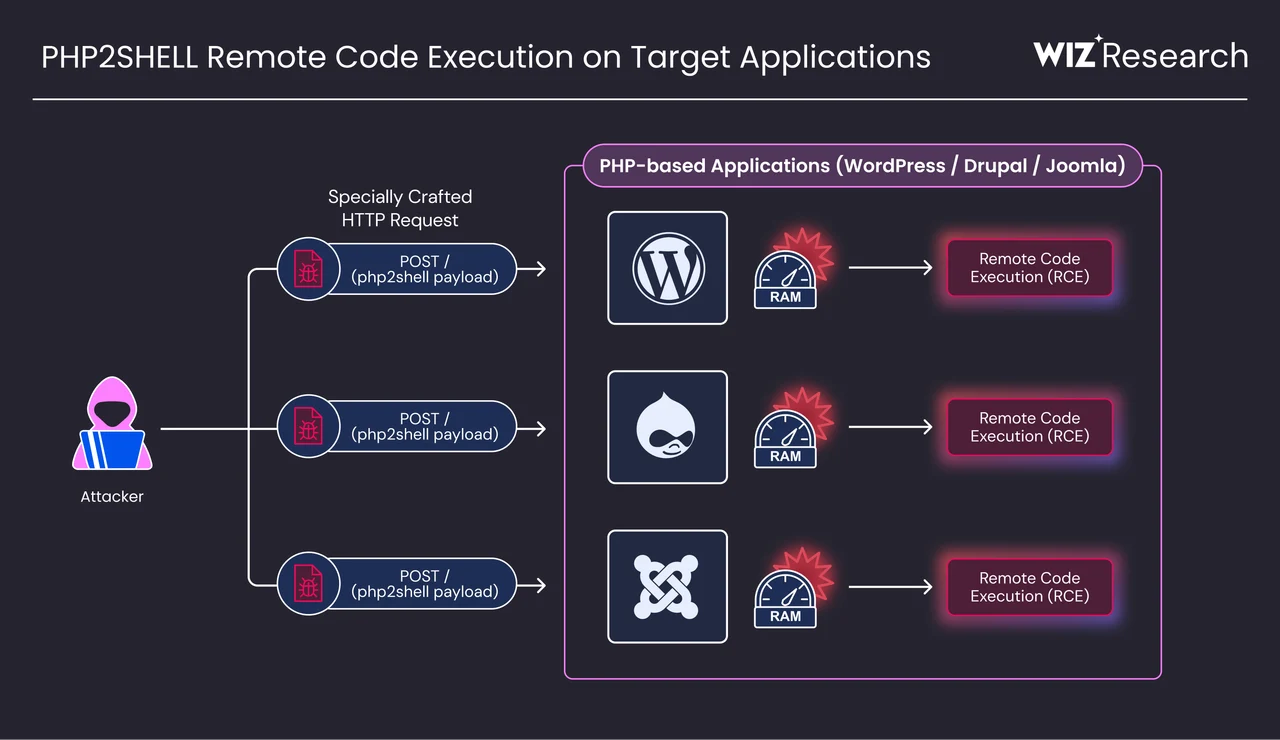
Wiz reports unauthenticated remote-code-execution demonstrations against WordPress, Drupal and Joomla deployments, plus disclosure of process memory that could contain secrets. Those are researcher demonstrations on selected targets, not evidence that every site running those applications has been compromised. The flaws are in PHP itself; an application’s own code can be secure while its underlying runtime remains vulnerable.
The two tracking IDs are CVE-2026-109618 and CVE-2026-109619, rated CVSS 9.2. They concern memory corruption and stale internal state around fatal errors. PHP identifies mod_php as especially risky and also reports confirmed remote execution through application-level PHP-FPM paths. Deployment details affect the attack route.
The fix was also an engineering and coordination problem
The PHP Foundation says competing fixes involved compatibility, performance and extension tradeoffs. It calls the earlier delay a structural failure involving decision-making and insufficient resources, rather than claiming that the root problem had been invisible until AI arrived.
According to its timeline, Calif researcher Ryan A and OpenAI independently reported the same root cause on August 11. Wiz reported additional vectors on August 24. The foundation says those reports made the practical impact clear and turned the fix into its security team’s top priority. People still made the decisions and worked on every patch.
The planned October 22 release moved to October 21 after CVE identifiers circulated and disclosure was disrupted. The foundation says it had not identified functional public exploits at the time of release. That is a time-bounded observation, not an assurance about subsequent attacks or a reason to postpone updates.
What operators should take from it
Check the actual PHP runtime and the security update supplied by the host or distribution, rather than assuming a WordPress plugin update fixes the engine. PHP lists patched releases for each supported branch; unsupported installations need a supported update path. Its PHP 8.6 release candidate also includes fixes but is explicitly not recommended for production.
The event shows AI helping defenders establish real exploitability and validate patches while potentially lowering attackers’ adaptation costs. Wiz’s broader claims about an AI turning point remain its assessment. The confirmed news is that critical runtime flaws now have released fixes, and administrators have an immediate update to apply.
Related reading
Can your agent prove it finished? Probity offers 2,736 tests