Talking AI teammates win more Pokemon battles, at 3.8x the prompt cost
Oliver Grabner reports a 64% win rate for freely chatting Qwen teammates versus 42% without chat, with a substantial token trade-off. His October 10 experiment reached Hacker News on October 22.
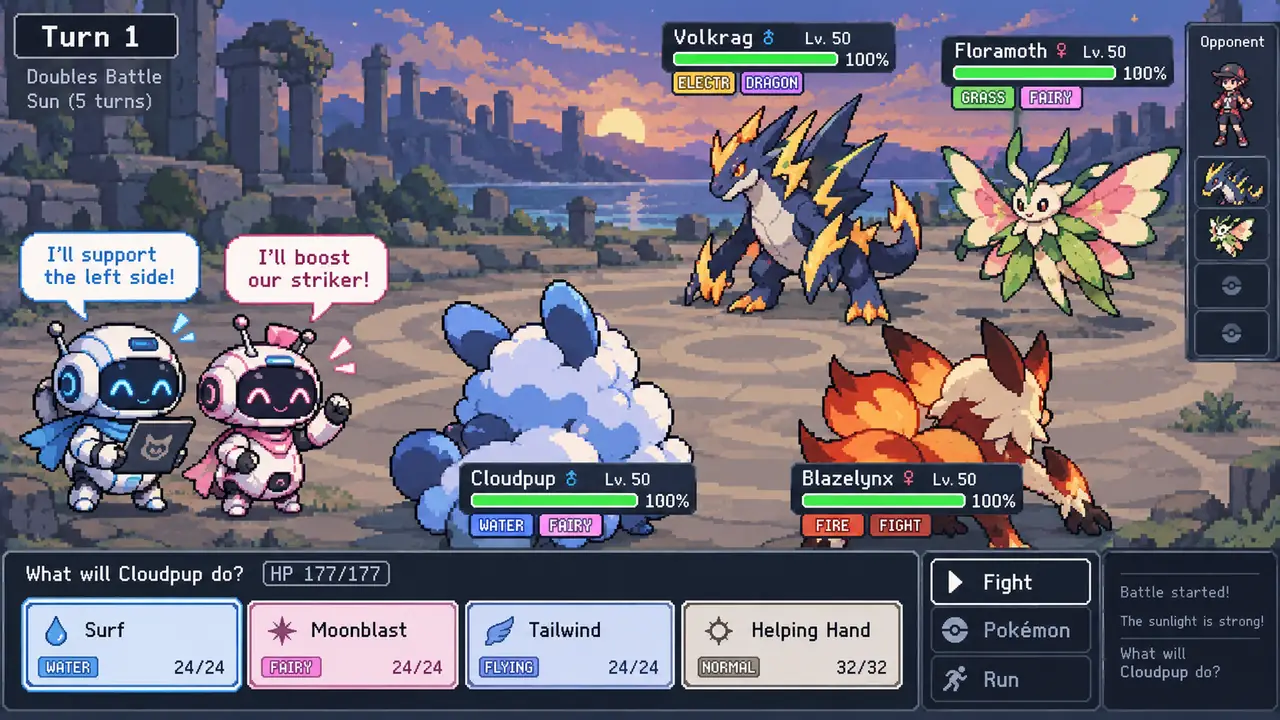
Letting two AI teammates talk improved their Pokemon battle results in Oliver Grabner’s experiment, but the conversation came with a large prompt-token bill. His report puts freely communicating Qwen3.8-27B teammates at a 64% win rate against a scripted maximum-damage opponent, compared with 42% when the teammates could not talk.
The research page is dated October 10. Grabner shared it on Hacker News on October 22, where readers asked about team selection and performance against human ladder players. That is the current discussion hook; the submission does not turn the older experiment into a newly released model or establish human-level competitive play.
A game where partners choose separately
The environment wraps the Pokemon Showdown simulator for four-player Multi Battles: two players per side, each controlling one active Pokemon from a team of three. An agent receives an English battle summary and numbered legal actions. It can privately message its partner or select a move; choosing ends its talking, and its partner learns the selected move.
Grabner compares free conversation, one message per teammate, no conversation, and a single model controlling both Pokemon. Battles use fixed seeds and mirrored team assignments so the conditions face the same draws. The report describes hidden opposing sets and random damage, making coordination more demanding than simply assigning two independent tasks.
Against the scripted opponent, the reported win rates are 64% for free talk, 54% for one model controlling both, 52% for one message each and 42% for no talk. These are the author’s measurements in this environment, not independently reproduced scores or a general ranking of agent systems.
More coordination also means rereading more context
Free talk consumed a reported 978,000 prompt tokens per battle, versus 259,000 without talk, or about 3.8 times as many. The author attributes the increase to repeated model calls that reread the battle state and conversation. Prompt-token consumption is not itself a dollar price: local serving and paid APIs have different costs, and the figures do not describe generated tokens alone.
The report’s example shows one teammate correcting the other’s type-matchup reasoning before they commit to different targets. Grabner interprets the results as evidence that conversation helps, while identifying an unresolved follow-up: separating the value of talking from the value of seeing a partner’s chosen move. A broader model leaderboard and reinforcement-learning training are future work, not completed outcomes.
The public Python framework requires Python 3.11 or later and Node.js 18 or later for its simulator bridge. Its README documents local setup, replay generation and model-backed battles using an OpenAI-compatible client for vLLM and Gemini. The repository’s old Phase 2 status paragraph lags its later model-battle instructions; readers should distinguish those setup instructions from the results presented on the research page. AITrending has reviewed the sources, not rerun the battles.