Claude leads PostHog's MCP traffic, but bad arguments dominate failures
PostHog's public leaderboard shows Anthropic at 64.6% of known-model tool calls and schema mistakes behind most failed calls. It measures one server's traffic, with mostly self-reported model labels.
Usage is only one part of the scoreboard
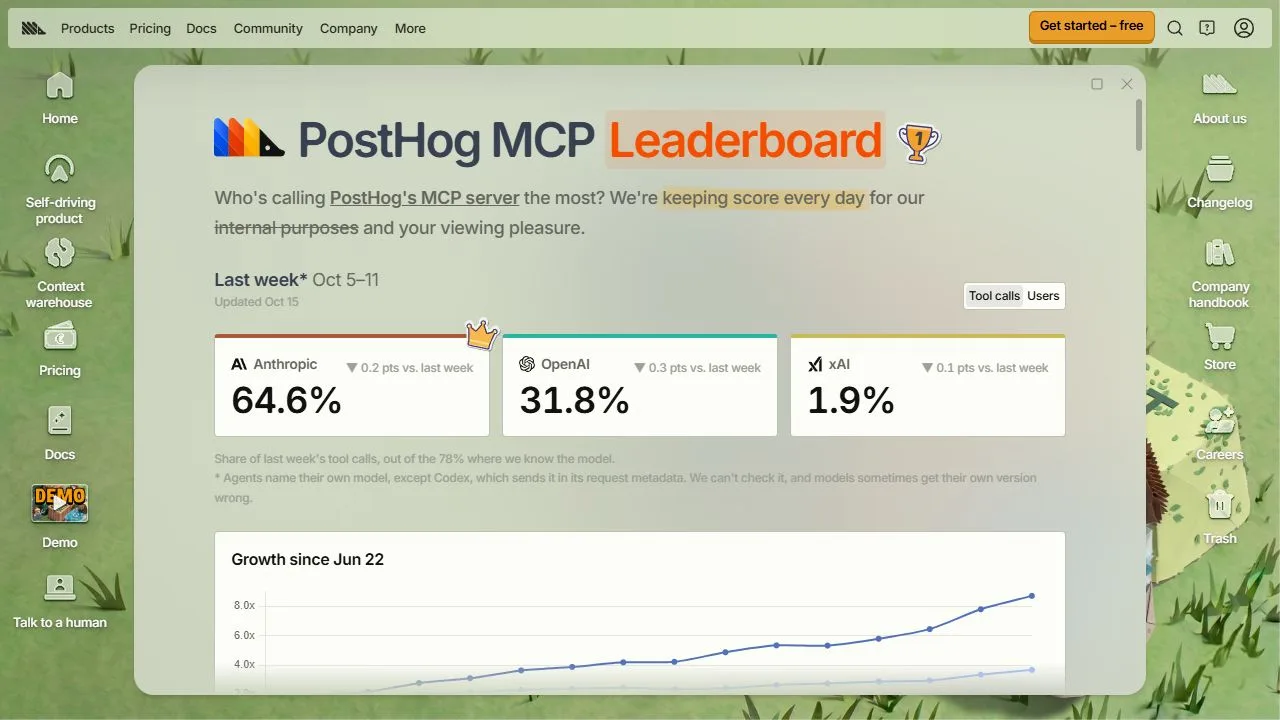
Anthropic accounts for 64.6% of known-model tool calls in PostHog’s October 15 MCP leaderboard snapshot, ahead of OpenAI at 31.8% and xAI at 1.9%. The weekly figures cover October 5-11. An October 15 Hacker News submission gives the page a current public discussion hook, without establishing a new launch or broad community endorsement.
The leaderboard describes activity on PostHog’s own Model Context Protocol server. It is a useful look at agents actually calling an analytics product, rather than a global market-share estimate. Its model-call percentages use only calls with a known model, a subset the page rounds to 78% of total traffic.
PostHog also separates the model from the harness calling it. Claude Code leads its harness table at 32.4%, while the Codex client accounts for 5.0%. A model’s share and a client’s share answer different questions; they should not be substituted for each other.
Schema mistakes are the bigger operational hook
Bad arguments account for 75.2% of failed calls in the snapshot. That does not mean three quarters of all calls fail. The category covers calls rejected because their arguments do not match the tool schema, making the leaderboard a window into integration friction as well as usage.
Among the ten most-called models, the displayed schema-rejection rate is 3.4% for Claude Opus 5.5, compared with 0.9% for GPT-6 and 0.8% for GPT-6 Astra. These are observed rates from different traffic mixes. Tasks, harnesses and users are not held constant, so the table cannot establish a universally better MCP model or a controlled reasoning comparison.
SQL tools account for 52.9% of calls. Separately, 85.1% of weekly users used execute-sql at least once. One is a share of calls and the other a share of users, illustrating why the page’s denominators matter.
Most model names come from the agents
PostHog says 72.6% of calls use agent-supplied model identification, 22.5% do not report a model and 4.9% use client metadata. It cannot verify the agents’ self-identification; Codex supplies its model through request metadata. Low-volume labels are grouped into Other, including apps with fewer than 25 users.
The methodology uses PostHog’s MCP analytics tool-call events and HogQL queries. Its server latency runs from receiving a request to sending a response, excluding model thinking and network time. Those limitations make this a specific operational snapshot worth inspecting, with a narrower meaning than the page’s competitive scoreboard framing might suggest.
Related reading

PortOS adds shot-by-shot rendering to its AI music-video studio