Project ProtoStar puts public science to an AI reuse test
Hugging Face and university partners announced a scientific-data initiative, with CMU's November climate challenge as its first practical test.
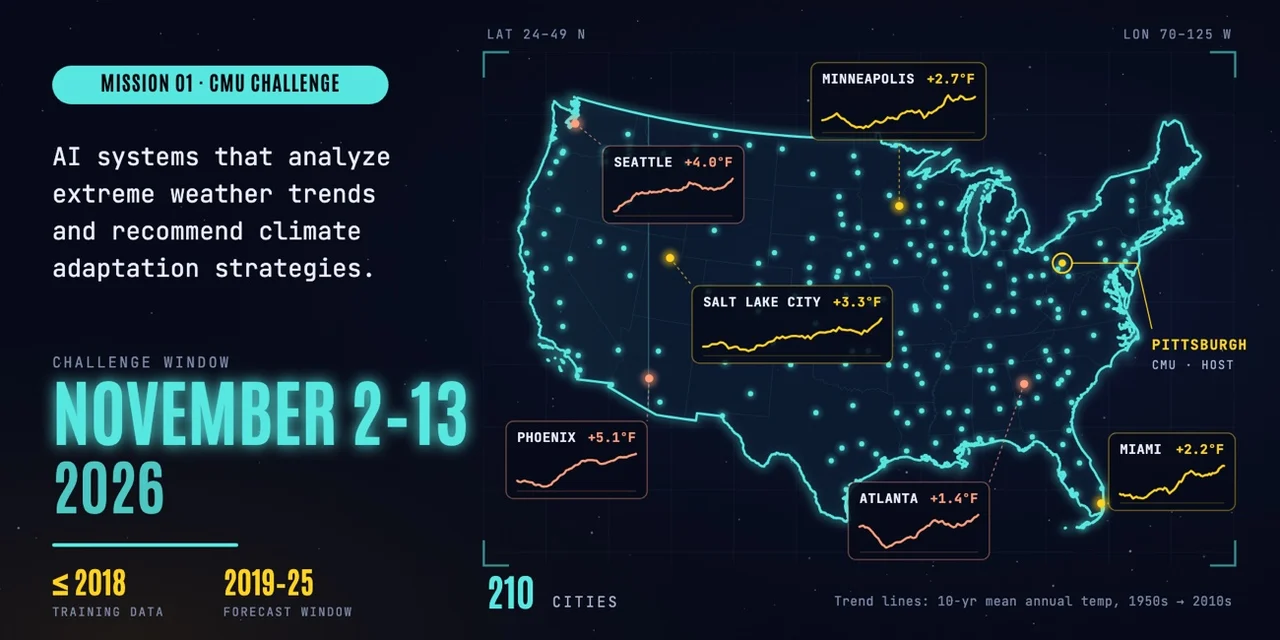
Project ProtoStar wants publicly funded science to become something AI developers can actually reuse. Announced on October 29, the initiative brings universities, Hugging Face and open-science organizations together to release scientific datasets, models and code in machine-actionable formats, then test their usefulness through open challenges.
Its first event is Carnegie Mellon University’s Climate Risk Intelligence challenge, scheduled for November 2-13, 2026. Participants will work with historical weather records covering 210 U.S. cities, train using data through 2018 and compare predictions with observed later weather.
A concrete task for open scientific data
Teams are asked to predict annual average temperature, annual precipitation, the hottest day of the year and cooling degree days, an indicator of air-conditioning demand. The organizers compare forecasts with simple reference methods, including historical averages and linear trends. Participants also propose a short climate-adaptation policy idea informed by their analysis.
The current submission documentation asks teams to sign in with Hugging Face and provide a public dataset containing forecasts in submission.csv, a README explaining the method and policy idea, and code. It records the submitted dataset commit, so a later repository edit does not automatically replace the submitted version.
This creates a useful test of the initiative’s premise: public availability alone does not supply documentation, compatible formats or enough context for another researcher to build on a dataset.
The published rules still have a mismatch
The launch announcement describes forecasting 2019-2026 and publishing final forecasting results in early 2027, after complete 2026 observations become available. At review time, however, CMU’s linked challenge instructions describe a 2019-2025 forecast window, with 2019-2021 used for live scoring and 2022-2025 for final scoring. The source-published challenge graphic also says 2019-2025.
Those are different specifications. Teams should recheck the challenge’s current instructions before preparing a submission rather than assume the two pages already agree. The Space’s About page says its live leaderboard is coming soon; the repository README also lists several operational limits as undecided. An announced challenge is not evidence that a functioning leaderboard or completed results already exist.
ProtoStar’s founding partners include CMU, Purdue, Georgia Tech, Arizona State and George Washington University through the Open Forum for AI, alongside the Astera Institute, Hugging Face and the Open Research Community Accelerator. The initiative plans further institution-hosted challenges.
For researchers and developers, the immediate opportunity is a defined data-reuse exercise with an approaching start date. Whether it produces better forecasts or reusable scientific breakthroughs is a question the initiative aims to investigate, not a result established by this launch.