Beam's 501B weights are finally downloadable under Apache 2.0
Reflection's October 5 preview becomes a public weight release, with BF16, FP8 and NVFP4 checkpoints, serving recipes and a companion coding-agent harness.
Storyline / Report 2 of 2
Reflection Beam preview and public weight release
Full timeline 2 reports
- DevelopingReflection AI introduces Beam but has not released its weights
- Source-backedBeam's 501B weights are finally downloadable under Apache 2.0 (current report)
Reflection’s Beam is now a model developers can download, rather than a promise of weights later in October. The company announced the public release on October 16, following its October 5 preview. The Hugging Face repository contains the weight shards and identifies Apache 2.0 as the license; an unauthenticated request for the first BF16 shard returned HTTP 200 during AITrending’s review.
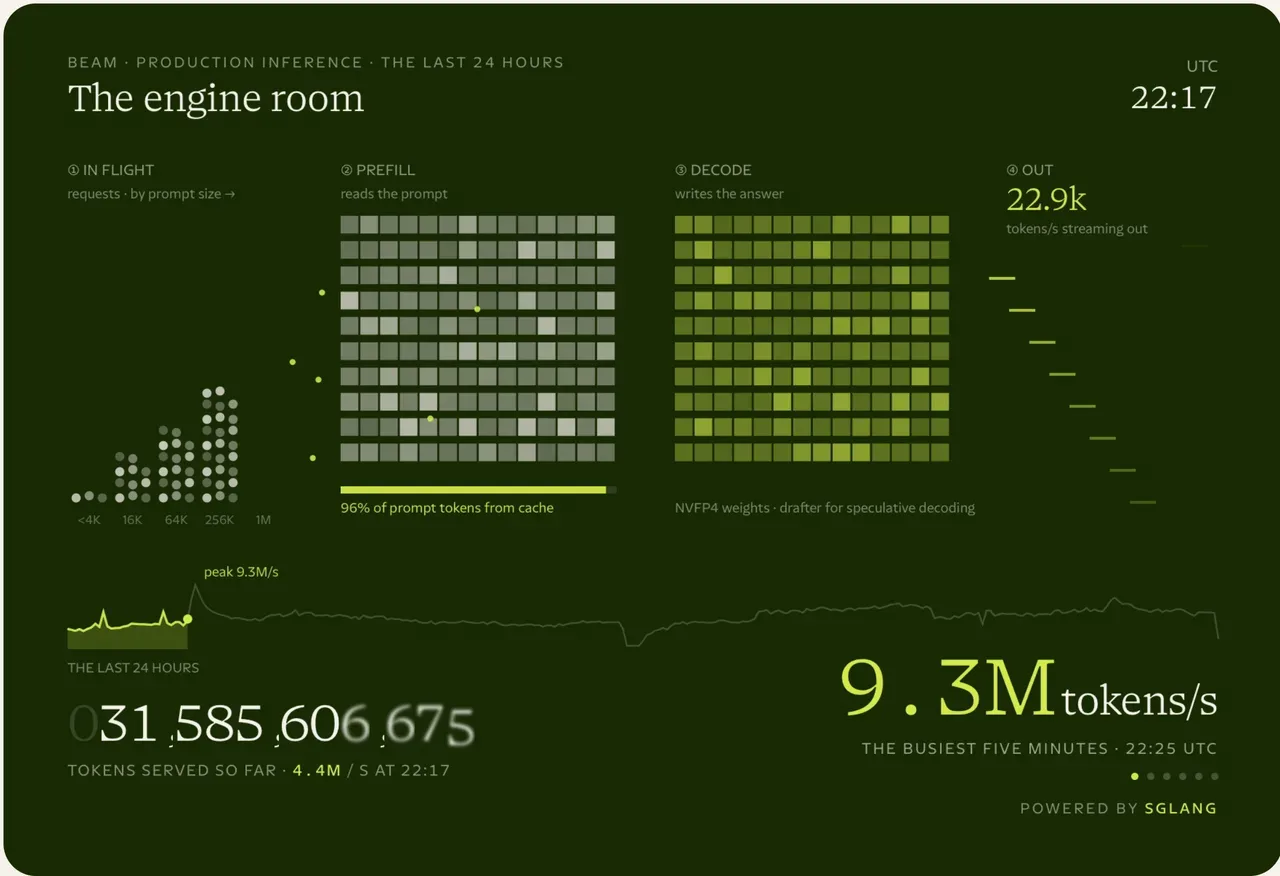
Beam is a text-only mixture-of-experts model with 501 billion total parameters, roughly 23 billion active per token and a one-million-token context window. Reflection released BF16, FP8 and NVFP4 formats alongside a speculative-decoding drafter. Those specifications describe the published model; they do not establish a universal performance advantage over competing systems.
Open weights still need large hardware
The active-parameter count is not a laptop memory budget. Hugging Face’s deployment guide puts the BF16 checkpoint at about 1TB and NVFP4 at roughly 280GB. It recommends planning for four B200 GPUs when serving the NVFP4 model with room for long contexts and concurrent requests, while also describing other configurations. NVFP4 targets NVIDIA Blackwell hardware; older hardware needs another supported precision and runtime configuration.
The same guide documents Transformers 5.20.1 or newer, vLLM and SGLang support. Hosted Hugging Face Inference Providers offer another route through Baseten, Fireworks and Together. That route uses an HF_TOKEN and provider billing; a permissive model license does not make hosted inference free.
A model release with agent integrations
Reflection also introduces Mirror CLI, a companion harness with a Python frontend and Rust agent core. The company describes tool-call approval, resumable conversations, worktrees, skills and MCP connections. It says Beam works with pi, OpenCode and Hermes through its API, third-party endpoints or self-hosting. These are separate harnesses around the model, not features automatically installed by downloading its weights.
Reflection’s model card publishes coding, reasoning and tool-use evaluations and claims token-efficient reasoning. Hugging Face explicitly attributes the benchmark table to Reflection and labels its own small task demonstrations as informal evaluations. AITrending has verified public access and documentation, not reproduced those scores or efficiency claims.
The release resolves the earlier access question. It does not mean every promised customization artifact is finished: Reflection says self-distillation recipes will arrive in the coming days, while the model card still marks the general technical report as forthcoming. The separate safety report is linked from the release.