65B against the giants: Ricursive releases Ripple with an 80.52 coding claim
Apache-2.0 weights, an NVFP4 option and a million-token pitch put Ricursive's dense model in the local coding conversation. Its benchmark lead is self-reported.
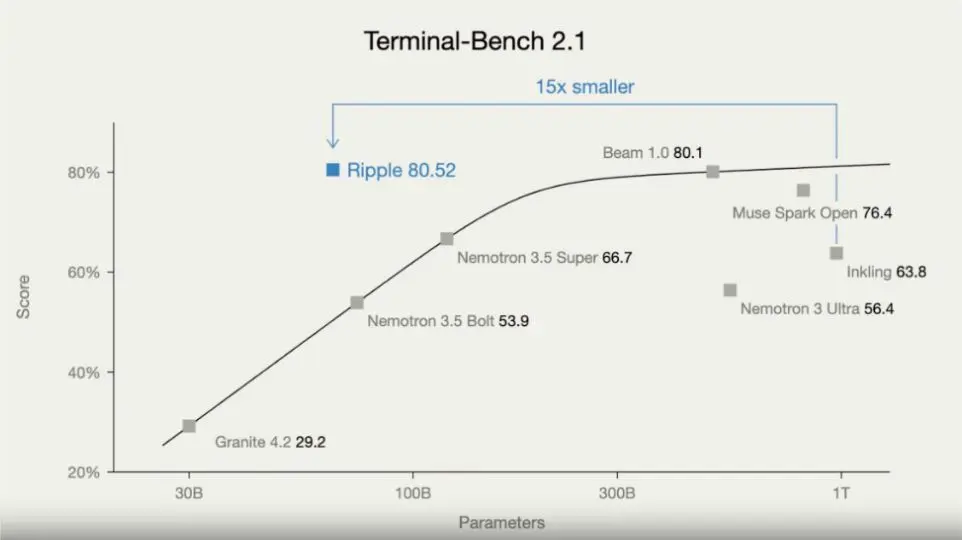
Ricursive Intelligence has released Ripple-65B Preview, a dense open-weight model that it says scores 80.52 on Terminal-Bench 2.1, ahead of much larger U.S. open-weight competitors in its comparison. The November 4 announcement turns the chip-design lab’s model work into a downloadable general-purpose option for coding and reasoning.
The release includes BF16 instruction weights, an NVFP4 instruction checkpoint and a BF16 base model under Apache 2.0. Ricursive describes a 65-billion-parameter Transformer pretrained on 12 trillion mostly English and code tokens, with support for up to one million tokens of context. The public model is a general-purpose variant of the proprietary model behind its chip-design platform.
A local-model hook with a benchmark caveat
The attraction is a smaller total weight footprint than the giant mixture-of-experts models in Ricursive’s chart. The author says Ripple can fit on a DGX Spark and provides a quantized checkpoint for local use. That does not establish that every device can serve its maximum context at useful speed: memory, precision and the serving configuration still matter.
The 80.52 result is Ricursive’s claim, not an independently reproduced ranking. Its model card mixes official competitor scores with internal runs for missing evaluations and says unspecified harnesses use OpenCode. It also reports lower Terminal-Bench results for most compared models when using the official Terminus 2 harness at 128K with summarization. Those differences matter when deciding whether the chart predicts a particular coding workflow.
Total parameter counts are not equal inference-compute budgets, either. Ripple is dense, activating all 65 billion parameters; the comparison models use mixture-of-experts architectures with smaller active subsets.
What the $32 million claim includes
Ricursive says it developed and trained Ripple for $32 million. Its launch page explicitly includes recipe development, data mixing, evaluations, debugging, synthetic data, post-training development and the final training runs in that full research-and-development figure. The accompanying one-tenth-cost comparison relies on the lab’s estimate of a competitor’s spending, rather than an audited comparison of equivalent training runs.
The immediate news is that readers can inspect the English card, license and checkpoints themselves. The claimed coding lead is a reason to evaluate Ripple on real tasks, with the chosen harness and hardware recorded.
Related reading
Take your Codex chat to another model: aichat adds provider porting
BoxyFit says its new Groot pack runs on a 12GB GPU — with a runtime catch