A 96-repo study puts AI credits at 8.7% of AI-infrastructure commits
The newly public coauthored dataset tracks disclosed AI participation in Git history, with a reusable scanner and a warning against equating attribution with code authorship.
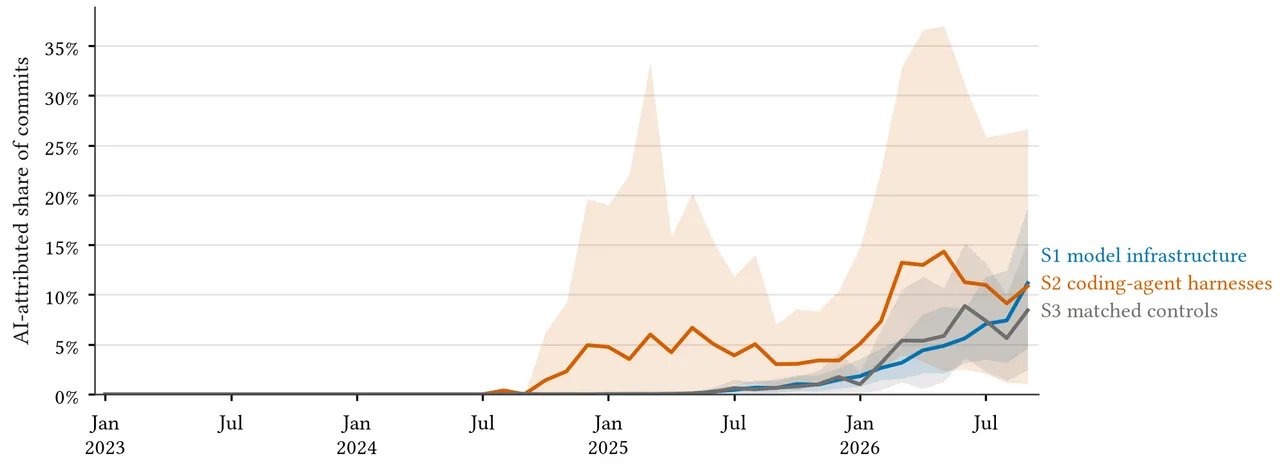
A newly public study offers a concrete number for a slippery question: how often does open-source AI infrastructure visibly credit AI assistance? Independent researcher Thanatchon Chongmankhong’s coauthored project reports that 8.7% of qualifying commits in its AI-infrastructure sample carried detectable AI attribution in the third quarter of 2026. That measures disclosed participation in commits, not the percentage of code written by AI.
The project’s first public Hugging Face aggregates revision appeared on October 29 at 02:21 UTC. Its repository snapshot is dated October 28, and its analysis window runs from January 2023 through September 2026. Those dates describe different things: publication of the dataset does not turn the older commits into new activity.
A comparison with wide uncertainty
The study scans 96 public repositories: 42 involved in training, fine-tuning, evaluating or serving AI, 12 coding-agent harnesses, and 42 matched popular non-AI controls. It uses 52 signatures covering 28 tools, looking for coauthor trailers, agent identities and generated-with markers. The main analysis excludes merge commits and maintenance-bot-authored commits while retaining AI-agent accounts.
For 2026’s third quarter, the author reports AI-attributed shares of 8.7% for infrastructure, 7.1% for controls and 10.3% for harnesses. Their respective 95% confidence intervals are 4.0-14.5%, 2.3-12.6% and 1.6-23.7%. The broad overlap makes the comparison inconclusive about whether infrastructure leads the controls. It does not establish equality or settle claims about recursive AI improvement.
Attribution can disappear when tools omit it, users disable it or repository workflows strip it. The sample is purposive rather than representative of all open source, and one control repository supplies 54% of attributed control commits. The project also discloses that its pilot validation used an AI assistant rather than independent human annotators. These are material limits on interpreting the results as adoption, productivity or quality measurements.
A provenance workflow developers can inspect
The release includes aggregate data, anonymized samples and a command-line tool for organization-level reports. Its documented installation route uses uv tool install git+https://github.com/thanatchon36/coauthored, followed by coauthored report --org <your-org>. The workflow requires Python 3.11 or newer and an authenticated GitHub CLI for repository discovery; scanning uses local Git objects.
The code is Apache-2.0 licensed and the dataset is CC-BY-4.0. AITrending has reviewed the English documents and chart but has not rerun the study. The useful new artifact is an inspectable way to measure visible AI credits, with enough disclosed uncertainty to resist treating them as a census of AI-written software.