Frame 1.0 joins code scanning with an AI exploit-and-fix loop
The first stable release pairs cross-file analysis and a Z3-based solver with optional local or hosted models for security work.
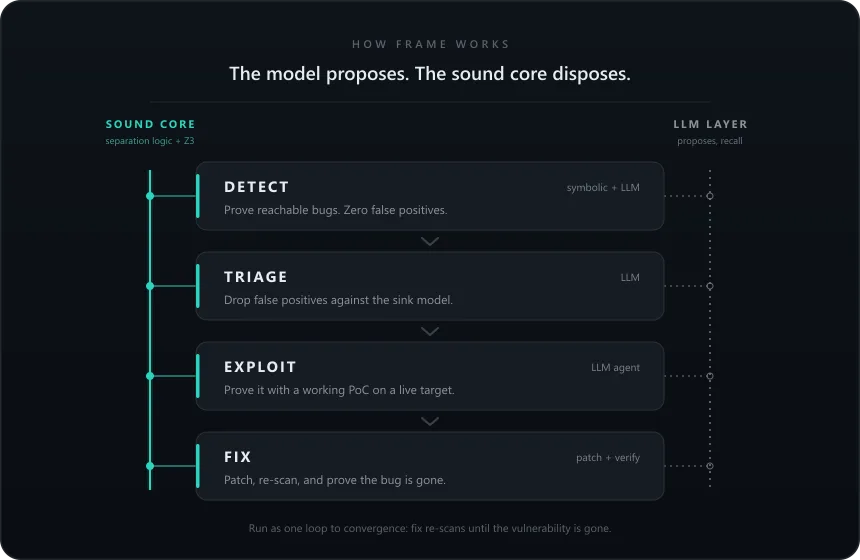
Frame’s first stable release puts a practical security loop around AI-assisted coding: trace suspicious data across files, examine findings, attempt an exploit against an authorized target, then generate a patch and scan again. The October 27 v1.0.0 release combines a conventional analysis core with an optional language-model layer, rather than asking a chatbot to pronounce a repository secure from a single prompt.
The project documents scanning for Python, JavaScript/TypeScript, Java, C# and C/C++. Its cross-file analysis follows a value from a request handler to a sensitive operation elsewhere in the application. A separation-logic engine built on Z3 supports the symbolic core. The release also describes more than 70 framework packs and lets developers describe their own framework in a TOML file. These are project-reported capabilities, not a claim that every program path is understood.
The model layer adds repository file and search tools, triage, exploit generation and proposed fixes. Its documentation keeps model-detected and symbolically grounded findings in separate tiers. Models connect through an OpenAI-compatible endpoint, so a local server and a hosted service are alternative backends. Hosted access can require API credentials and paid usage; a local setup requires a separately served model. Frame is the security tool, not a new model or a coding-harness fork.
Installation uses the Apache-2.0 Python package frame-security[scan] on Python 3.10 or later. Developers can run it as a command-line scanner, pre-commit hook or GitHub Action. The CI documentation requests repository read access and permission to upload security events when sending SARIF results to GitHub code scanning. Changed-file scans and baselines focus attention on new findings; re-scanning checks whether the scanner still detects an earlier issue.
The release includes author-run benchmarks with both misses and false positives. Its accompanying workflow diagram uses strong promotional language about proving bugs and removing false alarms; that is the author’s framing, not a universal guarantee or an AITrending test result. Exploit mode is documented for live targets the operator is authorized to test, and a clean scan or successful re-scan does not prove the absence of other vulnerabilities.
Related reading
Can your agent prove it finished? Probity offers 2,736 tests