Google puts Gemini 4 Carbon in cyber defenders' hands first
Google announces a new frontier model for sustained coding and cybersecurity, with phased Fairwind access and broader availability still to come.
Google’s next frontier model is starting with cyber defenders. Gemini 4 Carbon, announced on October 28, targets sustained software engineering and the full defensive workflow from finding vulnerabilities to validating and patching them. Google says a subset of defenders will receive access this week, followed gradually by additional trusted partners through its Fairwind Program.
That is an announced phased rollout. The post describes access for ordinary developers, businesses and consumers as coming later, without giving a general release date.
A model for longer engineering work
Google says internal teams have seen Carbon work for days on complex engineering tasks, persisting through dead ends and investigating subtle bugs across large codebases. Those observations belong to Google; they are not a guarantee that every user task will run successfully for days.
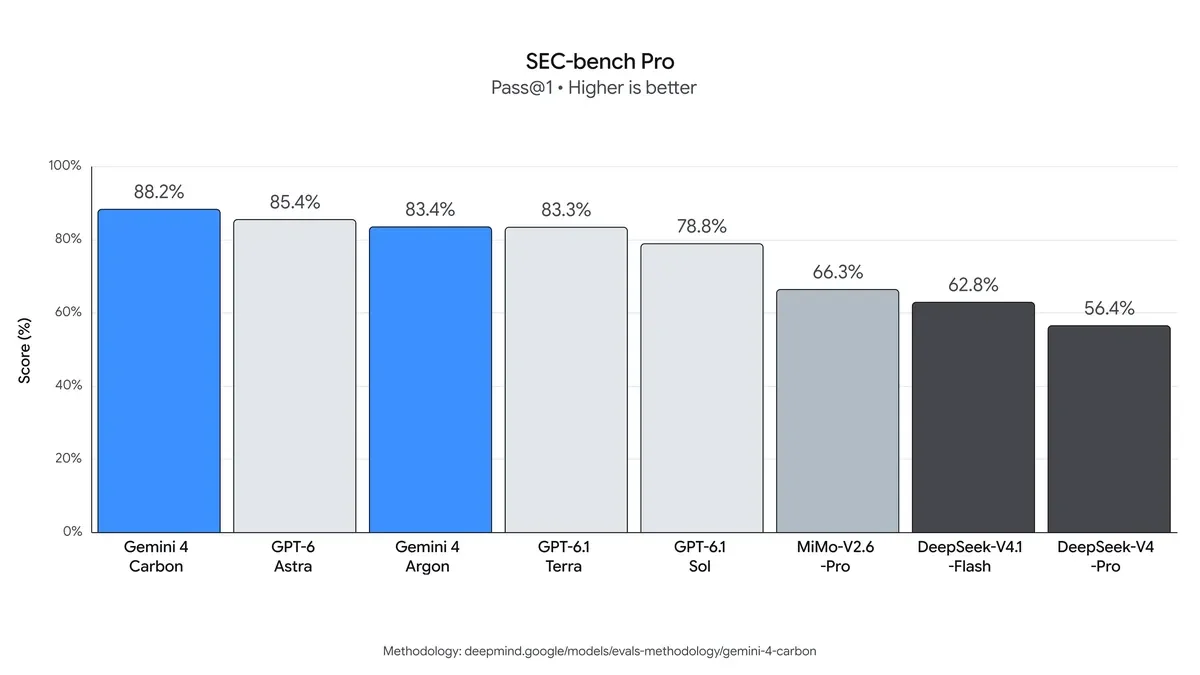
The company reports 88.2% on SEC-bench Pro for vulnerability discovery, 54.8% on ExploitGym for exploitation and 71.0% on CWE-bench for patching. Its announcement explicitly says these external cybersecurity evaluations were conducted without guardrails. The accompanying chart is Google’s published comparison, not an independent AITrending test or a promise of equivalent performance through the restricted service.
Google also reports stronger prompt-injection resistance and fewer unsupported claims in its evaluations. These are bounded test results, not proof that the model cannot be manipulated or make mistakes.
The price has an introductory period
Google lists introductory pricing of $2 per million input tokens and $10 per million output tokens, with cached input priced at 95% off the input rate. The footnote lists $4 input and $20 output after that period, without specifying an end date. Announced prices should not be mistaken for a generally available API endpoint.
Fairwind’s current program page describes vetted access for trusted defenders, due diligence and restrictions on redistributing model access. At review, that page still names Argon in its technology and FAQ sections; the new Carbon announcement supplies the Carbon-specific rollout plan.
For readers outside the initial cohort, the immediate news is a new model and its measured claims, with public access still pending. AITrending has reviewed the English announcement and program terms but has not independently run Carbon.
Related reading
Cheap coding agents spark a fight over who pays the review bill