Four Sparks, one huge GLM: a community kit tackles a silent serving stall
An existing GLM-5.3 self-hosting recipe gets a November 4 wake-up-path fix, alongside an attributed million-token setup and explicit hardware and licensing limits.
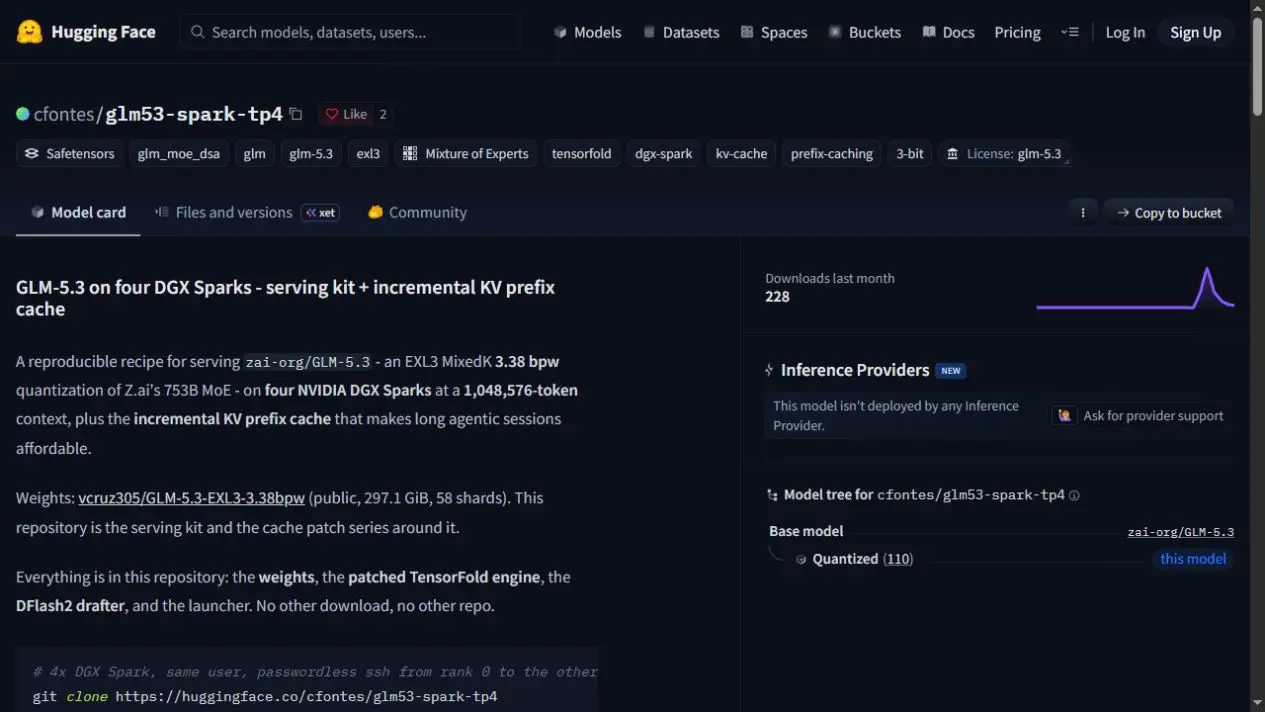
A community serving kit for running GLM-5.3 across four NVIDIA DGX Sparks has updated a failure path that could leave completions stuck while health checks still looked fine. Maintainer cfontes describes the November 4 change as a fix to the cluster’s “doorbell”: the small wake-up message that tells follower machines a request is ready.
The kit predates this update. Hugging Face records its creation on October 30; the new commits around 22:06 UTC on November 4 change the bundled TensorFold engine’s wake-up handling. This is an update to an existing community deployment recipe, rather than Z.ai releasing another model.
Why a healthy endpoint can still hang
The maintainer’s deployment guide says a failed send previously aborted the wake-up loop. Followers later in that loop could remain waiting for a message while the leading machine entered a collective operation, leaving generation stuck.
The reviewed code now attempts each peer separately and closes failed connections. If a peer is lost, it closes the remaining wake-up sockets too, so followers can leave that wait and take the shared fallback path. AITrending compared the earlier and November 4 source revisions; it has not reproduced the failure or verified recovery on a four-machine cluster. This change is not a claim that inference continues normally after arbitrary hardware failures.
A substantial local setup, with a narrow lane
The English model card describes a 3.38-bit-per-weight EXL3 quantization of GLM-5.3, a patched TensorFold runtime, a DFlash2 drafter and an incremental conversation-prefix cache. The author advertises a 1,048,576-token context on four Sparks. Those deployment and performance claims come from the project’s own measurements, not independent testing.
The guide requires four 128 GB Sparks, a RoCE-capable interconnect, passwordless SSH between nodes and roughly 320 GB of free disk on each. Its documented route is to clone the repository, verify the weights, start the launcher and check an actual completion, rather than rely only on a health endpoint.
The advertised configuration serves one request at a time, and its cache retains one conversation at a time. Switching conversations forfeits reuse. It is therefore a specific self-hosting option for sustained sessions, with explicit limits for parallel agent fleets.
Licensing also varies by component. The documentation identifies GLM-5.3 terms for weights, Apache-2.0 for the runtime and scripts, and a CC BY-NC-ND 4.0 upstream drafter. The maintainer warns against redistribution or commercial use of that bundled derivative; the whole kit should not be described as permissively licensed.
Related reading
Take your Codex chat to another model: aichat adds provider porting
Thermite puts every research agent on Live—and fixes stalled long prompts