Kindo's Deep Hat Sift wants to cut AI bills by skipping unnecessary agent runs
The new event selection model learns an agent's decisions, previews what it would withhold and requires a person to approve the filtering threshold.
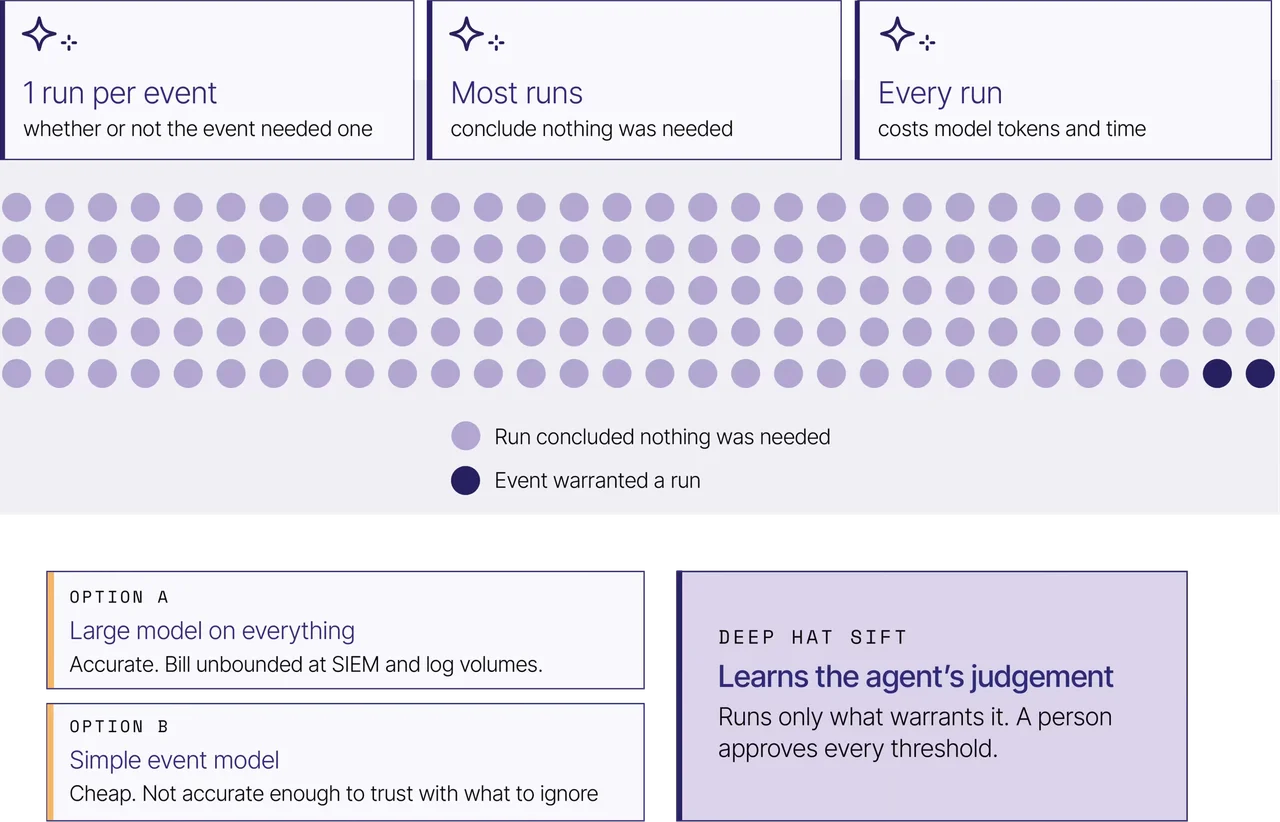
Kindo is taking aim at an expensive agent habit: paying a large model to conclude that nothing needs doing. The company announced Deep Hat Sift on October 28 as a model that sits ahead of an agent, learns which incoming events that agent dismisses, and can avoid starting those runs.
The launch targets high-volume streams such as security alerts, ticket queues, reported phishing and monitoring logs. Sift works with Kindo agents rather than replacing the SIEM, ticketing or logging system that produces the events. Kindo says it is available now on premises, in self-managed or Kindo cloud deployments, and in air-gapped environments.
Observe first, filter after approval
Sift initially operates in shadow mode: it scores events while the target agent still receives every one. The agent’s returned verdicts provide the learning signal. Operators then preview what Sift would withhold on their own events, and a person must approve the threshold with a written reason before filtering begins.
After activation, a random sample of otherwise withheld events still reaches the agent. Kindo says this supports continuing recall and miss-rate measurements, with drift or a breached activity ceiling returning the system to shadow mode. The crucial qualification is what those measurements mean: they compare Sift with the target agent’s judgments, not with an independent record of every real incident. Matching an agent does not establish that the agent itself is always correct.
A platform service with concrete limits
The product page describes local CPU scoring and one Kindo API key. Sources use the tenant’s existing integrations, and model calls go through Kindo on an administrator-selected model. Sift itself holds no model-provider keys; that does not establish that a chosen cloud model keeps all downstream processing local.
Kindo lists a single-host Docker Compose stack without clustering or failover, local accounts without SSO or MFA, and one tenant per installation. It is intended to operate behind a trusted perimeter. The company says Sift is included with its platform; the reviewed page provides no standalone usage tier or universal savings percentage.
The news is a different cost-control lever: deciding whether to run an agent at all. Actual savings and missed-event trade-offs will depend on the stream and the threshold. AITrending has not independently tested those outcomes.