Krea 2's community three-step LoRA gets a sharper new checkpoint
lvladikov's latest adapter offers a stock ComfyUI route from eight sampling steps to three, with downloadable comparison images and explicit tradeoffs.
Three steps, a normal LoRA loader, and a new checkpoint to try: community creator lvladikov has updated the Krea 2 Turbo three-step distillation adapter to chk00042000. The project started on October 28; the November 1 checkpoint is the new development, rather than a new launch of Krea’s base model.
The author positions it between an earlier four-step adapter, which stays closer to the eight-step teacher’s pictures, and a two-step version intended for fast previews. This is a community derivative, not an official Krea release or endorsement. Training is still continuing.
A practical ComfyUI route
The repository provides the same weights in diffusers and ComfyUI key formats, plus a stock-node ComfyUI workflow. Its recommended ComfyUI setup uses three steps, CFG 1, Euler/simple and LoRA strength 1.0. Users still need Krea 2 Turbo base weights, the Qwen3-VL 4B text encoder and Qwen Image VAE; the adapter alone is not a complete generator.
An optional Apple Silicon workflow uses the author’s LVNodes custom nodes and MLX. That is a separate installation route from the stock ComfyUI example. The two main weight filenames do not include the checkpoint number, so the accompanying checkpoint-info file matters when checking which release was downloaded.
What the speed claim measures
The author reports 2.6 times faster denoising, from 65.4 to 24.9 seconds at 1024 by 1024, in an Apple Silicon MLX comparison with float16 computation. Those figures exclude text encoding and VAE decoding. They are the author’s measurements, not an AITrending reproduction or a promise of the same end-to-end gain on another machine.
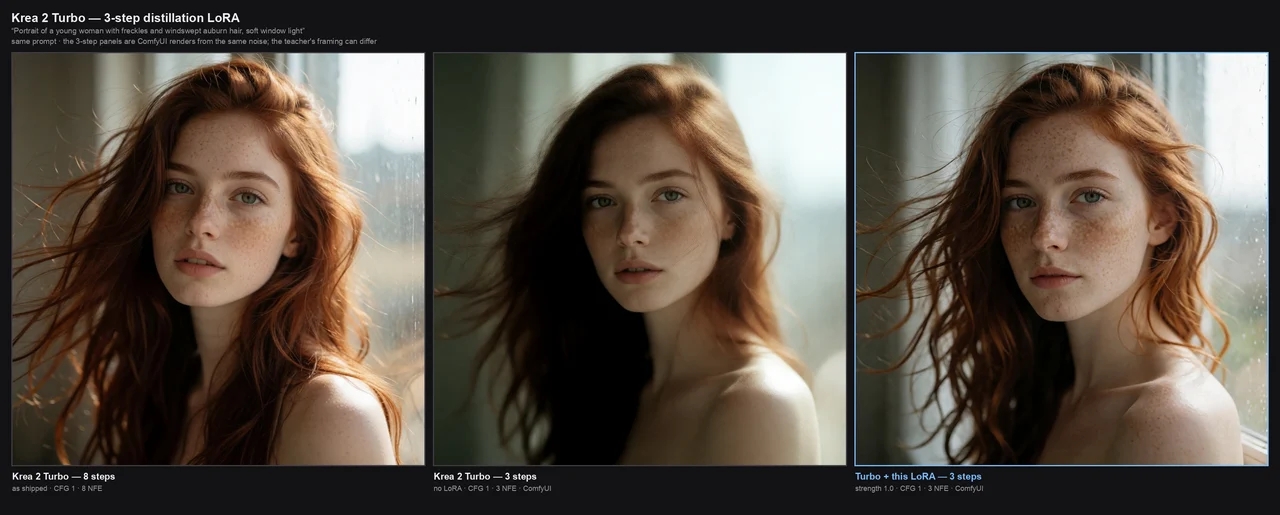
Published examples compare eight-step Turbo, three-step Turbo alone and three-step Turbo with the adapter. The two three-step panels use the same noise; the eight-step reference uses its own noise and is not a pixel-matched target. The card also warns of stronger grain, doubled fine edges, weak small faces and compositions that differ more from the teacher than the four-step adapter’s.
That makes this a concrete option for experimenting with fewer steps, with visible compromises to inspect. It remains a derivative under the Krea 2 Community License Agreement, including its commercial-use conditions and deployment obligations, rather than an unrestricted model release.