Wave Forcing gets a four-step video demo, with an eight-GPU speed catch
A new community Space puts released WaveForcing-1.3B weights into a single-GPU video demo. The authors' headline 134.8 fps belongs to a different, eight-H200 streaming runtime.
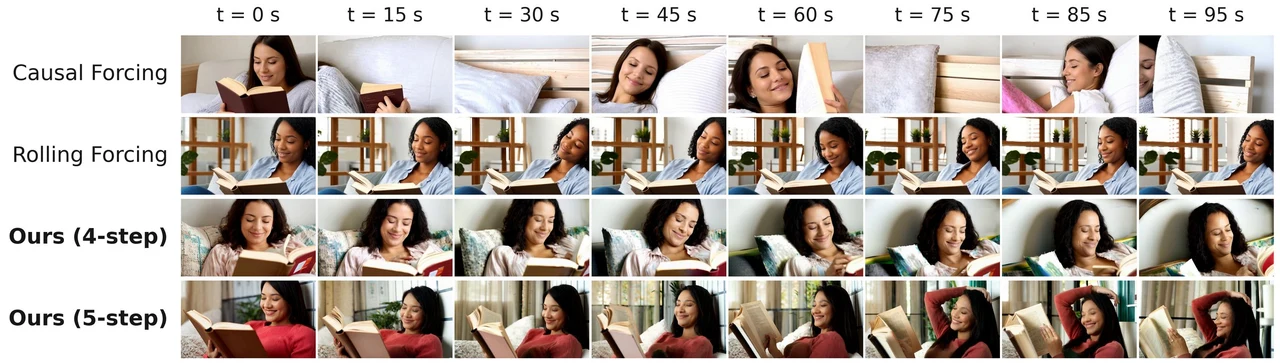
Wave Forcing now has a community browser demo for four- or five-step video generation, making its released 1.3B checkpoints easier to explore. Akhaliq created the Hugging Face Space on November 3 at 04:48:54 UTC. Its public implementation loads the authors’ distilled transformer weights into a Wan2.1 Diffusers pipeline and offers a prompt box, checkpoint selector, resolution controls and seed settings.
There is an important distinction behind the speed headline. The researchers report 134.8 end-to-end frames per second on eight H200 GPUs using their WaveRT streaming runtime. The new Space runs on a single ZeroGPU allocation and explicitly does not implement that multi-GPU wavefront pipeline. AITrending inspected the public code and Hugging Face’s running status; it has not independently generated a clip or measured its speed.
What you can try
The demo offers four-step and five-step variants, with landscape, portrait and square output choices. Its interface allows 17 to 81 frames and encodes playback at 16 fps, so the longest selectable output is roughly five seconds. That is a short-clip interface, not the authors’ separate 100-second streaming demonstration.
The transformer comes from SJTU-DENG-Lab’s released WaveForcing-1.3B checkpoints; the text encoder, tokenizer, VAE and base pipeline come from Wan2.1. The checkpoint card lists an Apache-2.0 license and supplies four-step and five-step weights. Loading the Space locally also requires its base components; the demo maintainer estimates an initial download of about 15 GB. Hosted access depends on Hugging Face’s available GPU allocation.
Why the research is drawing attention
The paper was submitted on October 31, rather than released for the first time today. Its authors introduced the project in an English Hugging Face discussion on November 3, alongside the new community demo. Their central idea is to begin denoising later video chunks before earlier ones have finished, using cleaner intermediate chunks as context. WaveRT overlaps work across model replicas and the video decoder so a filled pipeline can keep delivering chunks.
The authors’ 134.8 fps result uses the four-step 1.3B setup at 832 by 480 resolution. Their timing includes pipeline fill and drain and VAE decoding, but excludes model loading and video-file encoding. It is an author-reported benchmark, not a promised browser-demo frame rate. The project page’s 14B experiments use randomly initialized transformer weights to study system scaling; they are not evidence of a released, quality-tested 14B generator.
For people following practical video-generation workflows, the new hook is access to a small, inspectable few-step demo and downloadable weights. The compelling long-video and throughput claims remain attached to the authors’ own experiments, with hardware and runtime requirements that differ substantially from the community Space.