Local AI gets a control room: Lemonade rebuilds its desktop and web UI
Version 2026.45.3 brings a new model manager, visual routing-policy editor and mobile web interface, alongside HTTP behavior changes that client developers should check.
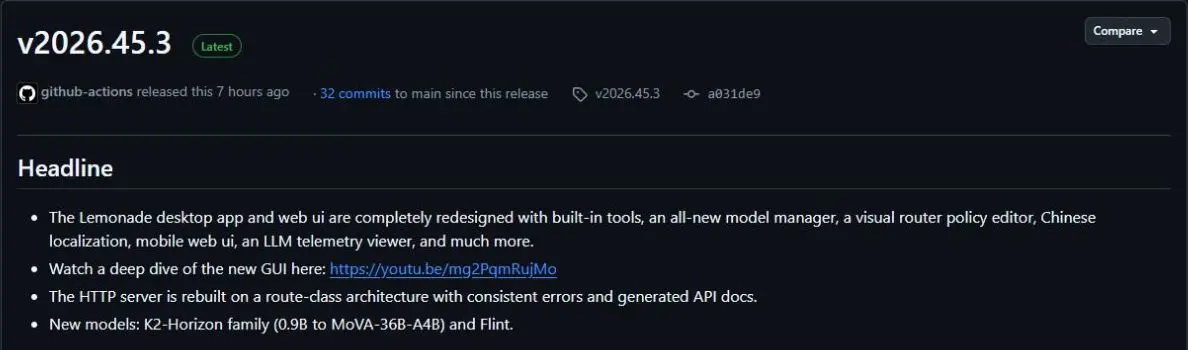
Lemonade is giving local AI users a new place to manage models and routing, with a complete desktop and web-interface redesign in version 2026.45.3. The community project’s November 4 release lists built-in tools, a new model manager, a visual routing-policy editor, a mobile web interface and an LLM telemetry viewer.
The practical hook is bringing model selection, routing configuration and monitoring into the same local stack. These are the maintainers’ documented release features; AITrending has read the original English notes and integration guides but has not benchmarked or independently exercised the new interface.
Lemonade is a local inference server and application layer, with community development and AMD sponsorship. It exposes OpenAI-, Anthropic- and Ollama-compatible APIs for other applications. It is not a new model, and compatibility endpoints do not imply that every hosted provider feature is reproduced.
A coding-agent route is already documented
The versioned Claude Code guide documents lemonade launch claude, which configures Anthropic’s coding harness to use the local server. Its interactive flow can select downloaded models, browse recommended models or import a recipe; a --model argument goes directly to the chosen model. Claude Code and the local model remain separate components, and the model’s actual tool-use quality still matters.
The release provides a Windows MSI, a macOS package and Linux installation options, including Ubuntu, Debian and Fedora. Embeddable binaries are also listed for applications that want to bundle the server. Hardware and backend support vary, so the project recommends lemonade backends to inspect the options supported on a particular machine.
Lemonade’s software uses Apache 2.0, with component-specific notices. Local inference uses the user’s hardware rather than buying a hosted model subscription; downloaded weights retain their own license conditions. The API reference supports a configured LEMONADE_API_KEY. Model downloads and registry lookups can contact external services, so local inference should not be mistaken for a promise of zero network activity during setup.
Client integrations have changes to check
The HTTP server has also been rebuilt, and the release explicitly flags behavior changes. GET requests to listed POST-only paths now return 405 instead of 404. Missing model fields use a consistent error across model routes, while invalid field types in form-encoded requests return 400 instead of 500.
For existing clients, those error contracts are as relevant as the new interface: code that interprets the old status codes should be reviewed when upgrading. The release also adds K2-Horizon catalog entries and Flint, without establishing that every model runs on every supported device.
Related reading
Four Sparks, one huge GLM: a community kit tackles a silent serving stall
Take your Codex chat to another model: aichat adds provider porting