Is that llama.cpp PR actually faster? LlamaForge adds a one-click reality check
Version 0.18.27 benchmarks the same GGUF on your current engine and a pull-request build, and marks small differences as within noise.
A pull request promises faster local inference. LlamaForge now gives you a button to measure it on your own machine. Version 0.18.27, released November 3 at 22:01 UTC, adds Compare speed to the dashboard’s llama.cpp pull-request build workflow.
The project’s documented procedure runs llama-bench against the same model file with the user’s current build, then the selected PR build. Both use the model’s same GPU settings. Other loaded models are unloaded for the comparison and loaded again afterward.
A speed claim you can inspect
The comparison measures prompt processing with pp512 and generation with tg128, with three runs each. The resulting card shows both speeds, llama-bench’s reported spread and the percentage change. A difference smaller than the two spreads added together is labeled within noise, rather than presented as a clear win.
The table can be copied as Markdown for a PR discussion. That is a useful community workflow: a tester can contribute hardware-specific evidence instead of extrapolating from somebody else’s GPU. AITrending has reviewed the release and documentation, but has not run this comparison or established a speedup for any particular patch.
Build the patch, keep your regular engine
The preceding PR-build workflow accepts a number or link for a pull request on ggml-org/llama.cpp. According to the tagged guide, it fetches a fixed commit into temporary sources and builds llama-server and llama-bench beside the user’s other engines. A changed upstream PR commit requires a new lookup. The PR build does not automatically replace the router’s build.
Building requires Git, CMake and a C++ compiler. LlamaForge itself uses Python 3.10 or later and supplies installers for Windows, Linux and Apple Silicon macOS. Windows with NVIDIA is its most tested path; the author describes Linux and macOS as having less real-hardware use.
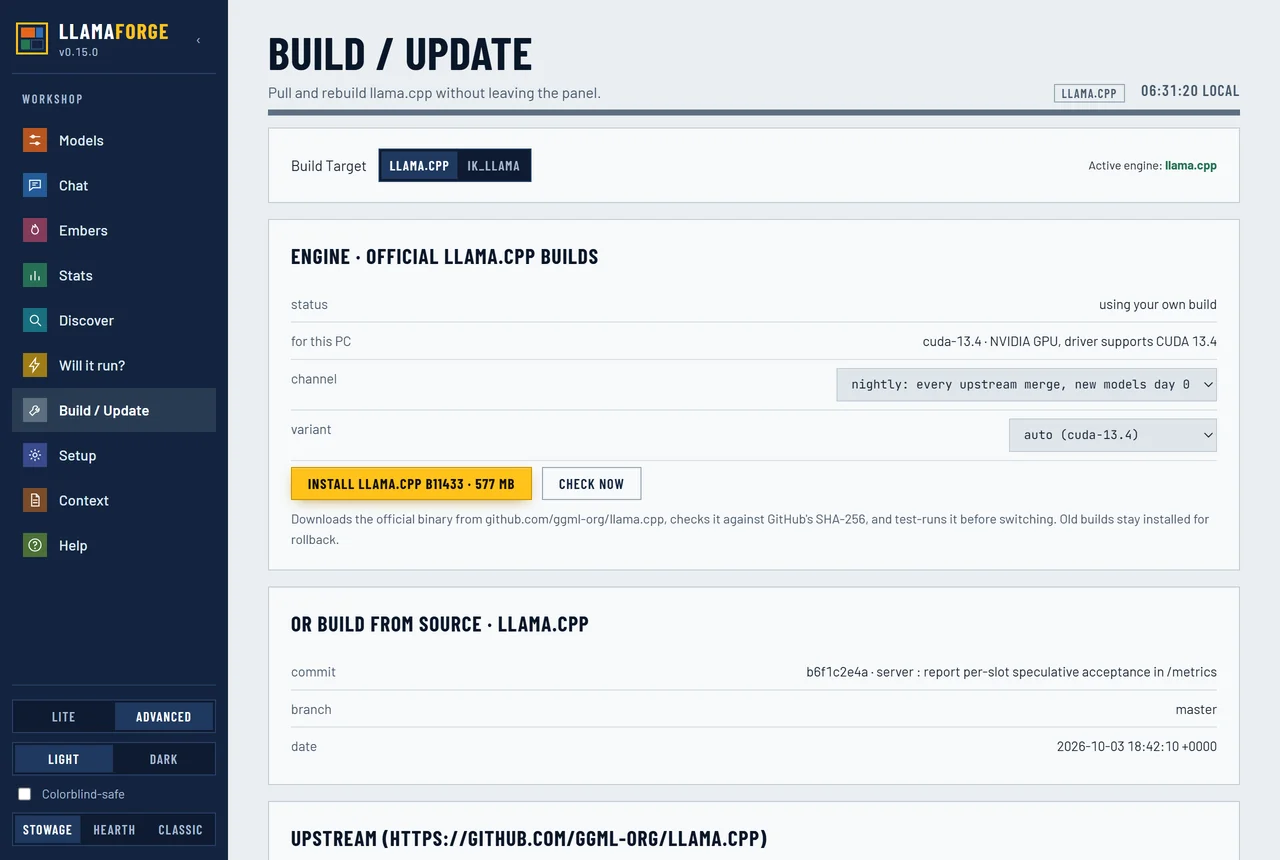
LlamaForge is a standalone dashboard over upstream llama.cpp, with client configuration and coding-agent connections. The documented comparison uses local model files and compute, with no hosted inference credential required for that operation. Its dashboard listens on localhost by default, and the local router uses an API key. The included older Build / Update screenshot illustrates the engine-management area; it does not show the newly released comparison controls.
Related reading
context-guru wants to stop paying for tools your agent never uses
620 tokens a second in Chrome? webyIQ puts a tiny Qwen model on your GPU