LoCo-7B learns when to stop thinking, reporting 45% fewer math tokens
The released DeepSeek-derived model uses math-only preference training to shorten reasoning, with author-reported gains transferring to code.
A reasoning model does not always need another page of self-checking. LoCo-7B tries to learn where enough thinking is enough. Its researchers report 41.7–45.4% fewer completion tokens across five mathematics benchmarks and 23.4–36.3% fewer across three code benchmarks, following training built entirely from mathematical reasoning traces.
The paper, Think Less, Locally, was submitted to arXiv on November 3 at 12:44:50 UTC. The released model is a fine-tuned version of DeepSeek-R1-Distill-Qwen-7B. By November 4, its Hugging Face repository contained four Safetensors weight shards, and the authors’ GitHub repository provided data-construction, training and evaluation code. On November 4’s Hugging Face paper page, co-author Liyan Xu announced the available model and answered a reader’s question about stopping too early.
Teach the stopping decision, rather than impose a shorter cap
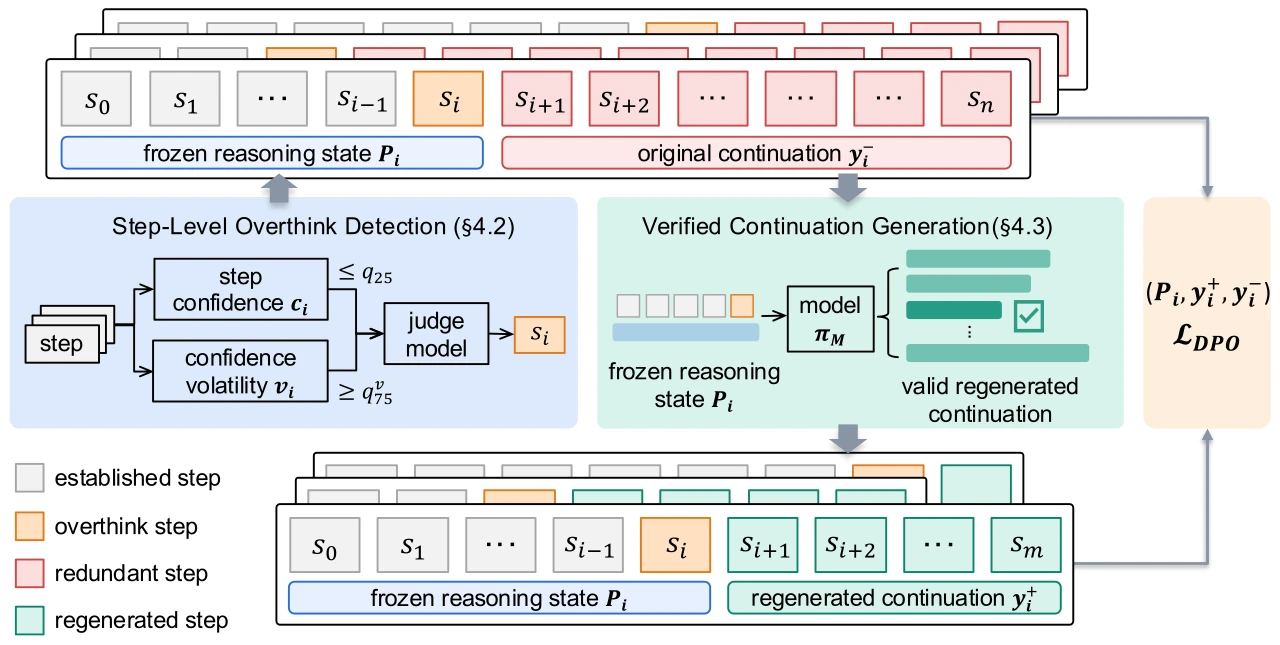
LoCo identifies possible overthinking points in the model’s own traces, checks them with a judge model, then freezes the reasoning prefix at each selected point. It generates alternative continuations and pairs a shorter answer-verified continuation against the original. Preference training teaches the model which continuation to favor from that particular reasoning state.
Here, “local” means an intermediate state within a reasoning trace. It does not mean that the method itself is a consumer-device deployment package.
The practical hook is transfer: training uses math traces, yet the authors also report shorter code completions. On AIME24, their table shows average completion length falling from 13,493 to 7,364 tokens while accuracy rises from 50.83% to 54.17%. On sanitized MBPP, accuracy remains 84.05% as average length falls from 3,403 to 2,167 tokens.
These are author-run experiments, not an AITrending reproduction. Accuracy does not improve in every row: MATH500 moves slightly from 91.88% to 91.80%. The reported token reductions also do not establish equivalent savings in elapsed time, electricity or serving costs.
Weights to try, with a verification question still worth asking
The English model card supplies a vLLM example using BF16 weights. The implementation README recommends Python 3.12 and CUDA 12.8 and documents its dependencies and evaluation commands. The card labels the model MIT; users still need suitable inference hardware and the associated dependencies. The reviewed material does not establish a consumer-GPU memory requirement.
A reader on Hugging Face asked whether compression could remove useful verification. Xu replied that the aim is to reduce redundant checking after sufficiently confident reasoning while retaining necessary verification. That is the author’s explanation of the learned behavior, rather than a guarantee for arbitrary tasks. The paper’s math and code evaluations give a bounded reason to experiment; they do not establish reliability for general tool-using agents or every task where a final check matters.
Related reading
Take your Codex chat to another model: aichat adds provider porting
A 1.1 GB Q4 option arrives for LFM3-Omni refusal-ablation research