Mistral releases Timestral, a forecasting model family that runs on CPUs
Four downloadable models span 5M to 209M parameters. Mistral claims leading zero-shot forecasting results, while the weights carry a revenue-based license restriction.
A small model family for numerical forecasts
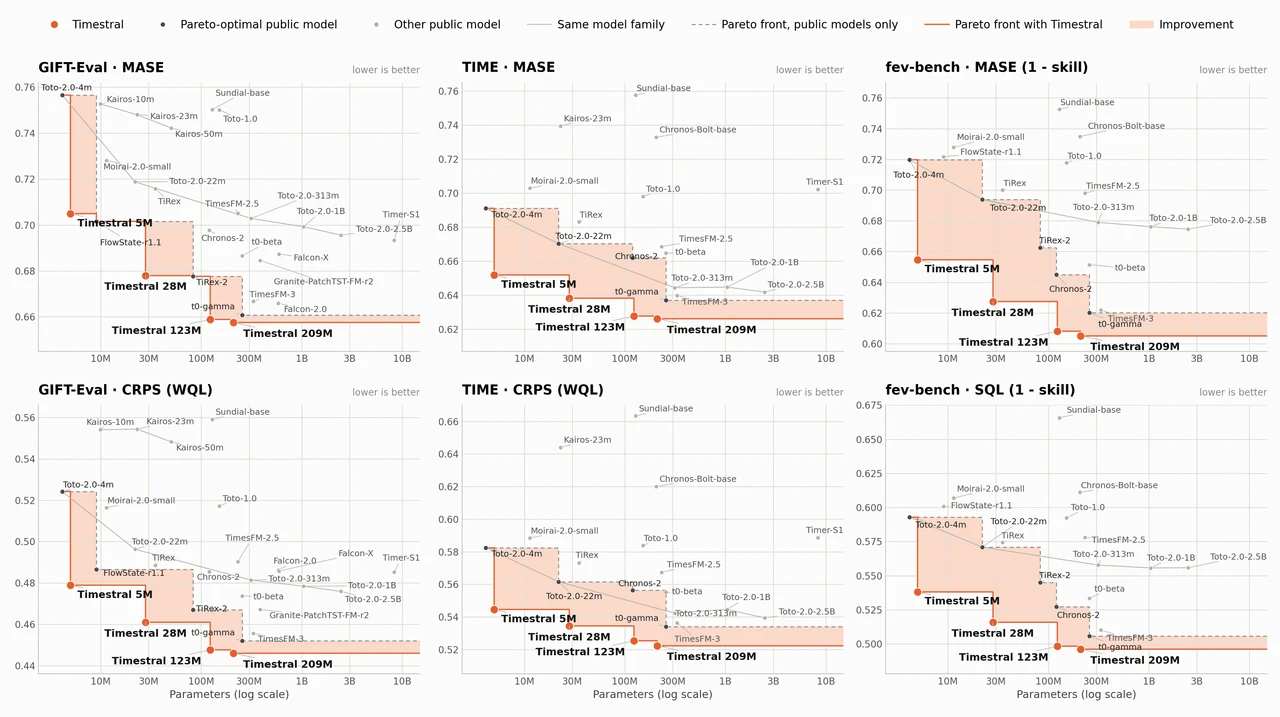
Mistral released Timestral on October 15, introducing four time-series foundation models with 5M, 28M, 123M and 209M parameters. The company says the largest checkpoint leads pretrained, zero-shot models on GIFT-Eval, TIME and fev-bench. Those are Mistral’s reported comparisons; AITrending has not rerun the evaluations.
The practical hook is forecasting without a GPU requirement. The public inference package runs with PyTorch on a CPU or GPU and downloads weights from Hugging Face. This is a numerical forecasting model, rather than a conversational assistant: developers supply historical observations and receive probabilistic predictions.
Timestral supports related series forecast together, past-only inputs and known-future inputs such as schedules. Its model card specifies up to 32,768 historical time steps, 21 output quantiles and up to 1,024 forecast steps in one forward pass. Longer horizons are produced block by block, feeding each block’s median back into the context.
Downloadable weights have a commercial boundary
The inference code is Apache-2.0, but the weights have a separate Modified MIT license. That distinction changes who can use them under the public grant. The weights license excludes a company, or the user’s employer, whose global consolidated revenue exceeded $20 million in the preceding month. Mistral directs organizations above that threshold to request a commercial license or use its hosted services.
Developers can install the inference package from Mistral’s GitHub repository. The documented requirements are Python 3.10 or later and PyTorch 2.4 or later. After downloading a checkpoint, the loader can use cached local files without network access. That provides a concrete route for local forecasting experiments, subject to the weights license.
Benchmark leadership is the launch claim
Mistral describes synthetic pretraining followed by training on real and synthetic data with a longer context. It also promotes CPU latency measurements and fine-tuning through Mistral Forge. These are vendor descriptions and measurements, not independently established production outcomes.
The company says a technical report will follow. For now, the supported development is a new downloadable forecasting family, source code for running it, and clearly different licensing for the code and weights. The announcement’s industrial agent workflow is an illustrative integration, not evidence that downloading Timestral supplies a complete autonomous maintenance system.
Related reading