Momentic says Mo found 3.1x as many bugs as Codex
A new first-party benchmark pits Mo against coding agents on 1,396 labeled web-app bugs. Mo leads recall, while Codex is cheaper and more precise in the headline comparison.
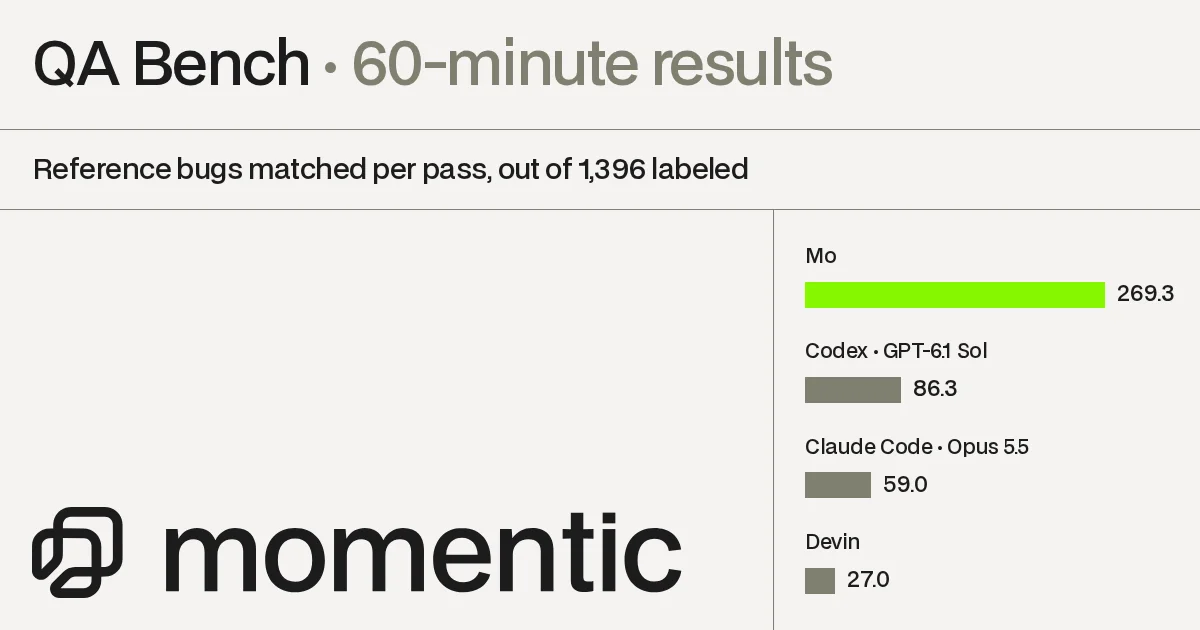
Momentic says its Mo QA agent found 3.1 times as many labeled bugs as the best Codex configuration in its new QA Bench, but at more than three times the cost per matched bug. The November 2 release makes the tradeoff unusually concrete: more coverage, rather than a clean sweep on accuracy or price.
The company’s benchmark covers 1,396 human-reviewed bug labels across 20 areas of Gitea, Metabase, Twenty and Saleor. In its 60-minute condition, Mo averaged 269.3 matched bugs per pass through the suite, or 19.3% recall. Codex with GPT-6.1 Sol and Playwright MCP averaged 86.3 matches, while Claude Code with Opus 5.5 and Playwright MCP averaged 59.0.
Those are averages across product areas and repeated runs, not 269 bugs found in one application’s one-hour session. Most configurations ran three times per area; Devin ran once. Even Mo left roughly four-fifths of the labeled bugs unfound on an average pass.
More bugs, more spend
Momentic reports 84.2% precision for Mo, compared with 86.0% for the headline Codex configuration. Mo’s cost was $2.67 per matched bug against Codex’s $0.80. The report puts Mo’s average total spend per pass across the suite at $719, versus $69 for that Codex configuration. Equal time limits did not mean equal compute or spending.
This is Momentic’s own evaluation: it built Mo, designed the benchmark, ran it and graded the findings. Candidate labels originated in agent bug bashes, including Mo’s; reports from scored runs could also expand the reviewed reference set. A GPT-6.1 Sol judge matched findings, with human review. These choices can influence the results, which AITrending has not independently reproduced.
The published methodology also discloses web-access exceptions: Codex search remained enabled, and some agent-browser runs had shell web access. The results therefore should not be described as a uniformly network-isolated contest. Costs exclude fixture hosting and grading, and the report provides no error bars.
What developers can actually try
Mo tests a running application through hosted browsers or remote mobile devices. Users supply a target, expected behavior, test accounts and prohibited actions. The documentation says a separate agent reproduces suspected functional bugs from a clean start; static issues can use a screenshot. Repositories provide read-only context, and Mo does not start the application from a checkout or write Momentic regression-test files.
The documented npm launcher is qa, with macOS, Linux and Windows x64 support and specified modern Node.js requirements. Users sign in with a Momentic account that has Mo access, or supply a Momentic API key for automation. The optional mo-qa skill connects a coding agent to the hosted service; it is not a replacement model running locally. Local or private apps need a tunnel, and mobile testing requires separate workspace access and an uploaded build.
The founders offered new signups $250 in Mo spend in their launch post. That is an attributed launch offer, not a promise of unlimited free testing or a price implied by the benchmark. Shared accounts and backend data still need isolation rules even when agents use separate browsers.
The new event is QA Bench and the current availability update. Mo’s original launch was September 28. The useful question now is whether its extra coverage justifies the additional spend on a team’s own application, rather than whether this first-party table proves one agent universally better.
Related reading
OmO tells its architect to fix the code, and rolls back higher reasoning defaults