Mosaic reports better web research with fewer agent sessions
An October 15 preprint trains a Qwen3.5-4B agent across context compaction and subagent forks, reporting higher BrowseComp accuracy with fewer sessions than a broadcasting baseline.
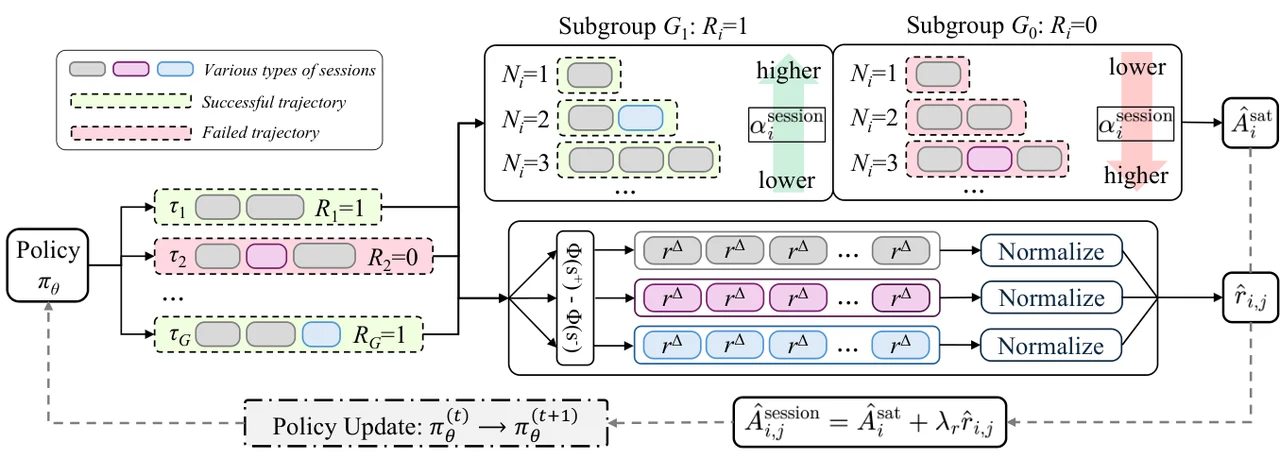
More agent sessions are not automatically better. Mosaic’s authors report that a small web-research agent can answer more questions correctly while using fewer sessions, if its training learns which sessions actually help. Their October 15 preprint targets a familiar mismatch: modern agents compact context or fork subagents, while many reinforcement learning methods assume one continuously accumulated conversation.
Mosaic treats those separate contexts as parts of one task. Instead of giving every session the same learning signal from the final result, it adjusts the overall signal using session counts and adds an estimate of each session’s contribution. That estimate uses changes in the model’s likelihood of the correct answer during training, with separate normalization for different session types. It does not give the agent the correct answer at inference time.
The reported improvement
In the paper’s Qwen3.5-4B BrowseComp experiments, Mosaic reaches 38.86% accuracy with context compaction, compared with 35.31% for the multi-session broadcasting baseline. Average session count falls from 3.17 to 2.35. With subagent forking, the reported accuracy moves from 31.44% to 32.46%, while average sessions fall from 4.43 to 3.77.
These are the authors’ results, not AITrending measurements. The smaller improvement with subagents matters: the paper says branching sessions make it harder to estimate a session’s contribution to the final outcome. Session count is also only a proxy for execution cost, so fewer sessions do not establish an equivalent percentage reduction in tokens, latency or a user’s bill.
The experiments use a ReAct-style agent with Serper search and Jina Reader page access, a 128K-token limit per session and 1,000 deep-search training tasks from REDSearcher. DeepSeek-V4-Flash serves as the answer judge; Qwen3.5-4B is the agent being trained. The paper’s results should be read within that benchmark and tool setup.
Training research, not an installed harness upgrade
The practical idea is to train for the way agents already work: preserving useful state through compaction and returning useful results from delegated tasks. The researchers identify open training data, asynchronous rollouts and transfers across session boundaries as continuing challenges.
Their discussion names partially opaque harnesses such as Claude Code as a future research direction. It does not demonstrate that installing Mosaic upgrades Claude Code or Codex, or that every production agent becomes more reliable. What is newly available is a specific training method and a documented comparison that other researchers can investigate.
Related reading
rStation wants your spare AI agents to join a public research lab
FDE-Gym's best tested agent resolves just 14 of 95 customer tasks