MOSS-Image-SFT gets a 4-bit Apple Silicon port
A community MLX conversion offers three precisions through a mflux fork; the smallest image Transformer is listed at 2.66GB, with slower reported steps.
Mac users have a new community route to MOSS-Image-SFT: an Apple MLX port with BF16, 8-bit and 4-bit weights. Contributor vanch007 opened the mflux implementation proposal on October 17 and published the 4-bit Hugging Face repository on October 18. This is an Apple Silicon workflow for SFT, distinct from the separate MOSS-Image-Base eight-step LoRA project.
The English card describes a 42-layer image Transformer, a Qwen 3.5 text encoder and a FLUX.2 Small VAE. Its advertised 2.66GB 4-bit figure refers to the Transformer. It does not mean the whole pipeline runs within that much unified memory; text conditioning, decoding and runtime allocations still matter.
Smaller does not mean faster
In the contributor’s Apple M3 Max comparison at 1024-square resolution, BF16 is listed at roughly 13.9 seconds per step, 8-bit at 17.1 seconds and 4-bit at 20.9 seconds. Those are per-step author measurements, not complete-image timings or AITrending benchmarks. Quantization is being pitched as a memory tradeoff, not an automatic acceleration.
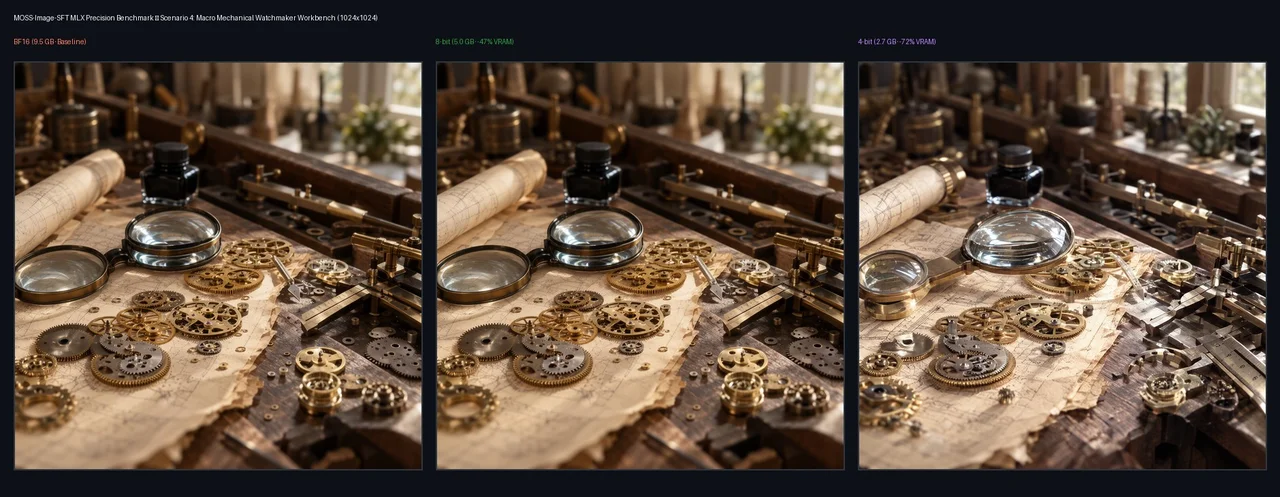
The card recommends 8-bit for everyday production and presents 4-bit as an option for 16GB unified-memory machines. Its precision comparison images are author-generated examples. The supplied fidelity percentages do not establish broad quality parity, so the samples are more useful as something readers can inspect than as a universal accuracy score.
Use the fork, check the status
At review time, upstream mflux pull request 895 remained open and unmerged. The documented installation clones vanch007/mflux on the feature/moss-image-sft branch and installs it with pip install -e .; users should not assume a normal mflux release already includes the port. The sample command uses mflux-generate-moss-image with the Hugging Face checkpoint, 12 steps and guidance 3.0.
The model card labels the conversion Apache-2.0. The documented workflow loads weights for local Apple Silicon generation rather than requiring a paid cloud image endpoint. AITrending reviewed the English card and implementation proposal without installing or running the fork. The news is an accessible community conversion and a concrete installation path, with upstream integration still pending.
Related reading
MOSS-Image-Base gets an eight-step community checkpoint and a simple LoRA route
Flare packages Qwen Flash Next for a single 96 GB Blackwell GPU