SimpleTuner opens its MOSS-Image LoRA lab, checkpoints included
A public experiment journal supplies recipes, adapter sequences and validation previews for comparing MOSS-Image Base and SFT, while separating completed runs from work still queued.
Inspect the training path, not just a final adapter
SimpleTuner has published a MOSS-Image LoRA experiment journal with downloadable checkpoints, training recipes and validation previews, giving image-model tinkerers a way to inspect how a small concept-training run develops. The October 17 repositories compare the existing MOSS-Image Base and SFT checkpoints at two resolutions; they do not announce a new upstream foundation model.
The reviewed journal snapshot lists the original-caption Base-512 and SFT-512 runs as completed at 10,000 optimizer updates. Each completed run publishes 20 adapter checkpoints, spaced 500 updates apart, with validation previews. The Base-512 card links the final adapter and the preceding sequence, so readers can examine intermediate outputs instead of relying only on a selected final image.
The protocol uses the same 29-image Domokun dataset revision and original filename captions for the initial four runs. It specifies rank-32 BF16 LoRA, batch four, learning rate 0.0001, seed 42 and REPA, with one H100 80GB per run. Resolution means equivalent image area while preserving aspect ratios, rather than forcing every training image into a square. These are the author’s recorded settings, not AITrending’s reproduction or a claim that an H100 is the minimum hardware requirement.
A live journal, with unfinished comparisons clearly marked
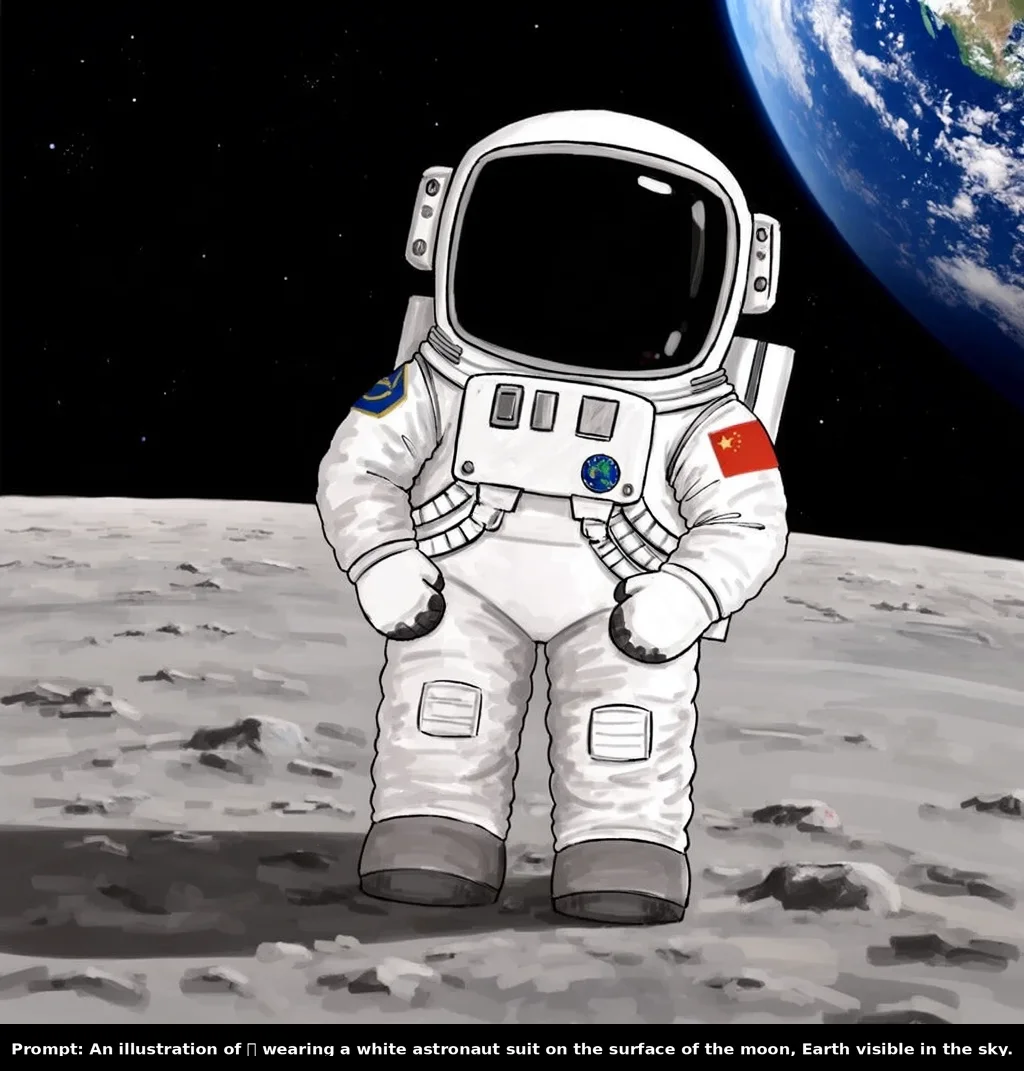
At the pinned 17:08 UTC snapshot, the two 1024px runs were still training: 6,000 updates observed, with the latest published adapters at 5,500. The illustrated astronaut validation is from that intermediate SFT-1024 checkpoint. It is a generated experiment output with the author’s prompt strip preserved, not evidence that the target concept has been learned successfully.
Two further 512px runs using vision-grounded JSON captions were queued, with no published adapter in the snapshot. The journal says those captions use Qwen3.5-27B and must pass schema, bounding-box, concept-token and tokenizer-length checks. A queued comparison cannot establish that JSON captions outperform the originals.
The repository cards declare Apache-2.0 licensing and provide configuration files, prompts and a dataset manifest; they say dataset images are not redistributed there. For readers evaluating MOSS fine-tuning, the useful release is the inspectable experiment trail. It supports comparing recipes and checkpoints, while leaving the eventual Base-versus-SFT and captioning conclusions open.
Related reading

MOSS-Image gets a four-step Turbo demo with an 11-second claim
DeepSeek claims a big coding jump from its minor Flash 1017 update