DeepSeek claims a big coding jump from its minor Flash 1017 update
The October 17 checkpoint ships with MIT-licensed weights, higher author-reported coding scores and a recommendation to update the harness alongside the model.
Storyline / Report 2 of 2
DeepSeek V4.1 Flash distribution and October 17 checkpoint update
Full timeline 2 reports
- Source-backedDeepSeek V4.1 Flash crossed 500k Hub downloads
- Source-backedDeepSeek claims a big coding jump from its minor Flash 1017 update (current report)
A minor update with a larger coding claim
DeepSeek has released V4.1 Flash 1017, reporting a Terminal-Bench 4.0 score of 42.3 versus 31.2 for the previous Flash checkpoint. Its October 17 announcement says the update is live on the website, app and API, with model weights available separately on Hugging Face.
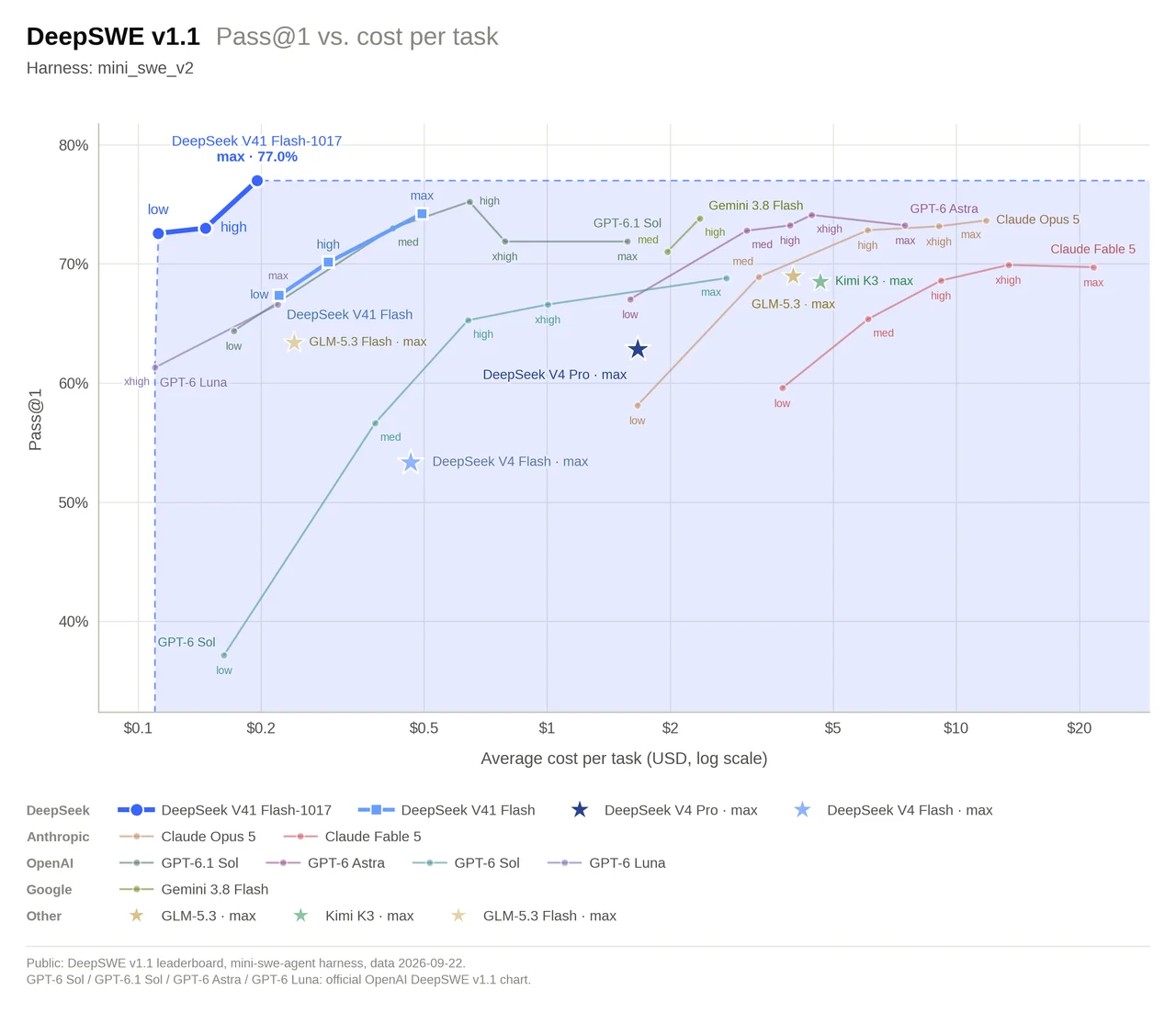
The model card calls it a minor update while claiming improvements in reasoning, coding, agent tasks and vision, alongside shorter outputs and faster task completion. Those performance claims are DeepSeek’s, not independently reproduced AITrending results. Its table also reports DeepSWE v1.1 at 77.0 versus 74.2 and ProgramBench at 29.1 versus 20.3 for the preceding Flash version.
The testing setup matters. DeepSeek says Terminal-Bench 4.0 uses the Claude Code harness and DeepSWE v1.1 uses Mini-SWE-V2. Its separate performance-versus-cost chart combines the company’s results with public comparison data; it should not be read as a controlled, identical-configuration test of every displayed model. The figures support reporting a specific claimed improvement, not declaring a universal coding winner.
Update the runtime path too
DeepSeek recommends Harness v0.2.1-rc.1 or later for the new model. Its announcement promotes end-to-end project creation, including games and 3D scenes, using reinforcement learning with self-feedback. The published examples are the developer’s demonstrations, not evidence that arbitrary complete projects will work without review.
For self-hosting, the repository and weights carry the MIT license. The card lists a one-million-token context window and recommends a maximum output setting of at least 256,000 tokens; those settings do not guarantee useful performance at every context length. The minimal inference directory explicitly describes itself as a readable reference implementation rather than a production serving engine. Its example converts weights for eight tensor-parallel ranks, without establishing a consumer-GPU memory requirement.
There is also no Jinja-format chat template in this release. DeepSeek supplies a Python prompt encoder and points to its Rust-based deepseek-recipe toolkit for request conversion, encoding and output parsing. That toolkit leaves inference, tool execution and HTTP transport to its caller. For developers evaluating the upgrade, selecting the checkpoint is only one part of the integration: prompt formatting and the surrounding agent harness remain part of the result.