SCOPE trains better image prompts without retraining the generator
Researchers report average relative gains of 9.48% on GenEval and 7.62% on T2I-CompBench over vanilla GRPO by training a prompt rewriter. Public code is available, but the documented setup is substantial.
SCOPE aims to fix awkward image composition by training the prompt rewriter while leaving the image generator untouched. In an October 15 preprint, Yufei Jiao, Jinfa Huang and collaborators report average relative improvements of 9.48% on GenEval and 7.62% on T2I-CompBench over vanilla GRPO, across their evaluated generators.
The practical hook is familiar: an image model can recognize the objects in a prompt yet miss their number, color or arrangement. SCOPE changes how reinforcement learning credits the language model that rewrites that prompt, rather than updating the image generator itself.
Give phrases shared credit
The researchers train a Qwen3-8B rewriter to produce an expanded prompt and semantic spans covering objects, counts, attributes and relations. Instead of treating each subword as an unrelated update, SCOPE pools policy log-probability shifts within a span and assigns a shared weight to its tokens. The completion still receives one overall advantage.
In the default eight-member rollout group, seven members are rewritten prompts and the eighth is the original. The original receives a score as a reference but is excluded from the rewriter’s parameter update. Images within a training group share a rendering seed; evaluation uses fresh seeds.
The span-credit calculation reuses the images and rewards already generated for training. It does not require extra rendering specifically for span credit. That is a narrower claim than training without rendering costs: the pipeline still generates and evaluates images.
Reported gains have boundaries
The paper evaluates Qwen-Image, Stable Diffusion 3 and FLUX.1-dev. Reported GenEval overall scores rise from 0.91 to 0.95, 0.74 to 0.84 and 0.76 to 0.84, respectively, compared with vanilla GRPO. The headline percentages are average relative gains, not percentage-point increases.
Counting and spatial relations show useful improvements, but the results do not improve every category: Qwen-Image’s color score slips from 0.94 to 0.93. The evaluation sets are separate from the training prompts. These remain author-reported research results; AITrending has not reproduced the experiments.
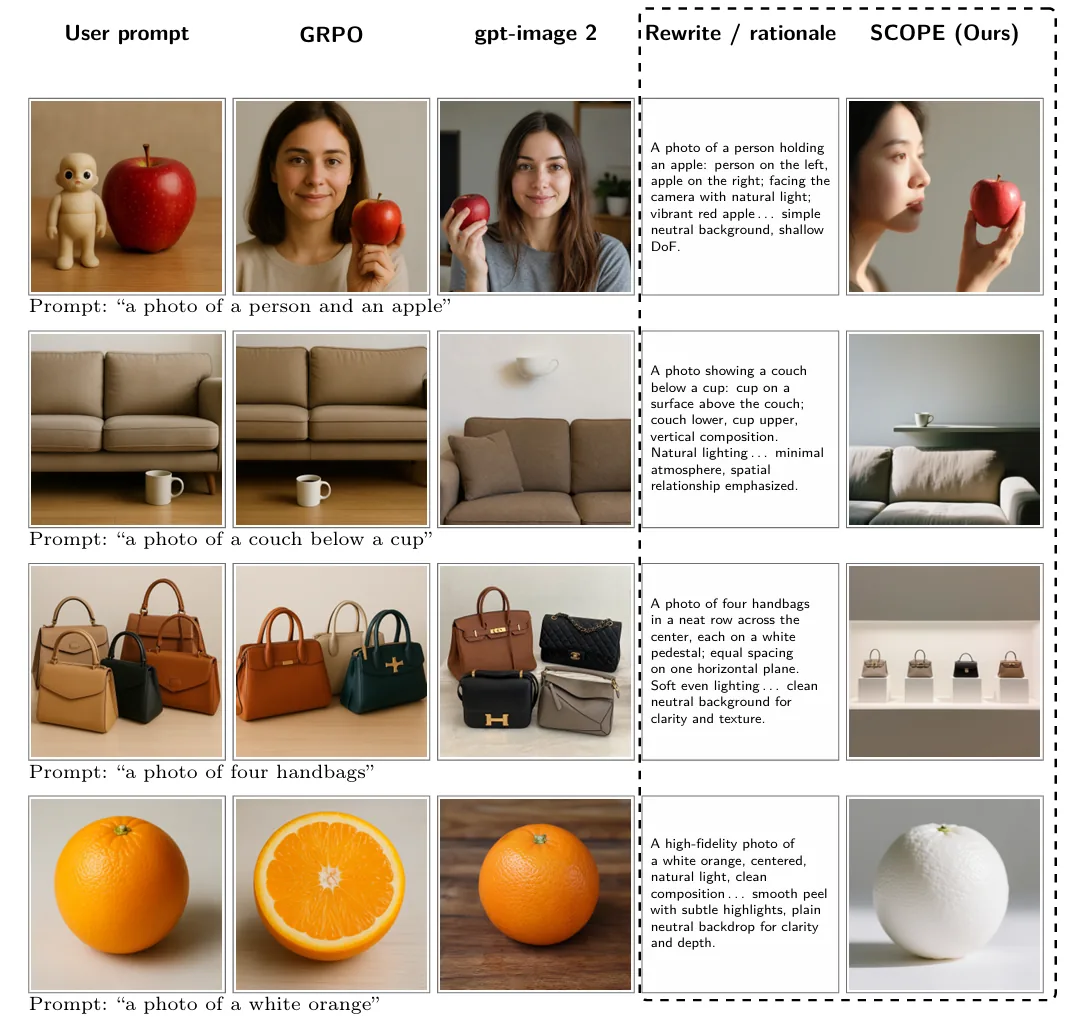
The authors’ generated examples show prompts such as four handbags, a cup above a couch and a white orange. Their selected comparisons include gpt-image 2, but those examples do not establish an overall benchmark win over that commercial model. The accompanying visual is an author-published comparison, rather than an independent test.
Public training code, substantial setup
The English repository documents Linux x86_64, NVIDIA GPUs and Python 3.10, with separate environments for training, image generation and GenEval. Local weights include Qwen3-8B, Qwen-Image, Mask2Former and CLIP. Its example distributed launcher uses eight nodes with eight GPUs each, split across the trainer, image servers and evaluator. That is the documented configuration, not a proven minimum hardware requirement.
The README does not link a ready-trained SCOPE rewriter checkpoint, so this is currently a research training workflow rather than a ready-to-install prompt-enhancement app. A repository-wide license was not established at review; public code access and upstream benchmark licenses alone do not establish unrestricted reuse rights.
Related reading
Meta's 816B Muse Spark Open fits a 512GB Mac with a 304GB GGUF

PortOS adds shot-by-shot rendering to its AI music-video studio