Meta's 816B Muse Spark Open fits a 512GB Mac with a 304GB GGUF
Hugging Face reports 18 tokens per second for a two-bit quantization on an M3 Ultra. Meta's new open-weight model takes multimodal inputs, but the memory bill and custom license remain substantial.
An 816B model, with a real local route
Meta’s Muse Spark Open is an 816-billion-parameter mixture-of-experts model built for coding, tool use and agentic work. Released on October 15, it now has a particularly concrete local-inference hook: Hugging Face says an imatrix-calibrated two-bit quantization ran at 18 tokens per second on an M3 Ultra with 512GB of unified memory, using 304GB for the model.
That is Hugging Face’s reported test, not an AITrending benchmark or a promise for an ordinary laptop. Roughly 42 billion parameters activate per token, but the rest of the experts still need to reside in memory. A smaller active count does not turn this into a 42B-sized download.
The ggml-org model card lists Q2_K at 304GB, Q4_K_S at 470GB and Q8_0 at 872GB, plus separate perception-encoder files. Its documented llama.cpp launch command is:
llama serve -hf ggml-org/Muse-Spark-Open-816B-A42B-GGUF:Q2_KUsers need a llama.cpp build supporting the architecture, enough storage and memory, and compliance with the model’s terms. The command identifies a published route; AITrending has not installed or tested it.
Multimodal input, text output
Meta describes text, image, audio and video inputs, text output and a context window of up to one million tokens. Runtime support differs: the Hugging Face guide’s vLLM reference supports text and images, while its SGLang integration supports all four input types. A maximum context specification also does not mean that every quantized local setup can fit the maximum-length cache.
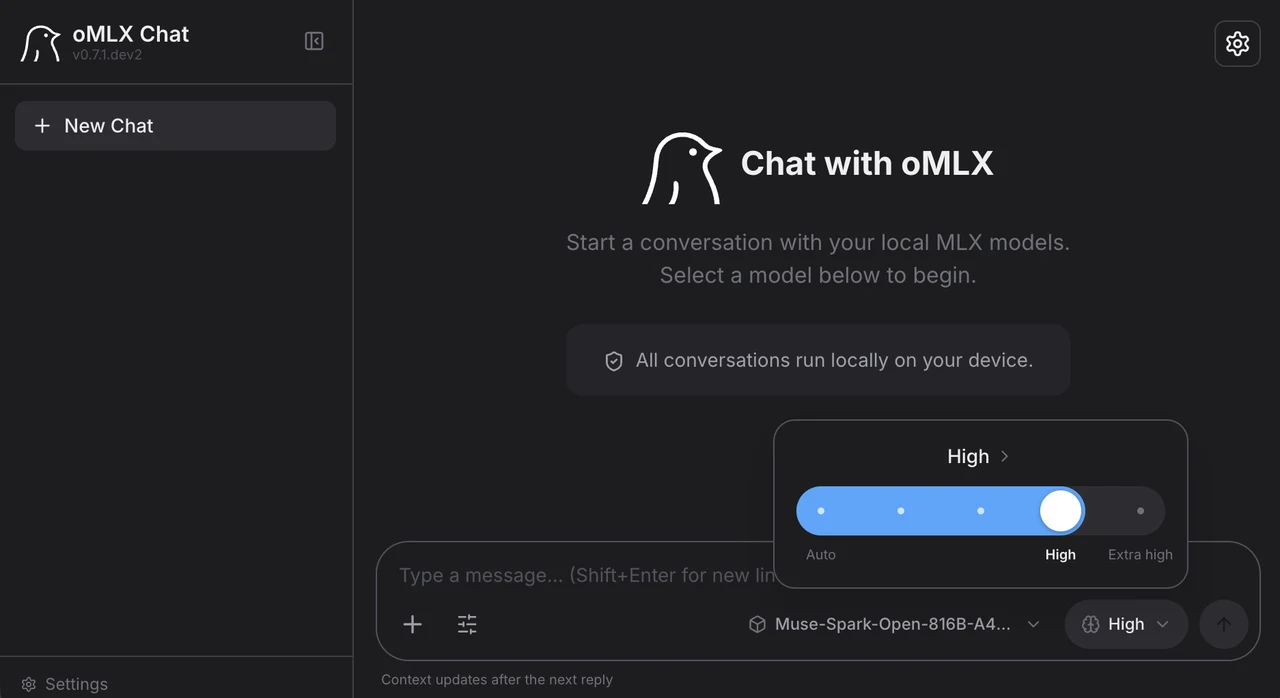
The local guide documents reasoning levels from low to xhigh, with xhigh as the default. Reasoning cannot be turned off; low is the suggested setting for shorter responses on easier tasks. Hugging Face also shows an oMLX interface, pictured here, with a reasoning control. That screenshot illustrates the software rather than independently validating throughput.
Open weights with specific terms
The original Meta checkpoint is gated on Hugging Face and uses the Muse Model License, including usage restrictions and a requirement to display “Built with Muse Spark Open” in the interface or accompanying documentation. This is not an unrestricted Apache- or MIT-style release.
The license requires a separate agreement for Model-as-a-Service businesses whose aggregate affiliate revenue exceeds $20 million over any consecutive twelve months before offering the model or derivatives in that business. It explicitly exempts internal use, non-MaaS commercial activity and use within a company’s own non-MaaS product features from that clause.
For local-model builders with unusually large-memory hardware, the quantization makes an enormous release more approachable. It does not remove compute costs, runtime differences or the model card’s acknowledged risks of inaccurate outputs and multi-step failures.
Related reading
SCOPE trains better image prompts without retraining the generator
AndroidHarness puts several projects in one phone coding-agent chat
