MOSS-Image gets a four-step Turbo demo with an 11-second claim
Akhaliq's community distillation offers downloadable weights and a Gradio demo, with a precision warning for anyone running it locally.

Four sampling steps, with weights to try
Akhaliq has put a four-step MOSS-Image Turbo checkpoint behind a public Gradio demo, claiming roughly 11 seconds for a 1024-by-1024 image on one A100. The community model’s new canonical repository and demo appeared on October 17. Its card says an earlier repository remains as a mirror; this is a new access point, not evidence that the underlying work began today.
The model distills the existing MOSS-Image-SFT image generator, building on lodestones’ eight-step checkpoint. The author’s method continues training with data-space DMD and publishes the selected 1,000-update checkpoint. Generation uses four steps without classifier-free guidance or a negative prompt. That gives image-model experimenters a concrete alternative to simply shortening an eight-step model’s sampling loop.
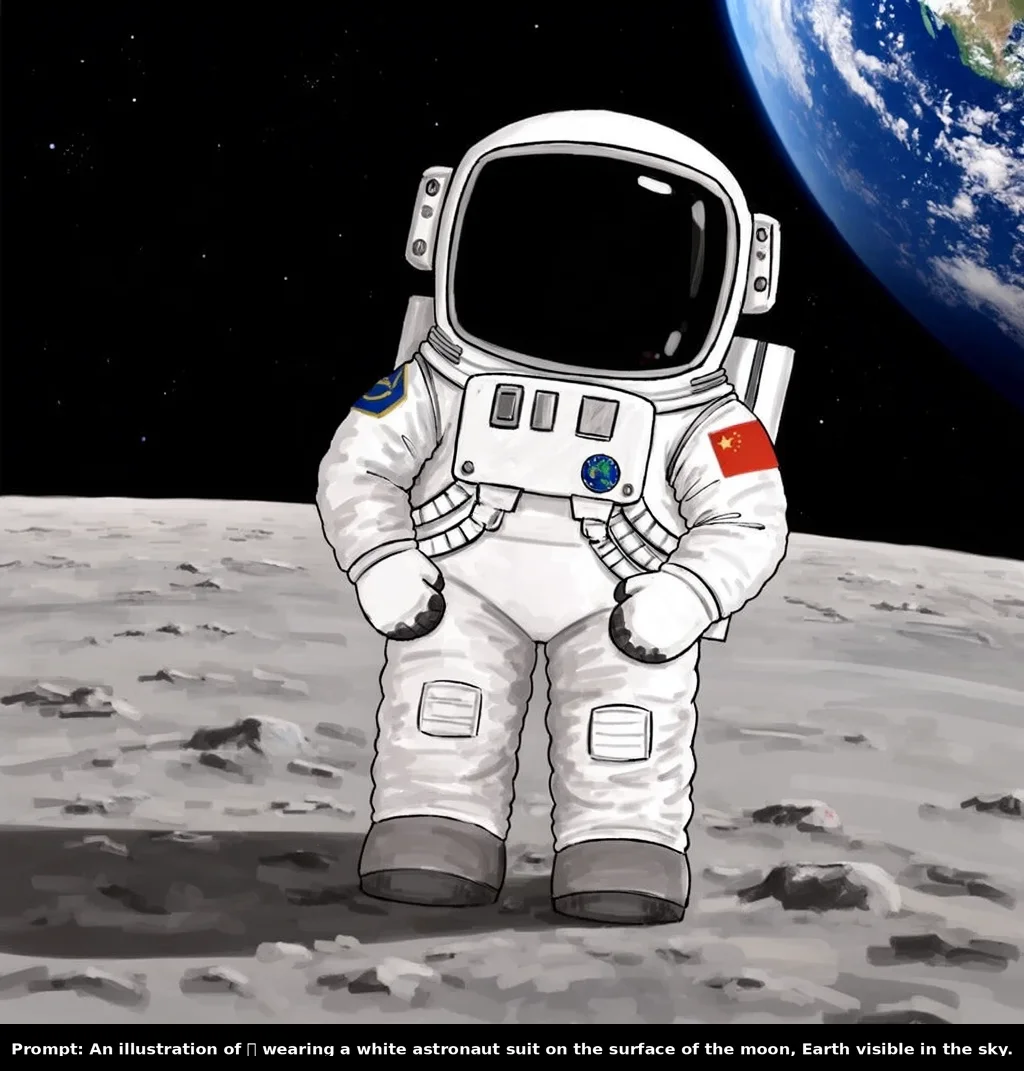
The author supplies comparison strips using eight prompts and fixed seeds, and says the four-step result matches the eight-step checkpoint’s text accuracy and photographic detail. Those are the author’s qualitative comparisons, not a broad benchmark or an independently reproduced speed result. The published sample shown here is generated imagery from that evaluation, not a real concert poster or an AITrending test.
The precision choice matters
For local use, the card recommends the base BF16 transformer with FP32 adapters, time-embedding replacements and sampler data. It warns that merging the LoRA into BF16 weights degrades fine text. A merged FP32 transformer is also available, described as roughly 20GB, but that file size is not a complete installation size or a minimum VRAM requirement.
Users still need the base model’s pipeline, text encoder, tokenizer and VAE. The demo implementation uses CUDA and Gradio; the sources do not establish a consumer-GPU memory floor or a ready-made ComfyUI installation path. Browser access offers an easier starting point, subject to the hosted demo’s availability and capacity.
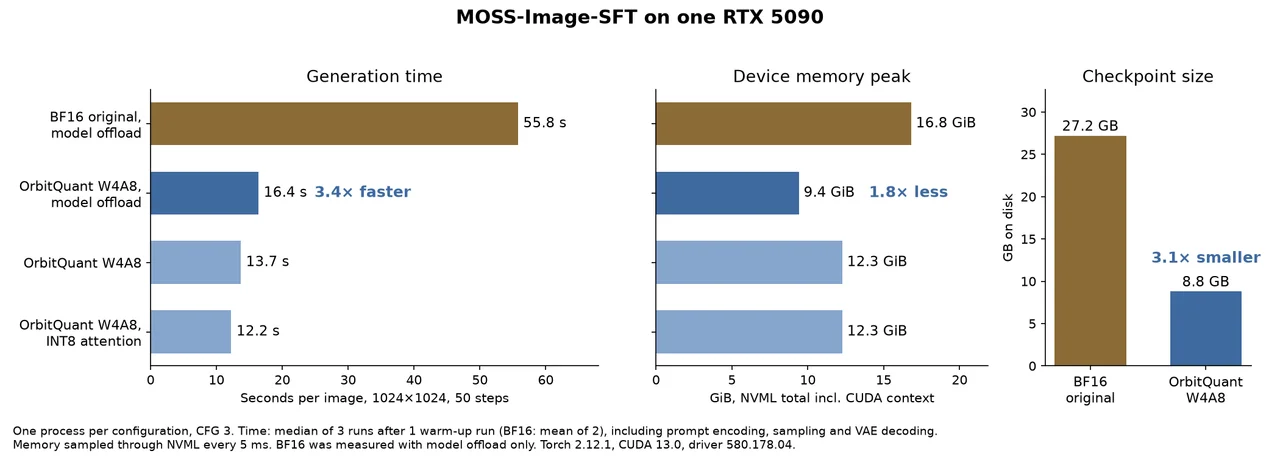
The card declares Apache-2.0 licensing. This is a separate community distillation from the recently covered WaveCut OrbitQuant conversion: one changes the sampling workflow, while the other packages quantized weights for a different runtime. Readers interested in faster MOSS experimentation can inspect the demo and precision recipe, with the 11-second figure understood as an A100-specific author claim.
Related reading
SimpleTuner opens its MOSS-Image LoRA lab, checkpoints included
DeepSeek claims a big coding jump from its minor Flash 1017 update