NVIDIA's Nemotron 3.5 retrieval stack targets better evidence and fewer agent tokens
New Embed, Rerank and Parse models tackle visual documents. NVIDIA reports roughly 14% fewer agent tokens when adding its reranker to the 8B embedding setup in its experiment.
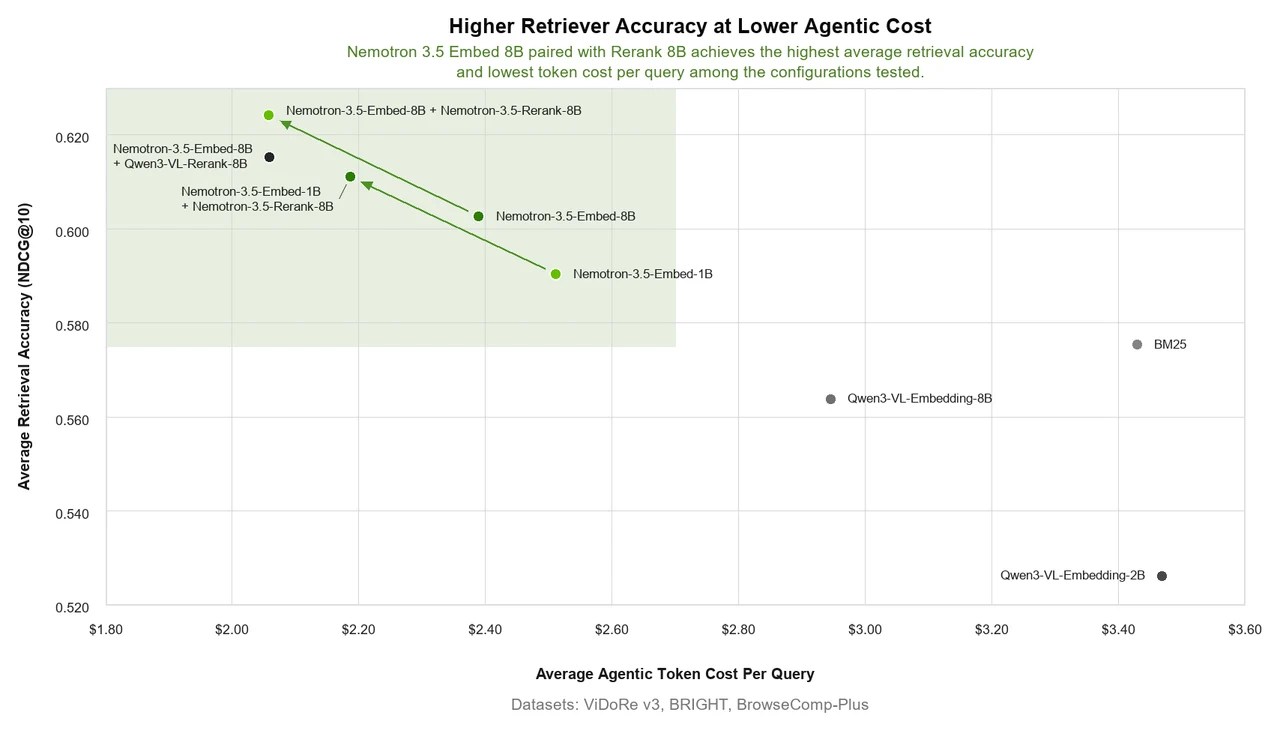
NVIDIA has released Nemotron 3.5 Embed, Rerank and Parse, a retrieval family aimed at helping agents find useful evidence in documents that mix text with charts, tables and images. Its headline efficiency result is about the work an agent does after retrieval: NVIDIA reports that adding its reranker reduced total agent input and output tokens by roughly 14% with the 8B embedder and 13% with the 1B version in its test setup.
The October 21 announcement includes 8B and 1B BF16 embedding models, a 1B NVFP4 variant, an 8B BF16 reranker and a 631M-parameter parser. These are retrieval and document-processing components, not replacements for the agent’s reasoning model.
Better evidence before more reasoning
Embed represents text, page images or combined image-and-text documents for search. Rerank jointly scores a query and a candidate document to improve the ordering of retrieved evidence. Parse extracts document structure, including Markdown, HTML tables, regions and reading order, for downstream processing.
NVIDIA’s agent experiment kept the language model, tools, corpus, tasks and execution policy fixed while varying retrieval configurations across ViDoRe v3, BRIGHT and BrowseComp-Plus. It reports better average retrieval accuracy and lower agent token use for the combined embedding-and-reranking setup.
Those are vendor measurements under the published experiment’s conditions. Fewer agent tokens do not establish the same percentage reduction in a complete service bill: embedding, parsing, reranking and infrastructure also consume resources. The release does not prove that every corpus or agent will benefit equally.
The parser’s strongest reported score also needs its operating point attached. NVIDIA reports a ParseBench score of 75.20 at 10.5 pages per second on an H100 using triple-pass inference. Its faster single-pass result has a lower score; the best score and fastest speed are not one configuration.
Downloadable models, specific runtimes
The reviewed Embed 8B card identifies OpenMDW-1.1 as its model license, with the underlying Ministral base model under Apache 2.0. Check each component’s own terms rather than treating the whole family as MIT software.
For Embed 8B, the card documents Linux with NVIDIA Ampere, Hopper or Blackwell hardware and examples for Transformers, Sentence Transformers and vLLM. Its vLLM example uses Python 3.12, vLLM 0.32.0 and Transformers 5.19.0 in a separate environment from the Transformers 5.20.0 path. These dependencies and GPU resources are deployment requirements, not a zero-cost hosted service.
The practical attraction is a choice of retrieval components for agents working with visual evidence. The immediate claim is narrower than universal cheaper reasoning: NVIDIA says better-ranked documents made the tested agent spend fewer tokens searching and answering.
Related reading
Liquid AI's LFM3 brings eyes, ears and tool calls to a compact local-model family

PortOS adds shot-by-shot rendering to its AI music-video studio
