Obsei trims a 3.4GB first run for its private customer-feedback AI
The self-hosted feedback tool stops fetching unused ONNX weights, following a release that enables GPU classification and caps long inputs.
Less to download before the feedback pipeline starts
Obsei 1.1.1 removes an avoidable hurdle in trying a self-hosted customer-feedback AI: downloading an ONNX model export that its local classifier does not use. The October 17 release changes the model download filter, and its maintainer says setup guidance now describes about 1.2GB instead of the roughly 3.4GB fetched before the fix.
The original pull request explains that obsei init and obsei models download fetched both the PyTorch weights and an ONNX export of bge-m3-zeroshot-v2.0, although the Transformers classifier loads only the former. The maintainer reports checking an empty cache and finding no ONNX files after the change. Those sizes and checks are the project’s report; AITrending has not repeated the download or audited the privacy controls.
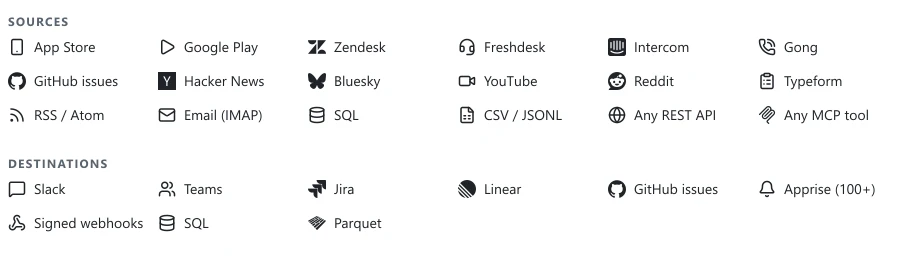
Obsei targets teams that want to classify reviews, tickets and other feedback inside their own infrastructure. Its documented workflow ingests records, redacts supported personal information, classifies feedback and groups themes before delivering results to configured destinations. The Apache-2.0 project presents this as an alternative to hosted voice-of-customer analytics. Redaction is a documented control, not proof that every sensitive detail will be caught or a compliance guarantee.
GPU support comes with a long-text tradeoff
The preceding 1.1.0 release, published on October 16, also changes the local classifier’s operating cost. Its maintainer says it now lets Transformers select an available accelerator instead of always forcing the CPU. It also scores only the first 512 tokens of each message. Longer reports can therefore receive different labels because later text is excluded; faster classification is not the same as reading a whole long issue.
The tagged guide offers uvx --from "obsei[recommended]>=1.0" obsei init for a local setup and uv tool install "obsei[recommended]" for a persistent command. It also documents the versioned Docker image ghcr.io/obsei/obsei:1.1.1. Operators supply credentials for chosen feedback sources and destinations. Optional hosted model access requires separate configuration and provider access; the software license does not include those services.
For coding assistants, Obsei provides an MCP server and repository-installed plugins, including a voice-of-customer skill. It is a standalone feedback service that an assistant connects to, rather than a replacement coding harness or an official plugin-directory endorsement. The integration guide says search and statistics tools return redacted records with citation IDs, while propose_issue queues a proposal for a person to approve. Remote HTTP MCP uses a bearer token or an SSO proxy.
The immediate recommendation is specific: users evaluating a local feedback pipeline get a smaller initial model download, plus a clearer choice about GPU use and truncated inputs. The new release does not establish universal PII removal, complete long-document understanding or independently measured speedups.
Related reading
Tether gives small-model agents a brake on repeated commands