OmO 5.1.38 lets goals keep running while the agent makes progress
The standalone agent replaces a total continuation ceiling with an inactivity rule, while the release also promises durable queued input and a smaller memory-recall index.
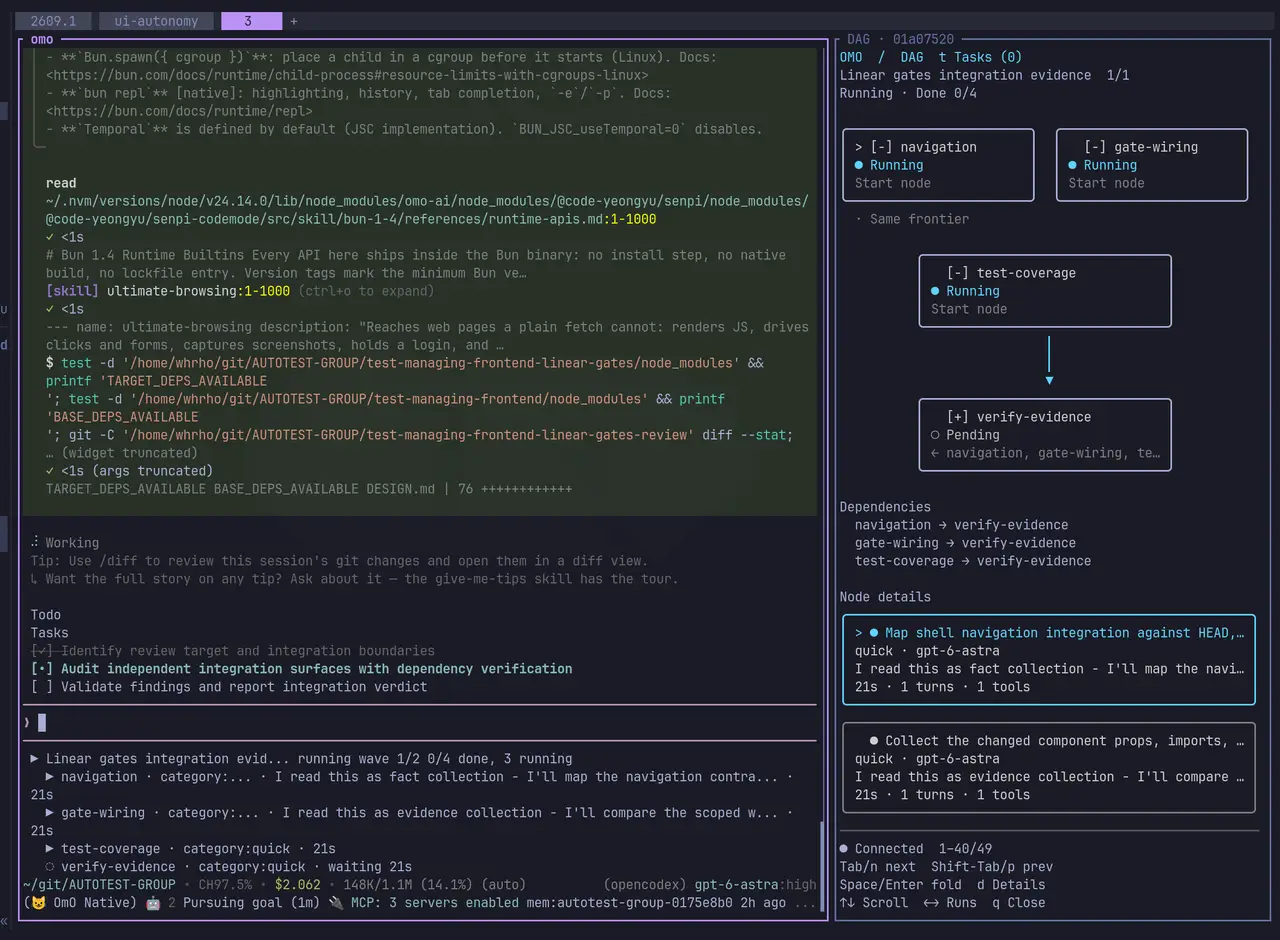
OmO’s latest release changes when a long-running goal gives up. Version 5.1.38 says goals no longer stop after a fixed total of 150 automatic continuations. Instead, the agent stops after 60 consecutive continuations with no new tool effect, task-list change or message from a person.
That makes continued progress the relevant signal, rather than simply how many times the loop has resumed. The release says a stopped goal explains why it paused and can resume when a person sends a message. This is a change to the harness’s continuation policy, not evidence that every extended task will finish successfully or stay within a particular token budget.
Keep a restart from losing queued work
OmO is a standalone coding and research agent running on senpi, its maintainer’s fork of Pi. The new release moves its engine to senpi 2026.10.19 and describes another practical continuity change: input queued with a client ID is written to the session file before queuing, with exactly-once delivery claimed by the maintainers.
The notes also describe handling for extension lifecycle callbacks that never settle. A hung handler is identified after 60 seconds and released after 20 minutes, or earlier when the user presses Escape or a turn deadline arrives. That gives a stalled extension a documented exit path; it does not mean every slow tool operation is automatically cancelled after the same interval.
Retained sessions get attention too. A client reattaching to a still-open session receives its full task snapshot again, rather than waiting for a later state change. These changes target work that spans disconnects, crashes or multiple clients.
A smaller memory index, according to the maintainers
The release describes replacing per-note word tables with shared word numbering and compact lists. In the maintainers’ example of 6,406 notes, the recall index drops from about 231 MB to 55 MB per session, and an incremental memory write takes about 16 milliseconds instead of rebuilding the index in 3 to 11 seconds.
Those are project-reported measurements for a particular memory collection, not an AITrending benchmark or a guarantee of equivalent gains on every machine. The authors say retrieval results and their order stay unchanged.
Install the standalone package deliberately
The matching omo-ai 5.1.38 package is present on npm and requires Node 24 or newer. The tagged README documents npm install -g omo-ai@5.1.38, followed by omo, as well as native installation for Windows and Unix-like systems. The unrelated npm package named omo is a different product.
Model access remains separate: the guide describes provider API keys and subscription sign-in, with provider billing and quotas still applicable. Migrating from OpenCode can carry selected keys, model choices, MCP definitions and skills, but provider-bound OAuth logins need a fresh sign-in, and execution permissions do not transfer as equivalent controls.
The repository’s Sustainable Use License permits internal business and personal or non-commercial use under its terms; it is not an unrestricted permissive license. The release notes also say 5.1.36 never published and 5.1.37’s main npm packages failed to publish. Version 5.1.38 is the confirmed distribution point for the changes described here.