OpenVLHarness says visual memory and tools can beat simply thinking harder
The training-free harness reports 9.7-12.6-point average gains with perception, search and Python, while keeping images and tool results available throughout a question.
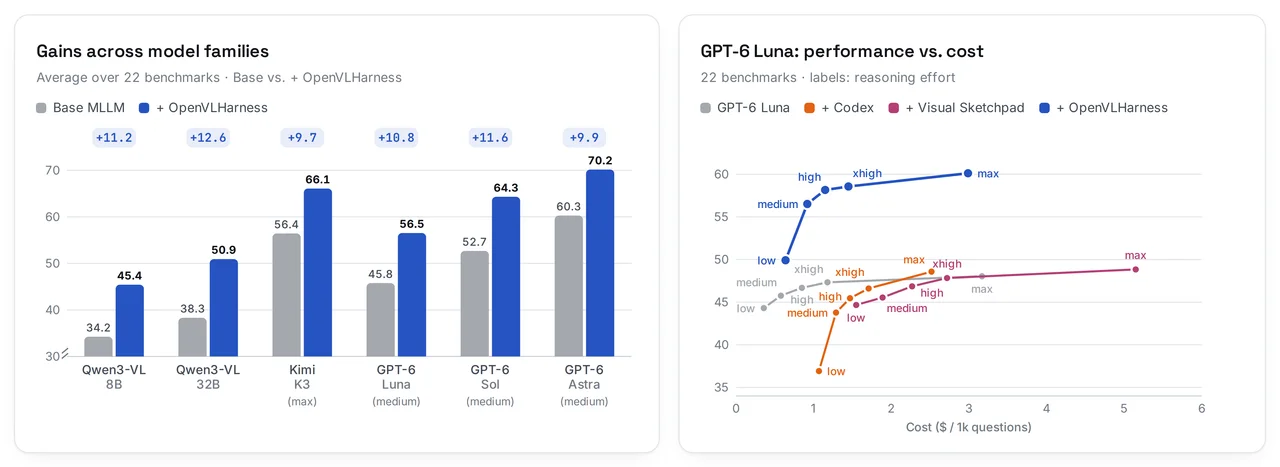
OpenVLHarness makes the case that a visual agent needs better evidence, not just a larger reasoning budget. The newly posted arXiv paper describes a training-free harness that lets existing multimodal models inspect images, search the web and calculate over tool results without repeatedly losing the evidence between steps.
Its authors report average improvements of 9.7-12.6 points over matched no-tool baselines across their 22-benchmark evaluation. The README’s table includes a move from 34.24 to 45.41 for Qwen3-VL-8B-Instruct and from 60.27 to 70.17 for GPT-6 Astra. These are the researchers’ results, not AITrending replications or a promise of the same gain on every visual task.
Keep the image evidence within reach
Nine capabilities cover visual grounding, OCR, depth, camera trajectories, zooming, text search, image search, webpage visits and a Python coding agent. A capability layer renders heterogeneous outputs into observations the model can read. Images, boxes, masks, numerical arrays and web references remain addressable for the question, letting a later tool or calculation reuse earlier evidence.
For example, an agent can find objects, estimate their depth and calculate a spatial relationship. It can also crop an unfamiliar object, search for visual matches and check a webpage. This is a harness around existing weights, rather than a newly trained vision model. Its persistent memory lasts through the current question; the documented implementation starts fresh for the next one.
The authors also compare reasoning efforts using GPT-6 Luna. Their cost plots measure model-token spending at Standard-tier prices, including reasoning tokens but excluding tool execution and judging. They do not establish the total cost of running GPU services, paid search and the rest of the deployment. The project says its GPT-6 and Kimi results are single runs, while Qwen3-VL results average three runs.
Source code is available, setup is substantial
The MIT-licensed repository provides a Python 3.10+ source installation, including python -m pip install -e '.[qwen,server]', and presets for seven of the paper’s eight backbones. The code predates the October 19 arXiv submission; this week’s paper visibility is not evidence that the project was created today.
All nine capabilities need separately configured SAM 3, PaddleOCR-VL and Depth Anything 3 services, model access, and Serper credentials for search. Every preset also uses an auxiliary Qwen3-VL-8B-Instruct endpoint for search summarization and webpage extraction. Those dependencies have their own access requirements and costs.
The coding tool executes generated Python as the host user with network and filesystem access. Its timeout is not a sandbox, and the documentation calls for an appropriately isolated environment. Reverse image search also makes the query image available to the search service. Readers can inspect the code and recorded trajectories now, but should distinguish the published recipe and author evaluation from a tested deployment in their own environment.
Related reading
