Ecosystem
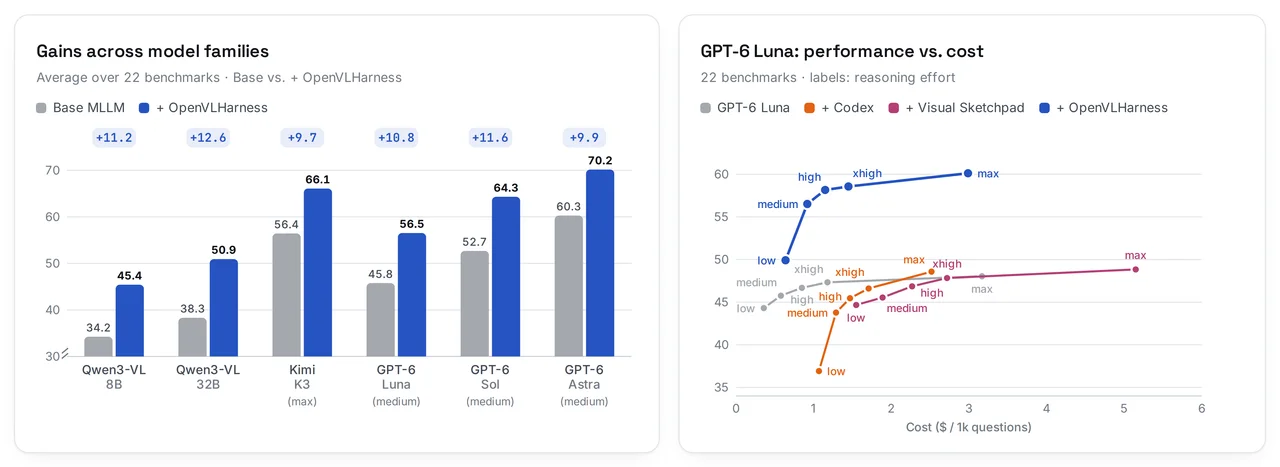
OpenVLHarness says visual memory and tools can beat simply thinking harder
Community reports 5 sources
An MIT-licensed, training-free multimodal agent harness that combines perception, web search and Python with reusable evidence memory for each question.
What happened lately
OpenVLHarness wraps existing multimodal models in an iterative tool-use loop. Nine capabilities provide object grounding, OCR, depth, camera trajectory estimation, cropping, text and image search, webpage visits and generated Python computations. Images, structured results and web references stay addressable throughout a question; the next question starts with fresh memory.
The source installation requires Python 3.10 or newer. Full functionality needs separately configured perception services, a main model endpoint, an auxiliary Qwen3-VL-8B-Instruct endpoint and Serper search access. Model inference and external services have their own costs and licenses. The harness code is MIT-licensed and does not fine-tune the backbone.
Its coding tool runs model-written Python on the host with the user’s network and filesystem access. The documented timeout is not a sandbox. The paper’s reported evaluation gains are author measurements rather than an independent AITrending test.