PhoneLLM Alpha 2 gives voice agents a fast Mini and a microthinking Max
Pipecat's new downloadable text models target phone-agent tool calls, with Flows training and a single sentence of reasoning in Max. Mini also gets FP8 and NVFP4 options.
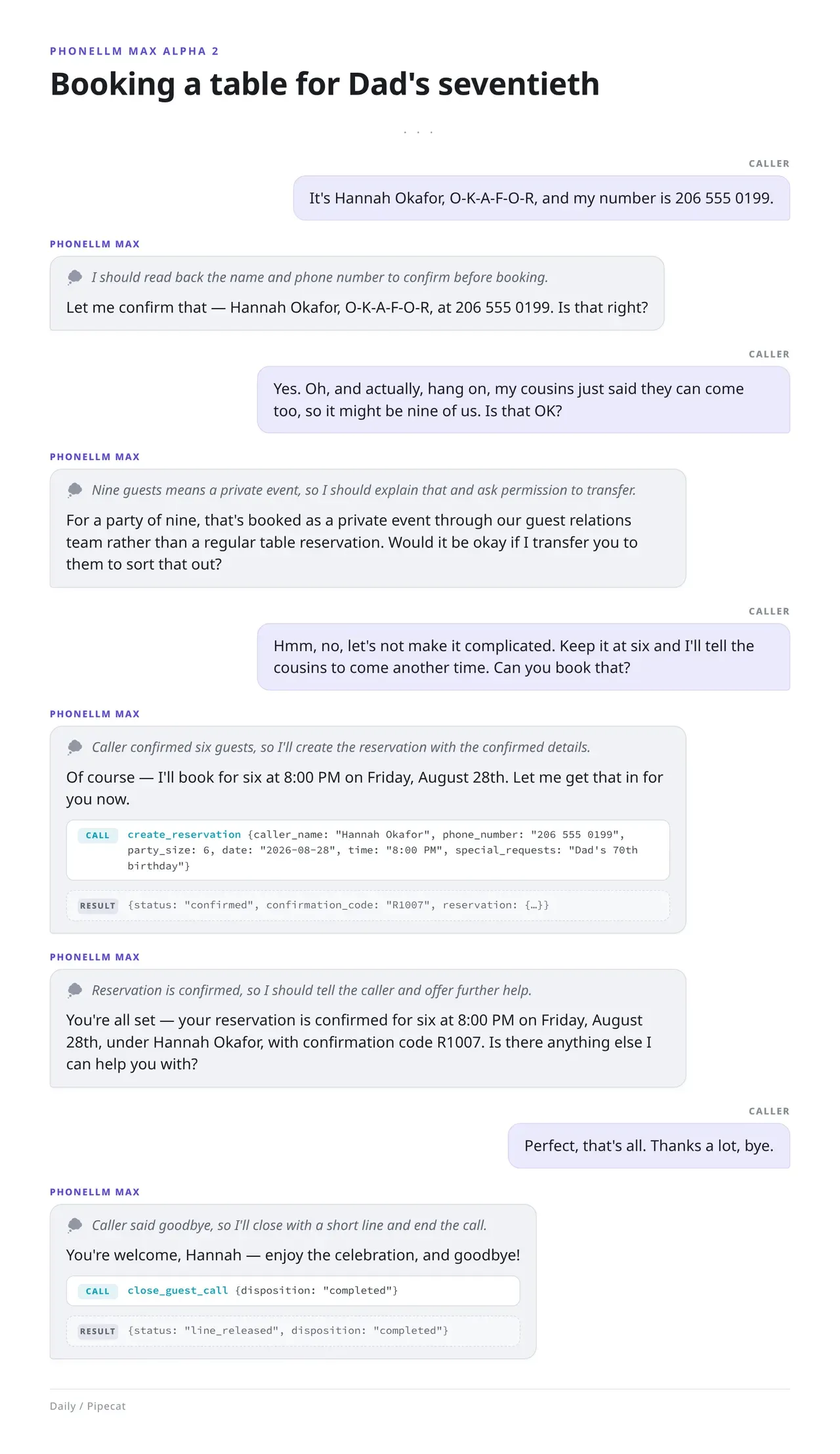
A short thought before the tool call
Daily released Pipecat PhoneLLM Alpha 2 on October 15 with two downloadable variants: Mini for speed and Max for stronger accuracy. The new hook is Max’s “microthinking”: one short sentence of reasoning before a response, intended to improve tool selection without the delay of a long reasoning trace.
These are text models for a voice-agent pipeline. Speech recognition, speech synthesis and the rest of a calling application remain separate components. Max is fine-tuned from the language backbone of NVIDIA Nemotron 3.5 Super VL 120B-A12B, with the vision encoder and projector removed; Mini is based on Nemotron 3 Nano.
Daily also trained Alpha 2 on synthetic Pipecat Flows conversations. Flows supplies a structured conversation harness, allowing developers to guide a call through defined steps. Daily says Max resolved calls more successfully than GPT-4.1 in customer testing with Flows, at around half the latency. That is Daily’s comparison, not an independently reproduced accuracy or end-to-end latency result.
The serving settings matter
The model cards recommend temperature zero. Mini should run with reasoning disabled. Max was trained with reasoning enabled and needs the Nemotron reasoning parser; its card explains how to send and retain reasoning fields in conversation history.
For Mini, the publisher reports about 17 milliseconds to first token and roughly 10,000 aggregate tokens per second at 128 concurrent requests on one B200 using vLLM 0.30. Those are model-serving measurements, not the response time of a complete phone call. Max’s measured recipe uses two B200 GPUs and reports about 27 milliseconds to first token.
Smaller files, different hardware choices
Mini’s FP8 package is approximately 33GB, while its NVFP4 package is approximately 19GB. The latter targets native Blackwell hardware; the card warns that Hopper uses slower emulation. The quantized cards say these builds have been smoke-tested but their throughput has not yet been benchmarked. Their file sizes do not establish total application memory requirements.
The NVFP4 instructions specifically select the FlashInfer CUTLASS MoE backend to avoid a documented problematic default configuration. Developers should follow the checkpoint’s recipe rather than assume every vLLM default works unchanged.
License terms also differ: Mini declares BSD-2-Clause for the PhoneLLM work while retaining NVIDIA base-model obligations; Max declares OpenMDW 1.1. Downloadable weights do not mean one uniform license across the family.