Primal VAE adds SD-style latents without deep compression
Ostris's new 4x1 checkpoint reaches the latent shape used by SD 1.5 and SDXL through patching, with openly limited reconstruction comparisons.
Primal VAE now has an option aimed at the latent layout familiar to SD 1.5 and SDXL builders. Ostris added the 4x1 checkpoint on November 4, extending an image-autoencoder project whose first two variants appeared October 30.
The substantive update is the 17:02:05 UTC commit adding 4x1. A later 17:02:49 cache-cleanup commit explains the repository’s freshest modification time; it is not a separate launch.
Compress less, then rearrange
According to the English model card, 4x1 reduces image width and height fourfold into a single channel. A further two-by-two patch rearrangement produces four channels at one-eighth image resolution—the same tensor layout used by the SD 1.5 and SDXL VAEs.
The point is to separate spatial compression from patching. The author describes a small convolutional encoder and decoder, with latent statistics trained toward the diffusion noise distribution instead of carrying a separate scaling or shift factor. Despite the VAE name, the documented encoder is deterministic, with no posterior sampling or KL term.
The new variant has roughly 122 million parameters, compared with roughly 80 million for the existing 2x variants, and requires image sides divisible by 32. These are the project’s specifications. Matching dimensions alone does not establish that an existing diffusion checkpoint will generate correctly with a replacement latent representation.
The examples show trade-offs
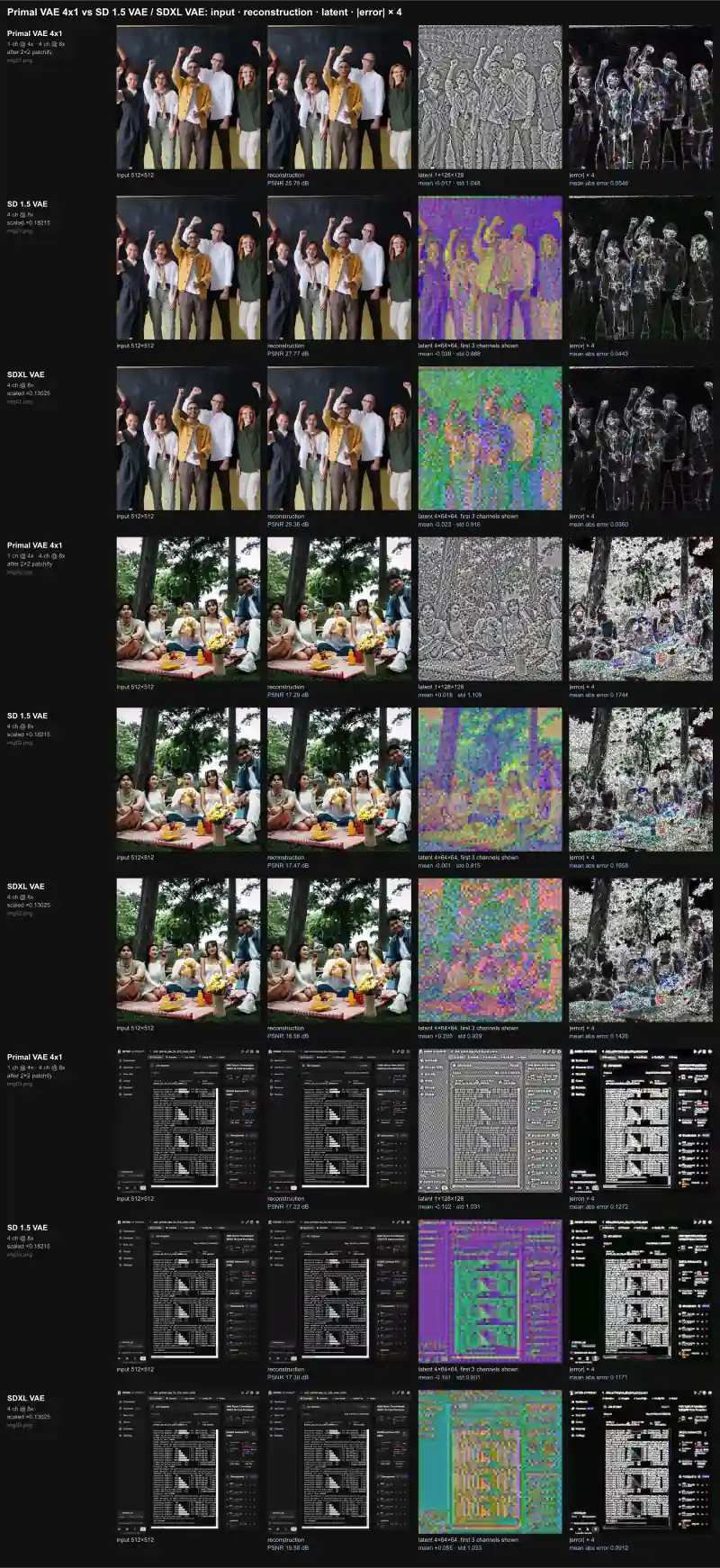
Ostris publishes input, reconstruction, latent and amplified-error panels for three 512-pixel images. In those examples, the author reports 4x1 close to the SD 1.5 VAE on textured images but behind on the studio image; the SDXL VAE stays ahead in reconstruction PSNR.
The card explicitly warns that three images and PSNR alone are not a benchmark. Reconstruction comparisons also do not establish end-to-end generation quality, speed or broad superiority over Flux or Stable Diffusion pipelines. The accompanying visual is the author’s comparison, not an AITrending reproduction.
For researchers who want to try the representation, the repository provides safetensors checkpoints and Diffusers loading instructions with custom remote code, plus patching helpers and gradient checkpointing. Its example uses PyTorch, CUDA and bfloat16; AITrending did not run it or measure hardware requirements. The model code and checkpoints are published under Apache 2.0.
Related reading
Greko brings contacts and chat memory to its offline Android assistant
A 1.1 GB Q4 option arrives for LFM3-Omni refusal-ablation research