A 9B model that runs its layers twice: SenseNova Loop's speed tradeoff
SenseNova's open-weight preview reuses a 24-layer block, while an early community tester reports similar personal-agent results at substantially slower generation than another 9B model.
More computation from the same stored weights is an appealing local-model pitch. It also has a speed bill. SenseNova-Loop-9B-Preview is drawing fresh attention with a decoder that runs its middle 24 layers twice, while an early community test illustrates why deeper execution does not automatically mean a better everyday agent.
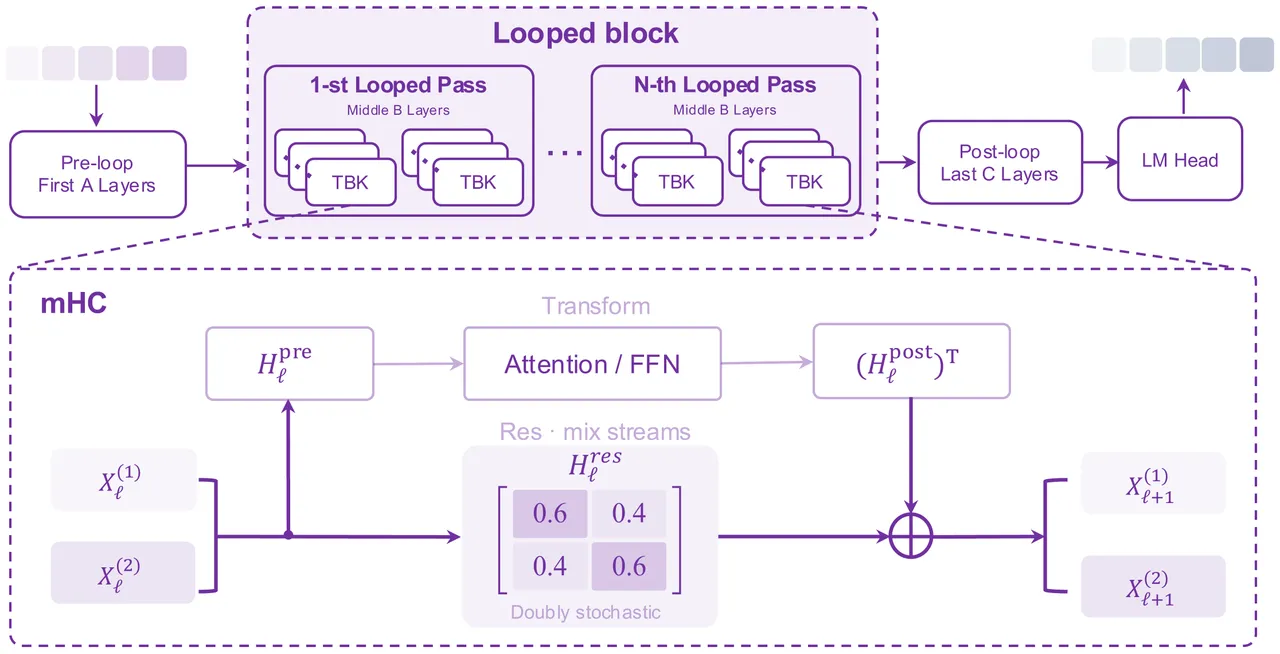
The English model card dates the release to October 30. It describes 32 distinct decoder layers performing 56 layer executions per forward pass, with shared weights in the repeated block. Two residual streams and learned mappings manage information flow through that section. The authors list roughly 9 billion total parameters and an approximately 14.6-billion inference-parameter scale; the latter is a description of repeated computation, not fourteen billion unique stored weights.
The model takes text and images and produces text. Its documented training sequences reach 262,144 tokens. That is a training-context specification, not proof of perfect recall across a full-length conversation. The card’s presentation and motion-design examples were created with Raccoon Work and should likewise be read as supplied demonstrations.
One user’s test supplies a useful counterpoint
In an October 31 English post, GooGZ AI compared the preview with NeoHorse 1 9B on a personal-agent suite, reporting the same llama.cpp fork, RTX 3080 and Q4_K_M quantization, with three runs each. The user described broadly similar quality but reported generation at 49 versus 89 tokens per second. This is one person’s workload and configuration, not an independently reproduced ranking or a universal speed ratio.
The observation is useful precisely because it separates the architecture’s attraction from a purchasing recommendation: storing fewer distinct weights does not make the second pass free. ModelScope’s November 2 English announcement emphasizes the shared block and reported benchmarks; replies also question practical benefits.
Deployment requires compatible model code. The card documents a custom-code Transformers example, LightLLM, and specific SGLang and vLLM pull-request versions. Its technical report remains forthcoming, and Dspark and Dflash2 acceleration are still described as training in progress. The model card declares Apache-2.0.
This is renewed coverage of an October release, prompted by a fresh November 4 trend observation, not a claim of a new launch or measured viral growth. X API credentials were unavailable during review; the cited public English X pages were accessible through the browser, providing a bounded view of the discussion.