18.73GB H3 video weights—or 14.65GB without the fix?
LokkenJP recommends a learned W6/INT8 fix1 HQ checkpoint for local H3 video, while keeping a smaller original Beta7 build that does not contain fix1 changes.
The smaller download is not the same model with fewer bits. LokkenJP’s TenEros Max quantization card now recommends the 18.73 GB Beta7 fix1 HQ transformer, while keeping a 14.65 GB compact alternative built from the original Beta7 source. The compact file does not contain fix1 changes, and the author explicitly rules out a compact fix1 companion.
This is a community conversion of TenStrip’s MiniMax H3-based video model. Its English card records mechanical validation and operator ComfyUI acceptance on November 2, 2026. The repository was created August 29; its November 4 discovery and update timestamps do not establish a new model launch or popularity growth.
Two checkpoints, different source identities
The recommended fix1 HQ mixes learned six-bit and INT8 weights and retains the source’s embedded eight-step Turbo. The author describes fix1 as primarily addressing higher-resolution output, while the compact original remains an option for more constrained setups. Upstream notes also warn that fix1 changes prompt behavior and may retain inconsistencies.
The download sizes are decimal disk gigabytes, not measured VRAM requirements. Both are transformer-only files: the text encoder, video/audio VAEs and workflow remain separate. The card lists an optional 15.35 GB compact text encoder, making clear why a transformer download alone cannot describe the complete installation.
For checkpoint loading, the card specifies ComfyUI 0.38.0 or newer with native W4A8, W6A8 and INT8 ConvRot support. The current bundled workflows have a stricter requirement: ComfyUI 0.44.0 or newer, because they use its native MiniMax H3 latent upscaler. Readers choosing the supplied two-pass workflow should follow that newer requirement.
Reconstruction scores are not a video-quality benchmark
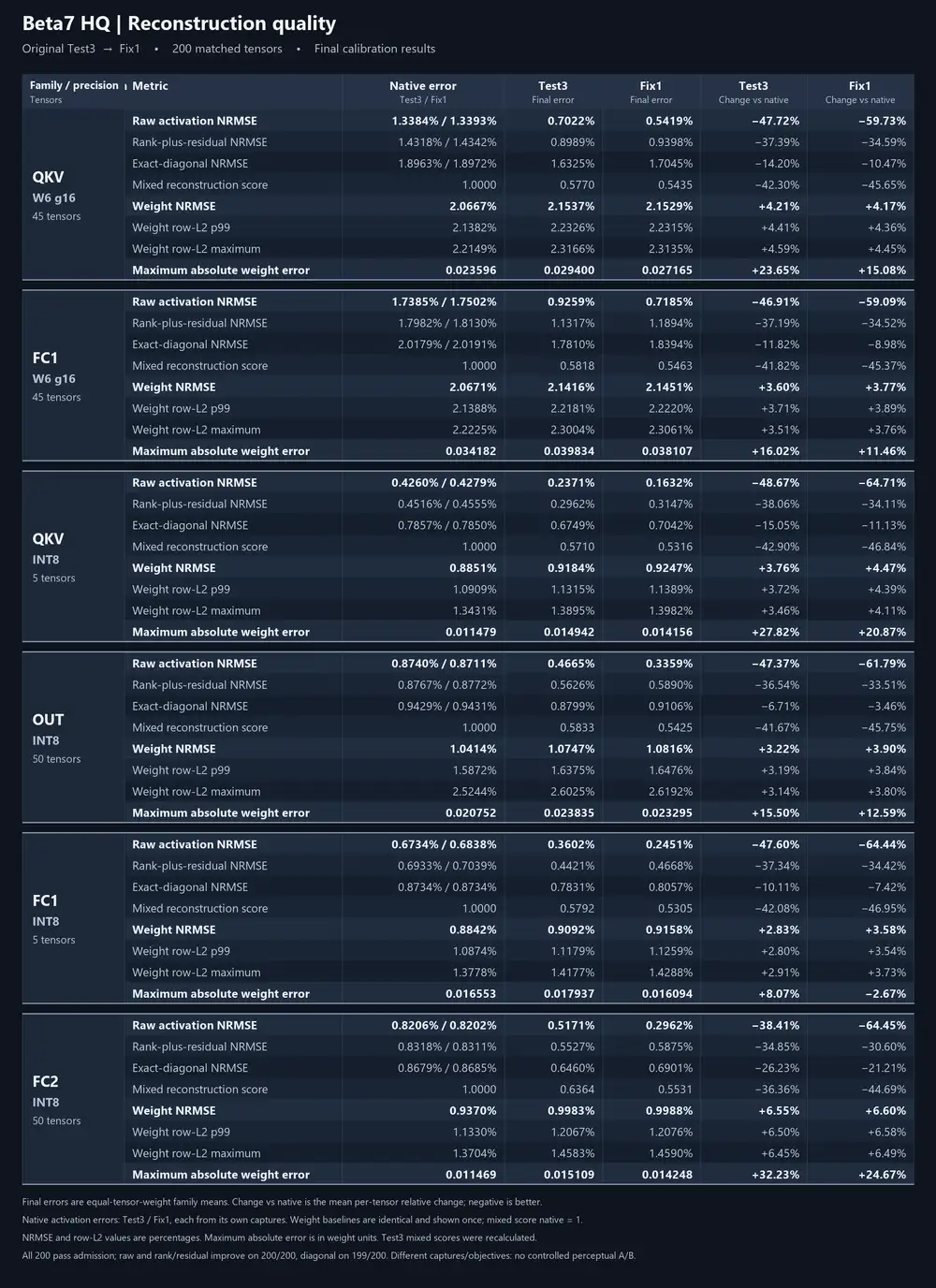
The author reports lower calibration activation-reconstruction error than matching native quantization, alongside some increases in ordinary weight-reconstruction error. Those measurements describe quantization tradeoffs. They do not quantify a perceptual-quality improvement, inference speed or parity with the BF16 source.
The operator says several generated videos looked excellent and were often preferred to the native INT8 companion. The card explicitly labels those observations subjective and says there was no controlled generated-video quality or speed benchmark. AITrending has not reproduced the results.
The practical recommendation is to choose by source version and workflow compatibility before choosing by download size. These derivatives carry community-license terms and an upstream Not-For-All-Audiences designation; this coverage does not treat them as permissively licensed or universally suitable generation models.