Proof of Human says AI browsers slipped past Turnstile in its survey test
A community-discussed benchmark reports sharply different detection rates for scripted browsers and AI agents, with no human false-positive test and a vendor testing its own product.
Three vision-capable AI browsing agents passed Cloudflare Turnstile in Proof of Human’s survey benchmark, even though ordinary scripted browsers were caught. The vendor’s report, now being discussed on Hacker News, illustrates why a test of automation fingerprints can produce very different results from a test of agents using browser interfaces.
The comparison used a five-question survey with multiple-choice and open-ended answers. Playwright-controlled Chromium, stealth-focused CloakBrowser, Browser Use, Perplexity Comet and Grok each attempted it 20 times per detector. Failures and crashes left 89 to 100 evaluable sessions for each system.
One task, very different detector outcomes
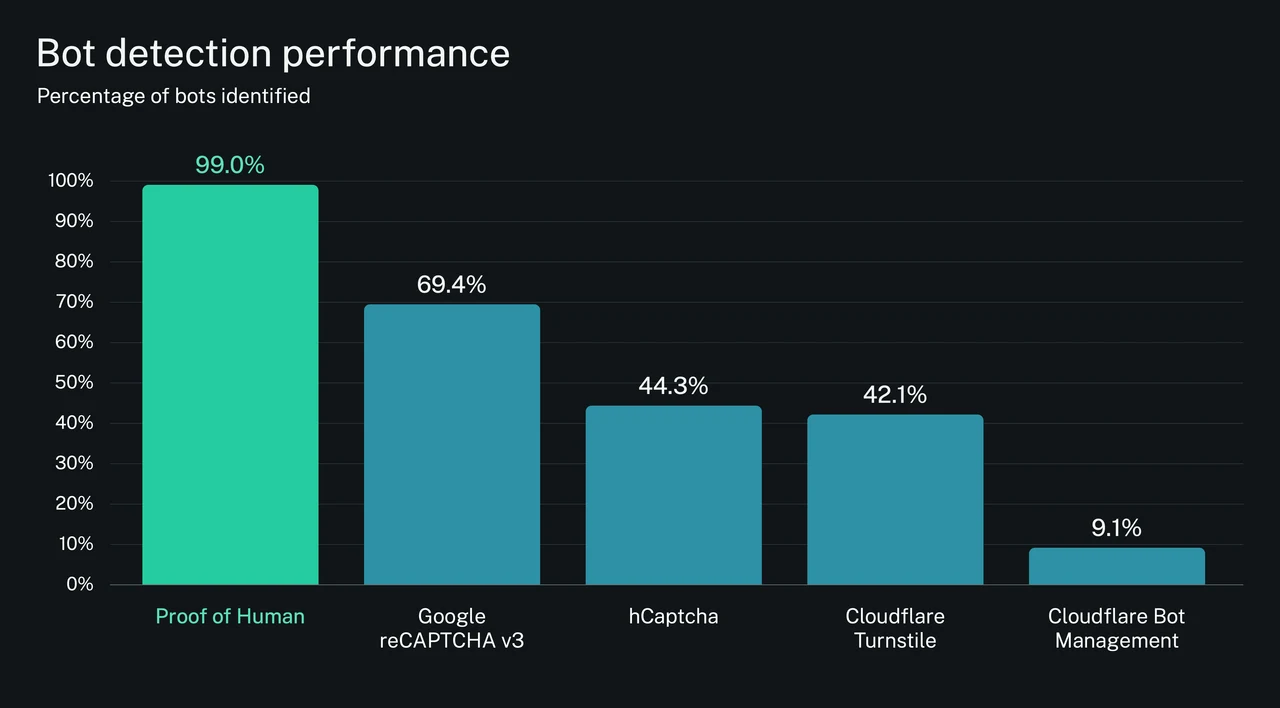
Aggregated across all five adversaries, the authors report automated-session detection rates of 99% for their own Proof of Human product, 69.4% for reCAPTCHA v3, 44.3% for hCaptcha, 42.1% for Turnstile and 9.1% for Cloudflare Bot Management.
The aggregate hides the more interesting split. According to the report, Turnstile withheld verification tokens from the two scripted-browser adversaries, but detected none of the three AI-agent groups and issued them no challenges. The vision agents also generally solved hCaptcha’s image grids. reCAPTCHA caught most agent sessions but none from CloakBrowser.
CloakBrowser uniquely combined source-level fingerprint changes, residential proxy traffic and optional input humanization. The experiment therefore cannot isolate the fingerprint from the network address as the reason for its results. Likewise, the authors cannot directly observe which signals drove the black-box detectors.
The leaderboard is not a deployment recommendation
Proof of Human employees ran the benchmark and are building the product that ranks first. Crucially, they measured automated sessions without testing how often genuine humans would be blocked. A high bot-detection rate alone cannot establish a useful human-versus-bot tradeoff.
The report also used available product tiers rather than enterprise editions, and describes Cloudflare Bot Management through its Pro-tier classifications. The 9.1% figure should not be generalized to every Cloudflare deployment or enterprise configuration. The authors note that traffic history and calibration could change results in a longer-running installation.
In the Hacker News thread, readers ask about configuration and benchmark-code availability and suggest testing additional systems. Those are public methodological questions, not evidence that the reported results were fabricated or independently reproduced.
The submission is dated October 20 at 17:10 UTC. The research page itself has no explicit original publication date; current discussion does not make it a new product release. The useful takeaway is narrower than declaring bot defense broken: evaluate the actual agents, task, settings and human rejection rate your site faces before drawing conclusions from a vendor chart.
Related reading