PS5LM turns a jailbroken PS5 into a GPU AI server with decision models
The community llama.cpp port adds typed decision requests and a TV interface, while serving local models to browsers and coding tools on the home network.
The console becomes the model backend
PS5LM v0.9.0 gives a jailbroken PlayStation 5 a new job: serving local language and decision models to other devices. The community project runs llama.cpp on the console’s GPU through Vulkan and RADV, with an author-described 11.4 GB shared-memory budget for the model and context.
The October 16 release adds typed decisions through /v1/systemone, the API also used by Ollaya on PCs. Instead of generating a paragraph, compatible models answer choice, score and yes-or-no questions about a supplied state. The release names d1, d1 Omni, Clef and OpenJev, and configures decision models with a 4,096-token context and 2,048-token batch.
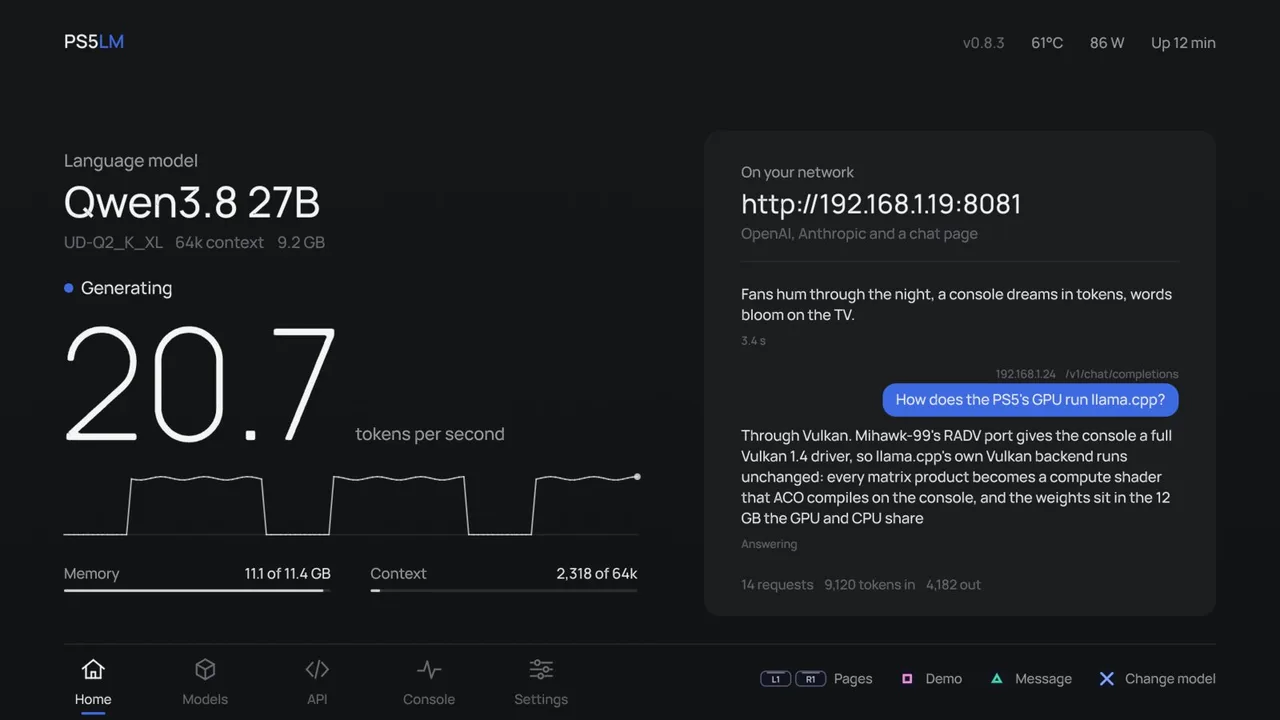
The native TV interface shows the loaded model and incoming requests, manages Hugging Face downloads, and charts console temperature, power and load. PS5LM now uses title ID PPSA99575; the release distinguishes it from contributor abhi245y’s PS5LM Plus app.
Local APIs do not mean cloud models
The project serves OpenAI-compatible Chat Completions and Responses endpoints and an Anthropic-compatible Messages endpoint on port 8081. Those are interface formats: requests run against the model loaded on the PS5, not OpenAI or Anthropic’s hosted models.
The English guide documents OpenCode, Codex, Claude Code and aider configurations. Its dated client checks cover a small Python-file edit, not a broad coding benchmark. The guide also warns that large agent prompts take minutes to process on the 27B configuration; smaller models can be a better fit.
The README reports about 20 output tokens per second for a quantized Qwen 3.8 27B on PS5 Slim, and 55 for Qwen 3.5 9B. These are the author’s measurements, not AITrending tests or prompt-processing speeds. Compatible GGUF architecture support also does not mean every model fits the available memory.
A homebrew workflow, with a known limit
The documented requirements are a jailbroken PS5 on firmware 7.00 through 13.60, with kstuff-lite, etaHEN and ShadowMountPlus. Installation copies the release ZIP’s app folder into the console’s homebrew directory. This is community homebrew, not a Sony store app.
The project requires no cloud account to run local inference. Its client examples accept placeholder API keys; readers should not mistake those strings for evidence of authenticated remote access. Coding clients retain their own file and command permissions.
One release limitation is explicit: a decision model can stop answering after roughly 55 consecutive requests, requiring an app restart or model reload. That makes this an interesting local experiment with a documented operational constraint, rather than a demonstrated unattended production server.