Qwen Image Turbo gets a 2.89GB EXL3 Transformer for AMD experiments
A community release offers 3-, 4- and 5-bit Transformer checkpoints with author comparisons, a custom ROCm runtime and research-only model terms.
Qwen-Image-2.1-Turbo now has a community EXL3 package whose smallest diffusion Transformer occupies about 2.89GB on disk. Contributor jyohukuchan published actual 3-bit weights on October 18, followed by 4- and 5-bit folders. The exl3-v1 package offers an unusually explicit view of the tradeoff: smaller weights alongside fixed-case numerical comparisons and generated samples.
This is a third-party conversion, not an official Qwen launch. It is also not a 2.89GB complete image generator. The figure covers the DiT safetensors files; the BF16 text encoder and VAE remain separate upstream downloads. The 4- and 5-bit versions occupy approximately 3.77GB and 4.64GB respectively, also in decimal storage units rather than total VRAM.
A specialized AMD route, rather than a drop-in checkpoint
The release requires the custom rocm_exl3_forme engine, pinned to a specific revision, and its Qwen Image command-line workflow. The files are neither GGUF, NF4 nor Nunchaku, and do not form a standard Diffusers from_pretrained() folder. Hosted Hugging Face inference is not configured.
The documented setup uses Python 3.12, ROCm PyTorch and a locally built engine extension; the engine requires ROCm 7.2.4 or newer. Generation keeps the DiT on the GPU while streaming the BF16 text encoder from CPU RAM. The author reports validation on one Radeon AI PRO R9700 32GB. CUDA, V620, other GPUs and multi-GPU image inference were not validated for this package.
The card also discloses a reproducibility limit: evaluation reused an existing compiled R9700 extension whose original build commit is unknown. A clean rebuild of that exact binary was not demonstrated. AITrending has not independently run these checkpoints.
Smaller files come with visible differences
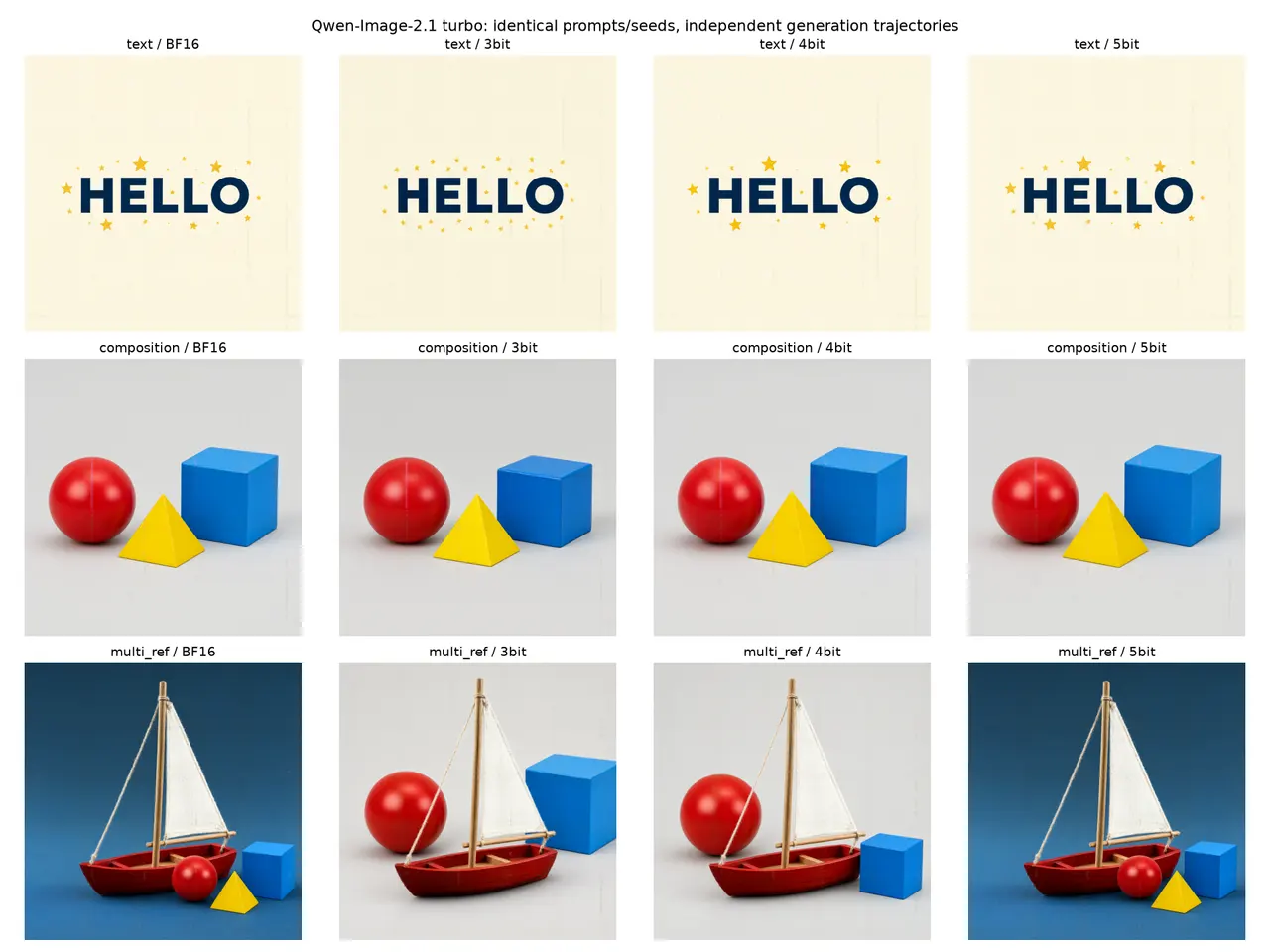
The author compares three held-out 1024px cases, one seed each. The 5-bit version has the lowest reported aggregate error against BF16 DiT predictions. That NMSE score measures numerical fidelity, not a percentage of image quality retained or proof of general superiority.
The English card and published comparison show a concrete difference: in the two-reference example, 3- and 4-bit output replaces the blue background with gray and changes the layout; the 3-bit cube is partly cropped. The 5-bit example retains the blue background and stays closer to BF16. These are author-generated samples from a small screen, not a broad quality guarantee. No new speed benchmark is claimed for 3- or 5-bit.
Finally, the weights inherit the September 20 Qwen Research License: noncommercial research and evaluation only, with a separate upstream license required for commercial use. The engine’s MIT license does not change those terms. For AMD experimenters comfortable building a specialized runtime, the release supplies concrete size choices and evidence to inspect before trading fidelity for storage.
Related reading