Revolut says self-hosted GLM cut its AI invoice to one-tenth
New reporting spotlights Revolut's claim that 56 B200 GPUs serving GLM brought its inference invoice to roughly a tenth of its previous provider bill, while frontier models remain in the mix.
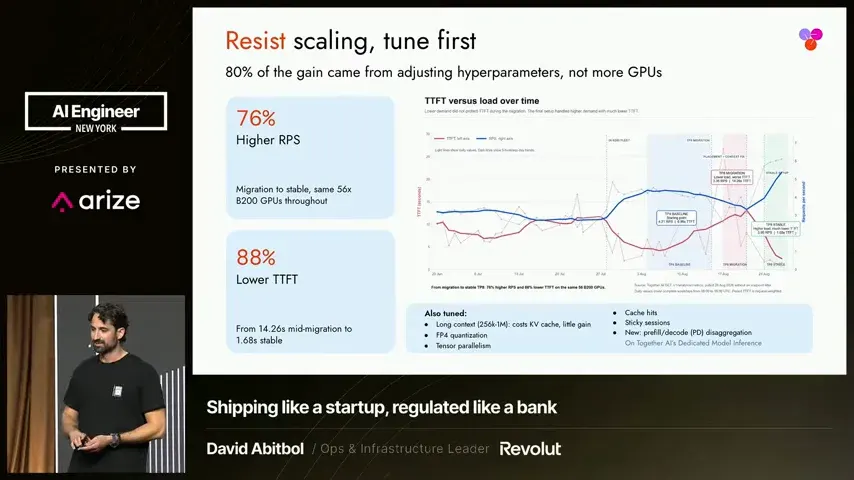
Revolut says bringing coding-model inference in-house cut its invoice to roughly one-tenth of its previous Anthropic and OpenAI bill. A November 3 report by The Register draws fresh attention to a deployment described by infrastructure leader David Abitbol at AI Engineer NYC on October 13.
The original English conference reading edition and transcript describe 56 Nvidia B200 GPUs serving around 2,000 engineers, with GLM-5.3 in the stack after earlier use of GLM-5.1. Abitbol puts the blended inference cost at about $0.30 per million tokens. That is a company-reported deployment figure, not a public retail tariff or an independently audited comparison of total ownership costs.
Owning the GPUs is only part of the claim
The presentation emphasizes tuning before adding capacity. It discusses FP4 precision, useful context lengths, caching and separating prefill from decoding. A slide compares throughput and time to first token on the same 56-GPU fleet. Those figures describe Revolut’s own configuration and workload; they do not establish what an arbitrary customer would save by renting similar hardware.
Nor does the account describe a complete exit from frontier providers. The conference material retains other models for exceptions, including routing image understanding elsewhere. OpenAI-compatible endpoints and Responses API support let existing harnesses, including OpenCode and Codex, connect to the internal serving layer. The model, the serving infrastructure and the coding interface remain distinct components.
The operational story also includes sandboxing, approval rules and telemetry. Self-hosting gives the company more infrastructure control, but it does not by itself establish regulatory compliance or remove the need for those controls.
The result is a concrete argument for high-utilization internal inference, with an important boundary: the one-tenth claim concerns Revolut’s reported bill and setup. The talk occurred October 13; the newer November 3 media report is the reason to revisit it now. Neither source provides a controlled experiment proving that changing model providers alone produced the entire saving.
Related reading
Anthropic says GLM-5.3's cyber safeguards are easy to bypass
OmO tells its architect to fix the code, and rolls back higher reasoning defaults