Route Anything reports 8.82× efficiency—but picking the right model is still hard
A new preprint studies routing across text, media and robots, separating large hindsight gains from the smaller gains its trained routers actually deliver.
What if an AI system chose a different model for each task instead of sticking with one favorite? Route Anything, a preprint submitted November 3 at 17:56 UTC, studies that question across language understanding, image, video and speech generation, coding and workplace agents, and robotic manipulation. Its authors report an average 8.82× relative efficiency across four testbeds—but the paper also shows how difficult it is to learn which candidate will actually win.
The work drew fresh attention on November 4: Hugging Face displayed it as the number-one paper of the day, with 74 upvotes when AITrending reviewed the page. Those are a dated platform snapshot, not evidence of growth or independent confirmation of the results.
The perfect picker and the trained picker differ
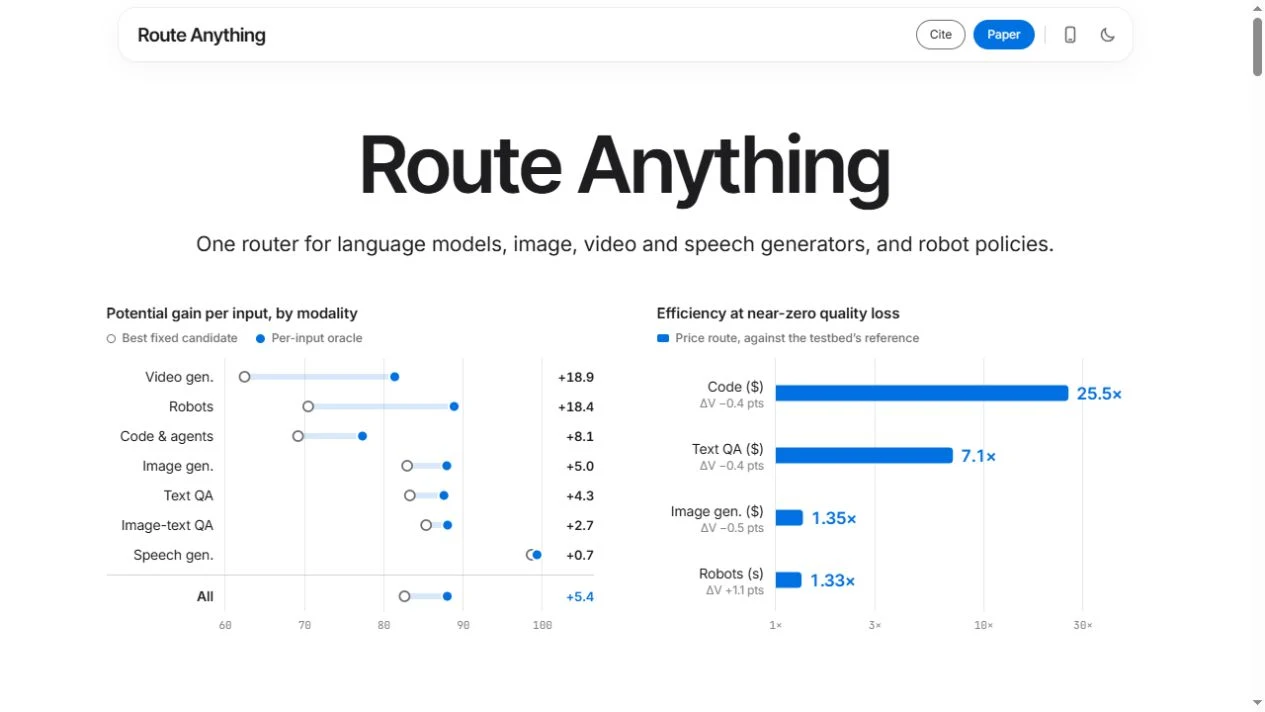
The researchers describe a matrix of 374,401 scored runs from 452 candidate configurations across 25 benchmarks. In a panel of 19,814 test inputs from 24 benchmarks, choosing the best candidate for each input in hindsight scored 87.98 against 82.60 for the best fixed candidate per benchmark: a 5.4-point gap.
That hindsight oracle already knows the outcomes. A trained capability-tree router, evaluated on a different panel of 16 benchmarks, scored 79.98 against 79.68 for its fixed baseline—a 0.3-point improvement. These panels have different inputs and baselines, so their absolute scores should not be compared directly. On two image-generation benchmarks, none of 124 tested routing configurations significantly beat the fixed generator.
What the 8.82× figure measures
The headline efficiency number averages four reported ratios: 25.5× for code, 7.1× for text question answering, 1.35× for image generation and 1.33× for robot manipulation. Efficiency means mean quality divided by mean resource use, measured in dollars for the first three settings and policy-inference seconds for robots. Each ratio uses its own reference; the code and text references are always-Opus 4.6 and always-GPT-4, respectively.
It is therefore not a claim that every current model becomes 8.82 times faster or cheaper. The fitted code and text routes lost 0.44 and 0.40 quality points on their test sets. Image generation lost 0.47 points, while the robot router’s reported success increased by 1.1 points with 24% less policy time. The robot improvement’s confidence interval included zero.
The study’s useful lesson is to price routing against a chosen quality floor, then test that floor on separate inputs. A fitted floor alone did not reliably hold on new code tasks; the authors report stronger results after independent-data certification.
There is also a material reproduction boundary. The repository releases router implementations and public code/text replay utilities, but says the 25-benchmark omni-modal matrix is proprietary. Its Hugging Face replay data does not contain that matrix, and synthetic examples do not reproduce those empirical scores. The theory also leaves routing states affected by earlier model choices and more complex long-horizon agent routing for further work. These are author-reported preprint results; AITrending has not independently reproduced them.
Related reading
Decision Forge fixes a data leak that could move test cases into training
STROT deletes its LLM fallback after a hate-speech test failed to justify the cost