SlopTotal's 23-engine AI detector gets a GPU boost and shows how far its score can still move
Version 1.3.0 adds CUDA inference and live score ranges; its author reports a 12-text run falling from 319 seconds to 5.3 seconds on an RTX 5070 Ti.
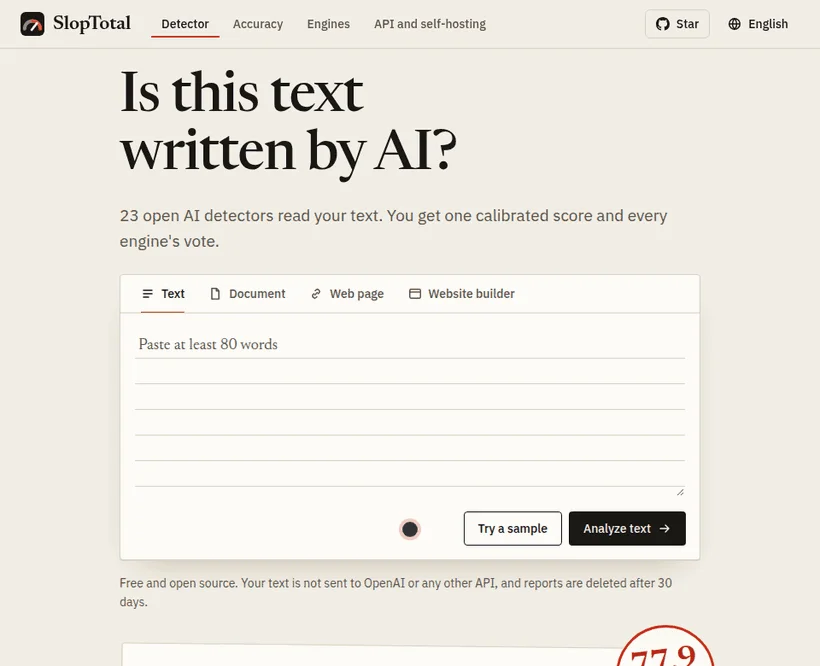
SlopTotal wants AI-text detection to be inspectable engine by engine, and its new release makes that workflow faster and clearer while a scan is still running. Version 1.3.0 adds CUDA inference and a live range showing where the final score can still land as more engines finish.
The author reports that a batch of 12 texts took 5.3 seconds on an RTX 5070 Ti, compared with 319 seconds in the comparison run, with identical scores. That is a project-reported measurement on one setup, not an AITrending benchmark or a speed guarantee for other hardware.
SlopTotal is a standalone, self-hosted application that combines 23 neural classifiers, statistical methods and linguistic heuristics into a calibrated score. Users can paste text, supply a URL or upload supported documents, then inspect individual engine results rather than relying on one unexplained number.
A score that admits it is still moving
The release says cheaper engines run first and the report displays the remaining score range, including when the result becomes final. That addresses an important interface problem: an early result should not look settled while slower models can still change it.
Version 1.3.0 also calibrates the quick-score and paragraph-score endpoints used by the project’s Chrome extension. Its release notes report that 1.4% of human texts were called AI in that quick-score evaluation, down from 12.5%. That figure concerns those endpoints. The tagged README separately reports a 1.7% human false-positive rate for the full ensemble’s “Likely AI” threshold on SlopBench; the two numbers should not be treated as interchangeable.
The same README reports a much higher error rate for non-native English essays: 15% of TOEFL essays were classified as Likely AI. It also calls scores below roughly 80 words weak signals and says heavily rewritten AI text remains difficult. These are material limits on what a detector result can establish about an individual author.
Running it on your own machine
The release provides a versioned Docker image, ghcr.io/pablocaeg/sloptotal:1.3.0, with a persistent model volume. The documented first scan downloads about 9 GB of models; the project estimates roughly 8.3 GB of RAM once models load. Source installation requires Python 3.10 or later.
GPU support needs additional attention. The tagged README says the standard requirements install CPU-only PyTorch. For CUDA inference, users must install the CUDA build of the same PyTorch version and meet the driver requirements; changing the version can change scores. CPU operation remains supported.
The MIT-licensed application uses local inference without third-party AI API credentials, while model weights retain their own licenses. Reports stay on the server running the application and are retained for 30 days by default. A public demo therefore processes text on that operator’s server, whereas self-hosting puts it on the user’s own infrastructure.
The update also adds an optional per-IP daily quota for analyses initiated outside a public instance’s own site; it is off by default. Faster scans and clearer score bounds make the tool more usable, but they do not turn a statistical classification into proof of authorship. The project’s own guidance says its detector should never be the sole evidence for an accusation.
Related reading
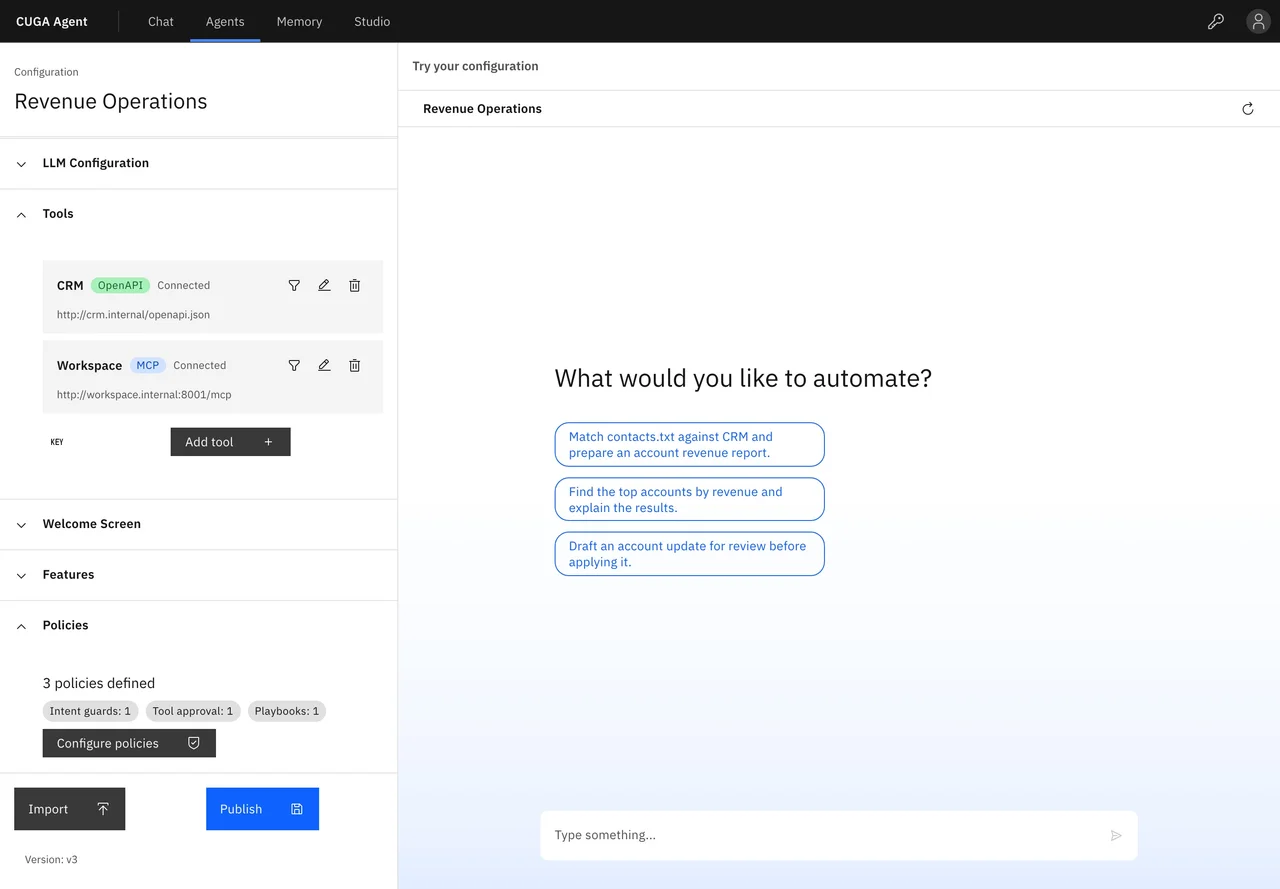
Same model, 30% to 81% task completion — IBM's CUGA team makes the case for choosing your harness